
Drafted — not technically validated
Record revision 1 · The US successor to napalm: a canister of thickened fuel used by the Marine Corps in 1991 and 2003.
Real-world weapon as described in public sources. Weights and dimensions change with the fins, fuzes and variant fitted; the data plate names the variants its figures describe, and differences are noted beside the number they affect. The record describes the weapon; it is not a guide to employing it.
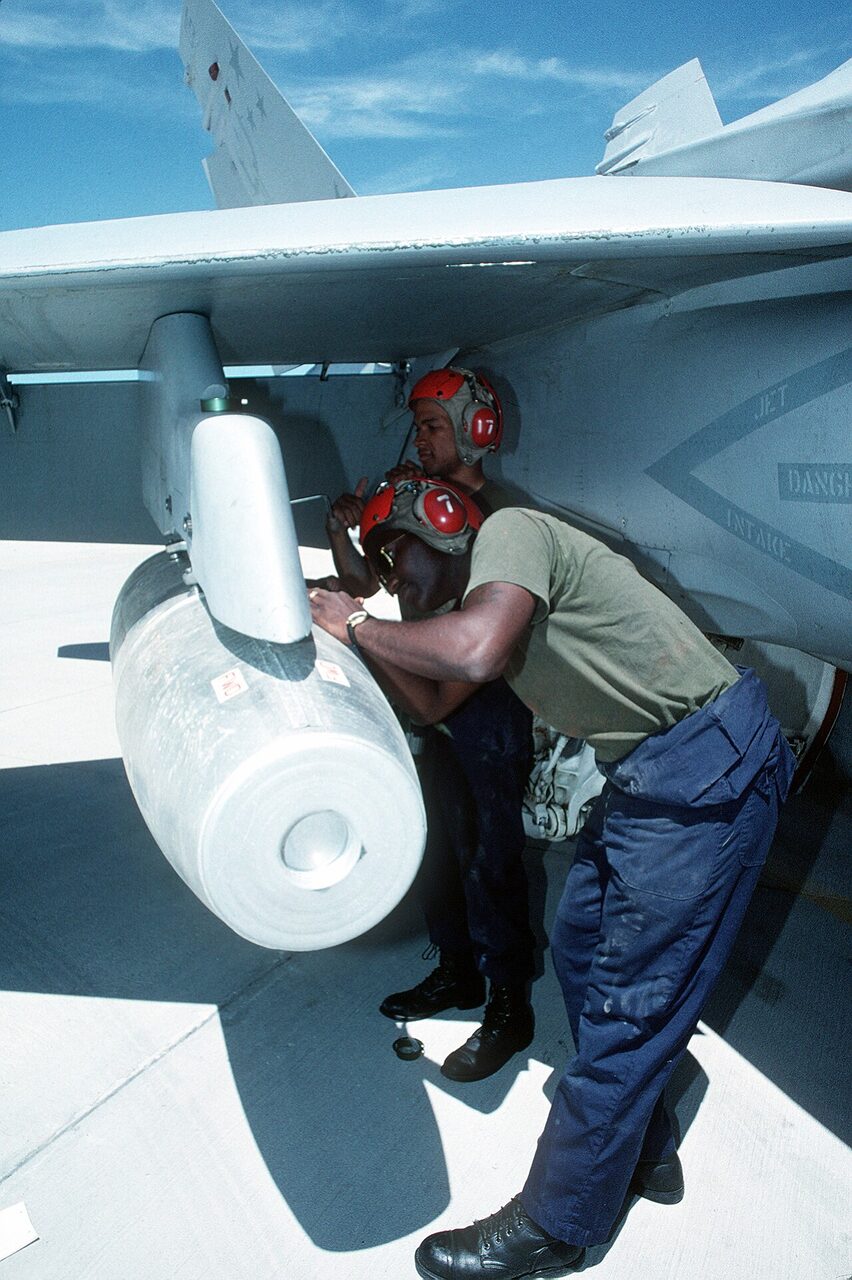
Mark 77 fire bomb · Mk 77
- Type
- Air-dropped incendiary bomb (fire bomb) [1]
- Origin
- United States
- In service
- Not given in the cited source; used in the 1991 Gulf War and the 2003 invasion of Iraq [1]
- Weight
- Mod 0: 750 lb (340 kg) with 110 US gal of fuel; Mod 4 and Mod 5: about 507 lb (230 kg) with 75 US gal [1]
- Dimensions
- Not given in the cited source
- Warhead or payload
- Thickened kerosene-based fuel gel, the successor to napalm; later mods carry JP-4, JP-5 or JP-8 jet fuel with a thickener [1]
- Guidance
- None
- Fuzing
- Not given in the cited source
- Delivery
- Free fall; limited accuracy keeps it away from urban areas, according to the Pentagon [1]
- Carried by
- US Marine Corps aircraft in the Gulf War and in Iraq in 2003 [1]
Napalm’s successor
The Mk 77 is a canister of thickened fuel: the United States military’s main incendiary weapon and the direct successor to napalm. [1] In the Second World War the American napalm bomb was the Mark 47, and in Vietnam a typical close air supportCAS GlossaryJoint terms: Close air support. Air action by fixed- and rotary-wing aircraft against hostile targets that are in close proximity to friendly forces and that require detailed integration of each air mission with the fire and movement… load paired retarded bombs with napalm canisters: “snake and nape”. [1] [2] The Mk 77 replaced napalm’s gasoline, polystyrene and benzene mix with a kerosene-based fuel lower in benzene. Its effects on the target are similar. [1]
Lighter over time
The first version, the Mod 0, weighed 750 lb and carried 110 US gallons of fuel. Later versions carried 75 gallons and weighed roughly 500 to 550 lb. The Mod 4 dropped in the 1991 Gulf War and the Mod 5 used in 2003 each weighed about 507 lb, the Mod 5 filled with JP-4, JP-5 or JP-8 jet fuel and a thickener. [1] Two bigger fire bombs, the Mk 78 and Mk 79, have left service. [1]
A Marine Corps weapon
In recent wars the Mk 77 has mainly been a Marine Corps weapon. Marines used it in Desert Storm and again in the 2003 invasion of Iraq; about 500 were dropped, reportedly mostly on Iraqi trenches filled with oil. It was also used at Tora Bora in Afghanistan. [1] The I Marine Expeditionary Force reported using 30 between 31 March and 2 April 2003, against military targets away from civilian areas, and the Pentagon told the British government that because of its limited accuracy the Mk 77 is not generally used in towns or where civilians gather. [1]
Incendiary weapons carry legal limits. Protocol III of the 1980 Convention on Certain Conventional Weapons bans air-delivered incendiaries against civilians, and against military targets inside concentrations of civilians. The United States reserved the right to use them against such targets where doing so would cause fewer casualties or less collateral damage than other weapons. [1]
Sources
- Mark 77 bomb. Wikipedia (secondary source). https://en.wikipedia.org/wiki/Mark_77_bomb (accessed 2026-10-26).
- Mark 81 bomb. Wikipedia (secondary source). https://en.wikipedia.org/wiki/Mark_81_bomb (accessed 2026-10-26).
Wikipedia articles are secondary sources and can change; they are cited with the date they were read. NAVEDTRA training manuals and budget justification exhibits are official US publications, but each describes the weapons in service when it was written.