
Drafted — not technically validated
Record revision 1 · A six-barrel 23 mm gun that powers itself with its own gas, with one of the highest rates of fire of any autocannon.
Real-world weapon as described in public sources. Weights and dimensions change with the fins, fuzes and variant fitted; the data plate names the variants its figures describe, and differences are noted beside the number they affect. The record describes the weapon; it is not a guide to employing it.
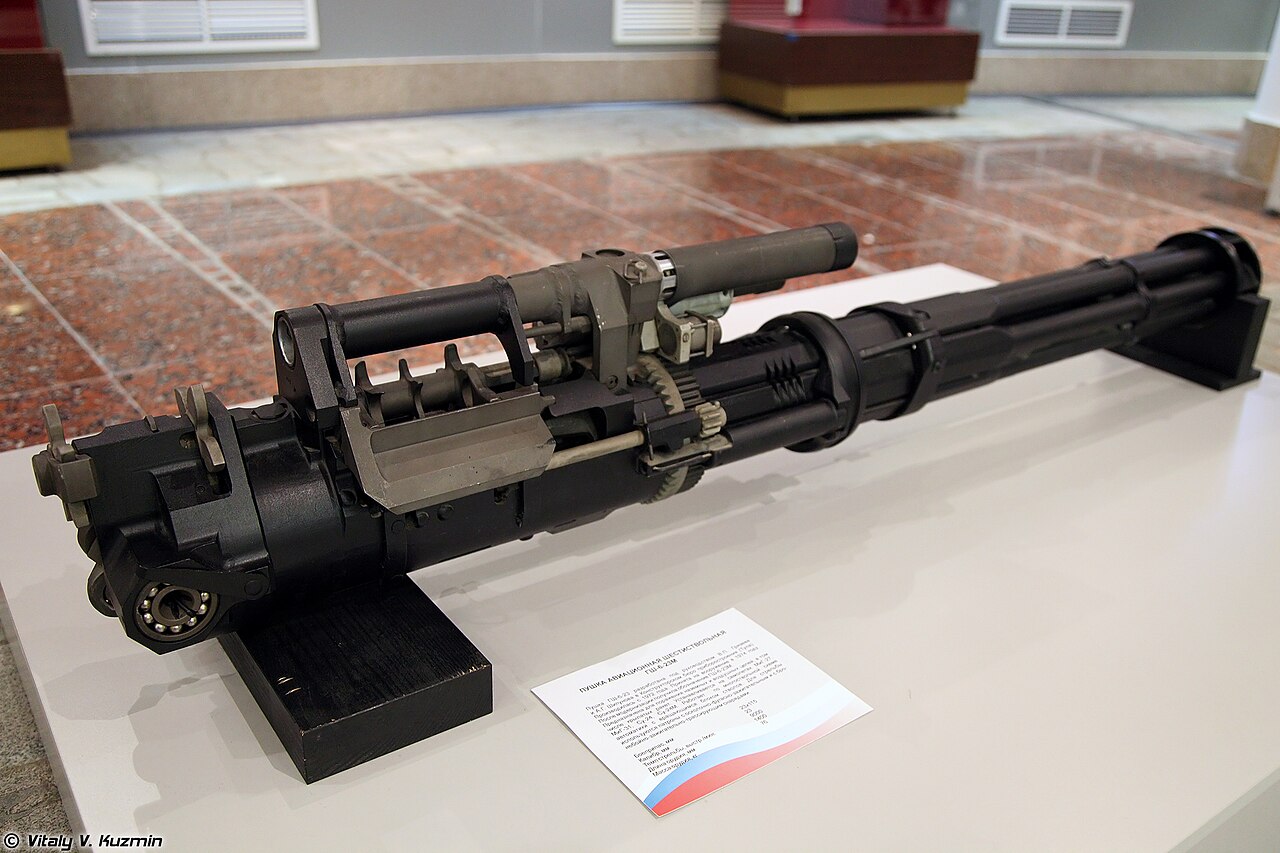
Gryazev-Shipunov GSh-6-23 six-barrel 23 mm rotary cannon · GSh-6-23 / GSh-6-23M
- Type
- Six-barrel 23 mm rotary cannon [1]
- Origin
- Soviet Union; KBP Instrument Design Bureau, Tula [1]
- In service
- Since 1975 [1]
- Weight
- 73 to 76 kg (161 to 167 lb) [1]
- Dimensions
- Length 1.4 m; barrels 1 m [1]
- Calibre
- 23 mm, firing the 23 × 115 mm AM-23 round [1]
- Action
- Gas operated, not driven by an outside electric, hydraulic or pneumatic system; 10 pyrotechnic cocking charges [1]
- Rate of fire
- About 10,000 rounds per minute [1]
- Muzzle velocity
- 715 m/s [1]
- Ammunition
- Linked belt or a limited linkless feed; the MiG-31 carries 260 rounds, 800 at most [1]
- Carried by
- MiG-31 interceptor and Su-24 attack aircraft, and formerly the Su-15 [1]
- Variants
- GSh-6-23M: modernised version [1]
A Gatling gun that drives itself
Most American multi-barrel aircraft guns, like the M61M61 Vulcan OrdnanceThe six-barrel 20 mm Gatling gun that has armed US fighters of every service since 1959., are turned by an electric, hydraulic or pneumatic motor. The GSh-6-23 is gas-operated instead, so it powers itself, and it uses 10 pyrotechnic cocking charges, as some European revolver cannon do. [1] The GSh-6-23M is credited with the highest rate of fire of any autocannon. At that rate a MiG-31 with its usual 260 rounds would empty its ammunition tank in less than two seconds. [1]
Service
The GSh-6-23 arms the MiG-31 interceptor and the Su-24 attack aircraft. [1] After two Su-24s were lost to shells detonating early in 1983, and after other problems with the gun, the Soviet Air Force command stopped its use for a time; Wikipedia reports that Russian Aerospace Forces aircraft now fly with fully operational guns. [1] It is also carried in the SPPU-6 gun pod, which can swivel 45° down and 45° to either side. [1]
Sources
- Gryazev-Shipunov GSh-6-23. Wikipedia (secondary source). https://en.wikipedia.org/wiki/Gryazev-Shipunov_GSh-6-23 (accessed 2026-10-27).
Wikipedia articles are secondary sources and can change; they are cited with the date they were read. NAVEDTRA training manuals and budget justification exhibits are official US publications, but each describes the weapons in service when it was written.