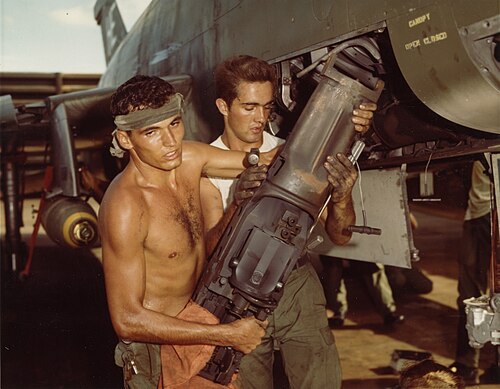

Drafted — not technically validated
Record revision 1 · The US Air Force's 20 mm revolver cannon of the 1950s, proven in Korea and still in the F-5's nose.
Real-world weapon as described in public sources. Weights and dimensions change with the fins, fuzes and variant fitted; the data plate names the variants its figures describe, and differences are noted beside the number they affect. The record describes the weapon; it is not a guide to employing it.
M39 20 mm revolver cannon · M39 / M39A2
- Type
- Single-barrel 20 mm revolver cannon with a five-chamber cylinder [1]
- Origin
- United States; developed by the Springfield Armory from the German Mauser MG 213 design [1]
- Weight
- 80.9 kg (178.5 lb) [1]
- Dimensions
- Length 1.83 m (6 ft) [1]
- Calibre
- 20 mm, firing the 20 × 102 mm cartridge [1]
- Action
- Gas operated, with a five-chamber cylinder running parallel to the barrel [1]
- Rate of fire
- About 1,500 rounds per minute [1]
- Muzzle velocity
- 1,030 m/s (3,300 ft/s) [1]
- Ammunition
- 20 × 102 mm, the round later used by the M61M61 Vulcan OrdnanceThe six-barrel 20 mm Gatling gun that has armed US fighters of every service since 1959. [1]
- Carried by
- F-100 Super SabreF-100 Super Sabre AircraftThe first US Air Force fighter supersonic in level flight; a fighter-bomber and fast FAC in Vietnam. and F-5F-5 Tiger II AircraftA small, cheap supersonic fighter for US allies, and a long-serving adversary aircraft that stands in for the MiG-21. [1]
- F-86H Sabre, F-101 Voodoo and B-57B [1]
- Variants
- M39A1, M39A2 and M39A3; the F-5 Tiger II still uses the M39A2 [1]
The Mauser idea
During the Second World War Mauser designed the MG 213, a revolver cannon whose rotating cylinder of chambers let it fire much faster than a conventional gun. It never saw combat, but it inspired three post-war guns: the British ADENADEN cannon OrdnanceThe 30 mm revolver cannon of every British gun-armed jet from the Hunter in 1954 to the Tornado., the French DEFADEFA 550 series OrdnanceFrance's 30 mm revolver cannon, the standard gun of every French gun-armed fighter from 1954 until the Rafale., and the American M39. The Americans chose a smaller 20 mm round to raise the rate of fire and muzzle velocity, at some cost in hitting power. [1]
From Korea to the F-5
Under the GunVal programme of late 1952, M39s went into a few F-86 Sabres and into action over Korea early in 1953. The gun then became the standard armament of the F-86H, the F-100 Super SabreF-100 Super Sabre AircraftThe first US Air Force fighter supersonic in level flight; a fighter-bomber and fast FAC in Vietnam., the F-101 Voodoo and the F-5F-5 Tiger II AircraftA small, cheap supersonic fighter for US allies, and a long-serving adversary aircraft that stands in for the MiG-21., and the M61 VulcanM61 Vulcan OrdnanceThe six-barrel 20 mm Gatling gun that has armed US fighters of every service since 1959. later replaced it in most roles. [1] Current F-5 Tiger IIs still carry the M39A2. [1]
Sources
- M39 cannon. Wikipedia (secondary source). https://en.wikipedia.org/wiki/M39_cannon (accessed 2026-10-27).
Wikipedia articles are secondary sources and can change; they are cited with the date they were read. NAVEDTRA training manuals and budget justification exhibits are official US publications, but each describes the weapons in service when it was written.