
Drafted — not technically validated
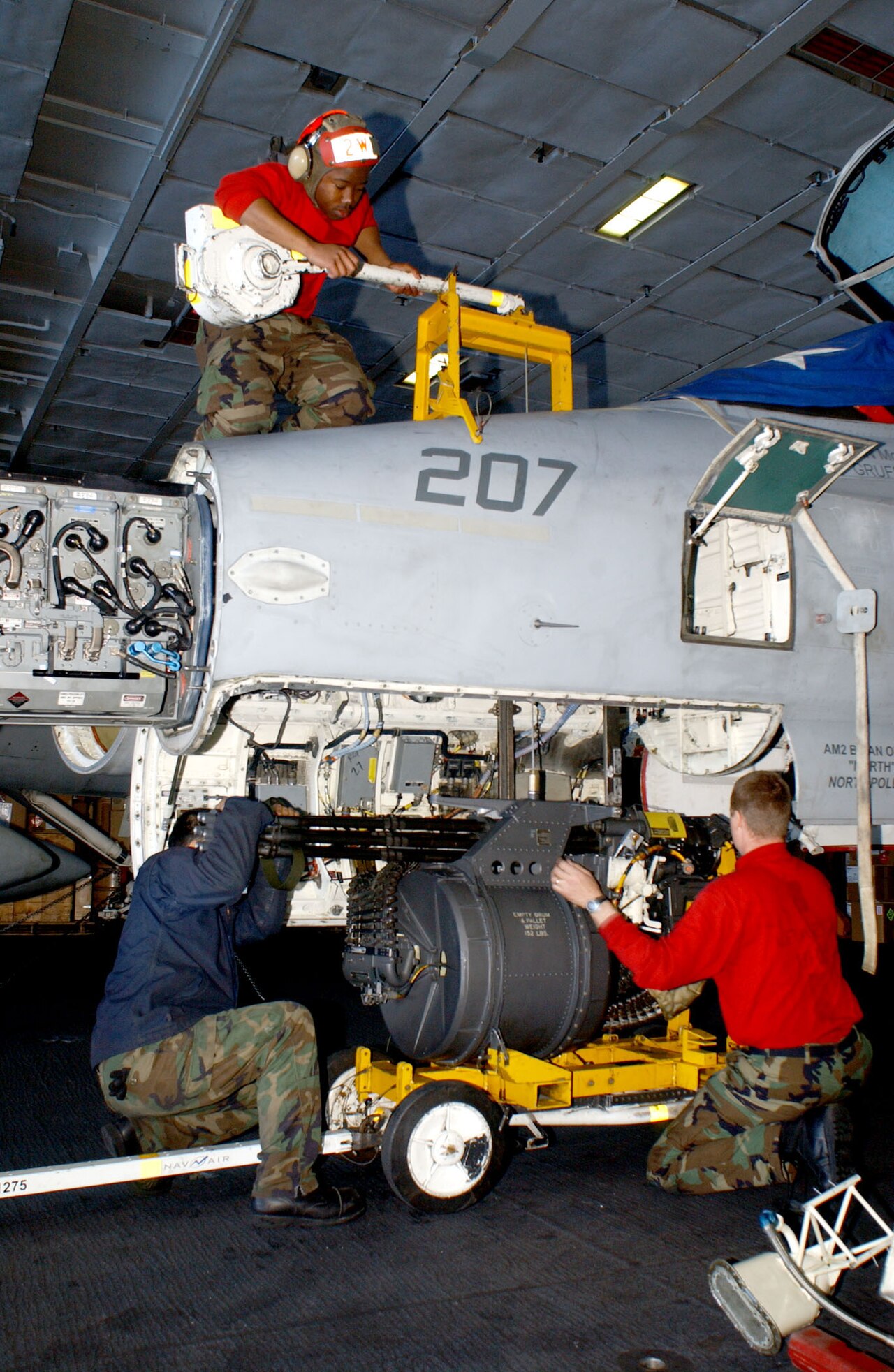
Record revision 1 · The six-barrel 20 mm Gatling gun that has armed US fighters of every service since 1959.
Real-world weapon as described in public sources. Weights and dimensions change with the fins, fuzes and variant fitted; the data plate names the variants its figures describe, and differences are noted beside the number they affect. The record describes the weapon; it is not a guide to employing it.
M61 Vulcan 20 mm rotary cannon · M61A1 / M61A2
- Type
- Six-barrel, rotary-action, automatic 20 mm gun based on the Gatling principle [2]
- Origin
- United States; designed by General Electric from 1946 [1]
- In service
- Since 1959, the main cannon of US fixed-wing military aircraft [1]
- Weight
- Not given in the sources cited here; the M61A2 is 20% lighter than the M61A1 [1]
- Dimensions
- Length 71.93 in (1.83 m); barrels 59.8 in (1.52 m) [1]
- Range
- About 3,000 m (9,842 ft) [1]
- Calibre
- 20 mm, firing the 20 × 102 mm cartridge [1]
- Action
- Hydraulically driven and electrically fired; a revolving cluster of six barrels, each fired once per revolution [2]
- Rate of fire
- 4,000 to 7,200 rounds per minute; in Navy aircraft the pilot selects 4,000 (GUN LOW) or 6,000 (GUN HIGH) [2]
- Muzzle velocity
- 3,450 ft/s (1,050 m/s) with the PGU-28/B round [1]
- Ammunition
- M50 and PGU-series 20 mm rounds, fed from a drum by an endless linkless conveyor that also carries the spent cases back to the drum [2]; the F/A-18 carries up to 578 rounds [4]
- Carried by
- F-14 TomcatF-14 Tomcat AircraftThe Navy's swing-wing fleet defence fighter: two crew, AWG-9 radar and AIM-54 Phoenix. and F/A-18 HornetF/A-18 Hornet AircraftA carrier-capable fighter and attack aircraft that one pilot can switch between roles on the same sortie. [2]
- F-4 Phantom IIF-4 Phantom II AircraftThe big two-seat Cold War fighter-bomber; the F-4E added an internal gun and slats after Vietnam., F-15 EagleF-15C Eagle AircraftA twin-engine air superiority fighter with more than 104 air-to-air victories and no losses., F-15E Strike EagleF-15E Strike Eagle AircraftThe two-seat, long-range, all-weather strike derivative of the Eagle. and F-16 Fighting FalconF-16 Fighting Falcon AircraftA single-engine multirole fighter: fly-by-wire, 9 g, and the US Air Force's main strike and SEAD aircraft. [1]
Volume of fire
At the end of the Second World War the US Army Air Forces saw that jet speeds would make it very hard to score enough hits with existing guns, unless the rate of fire went up a great deal. General Electric’s answer, designed from 1946, was an old idea driven by modern power: Richard Gatling’s revolving cluster of barrels. [1] [2] The Navy’s ordnance manual describes the M61A1 as a six-barrel, rotary-action, hydraulically driven and electrically controlled gun. Each barrel fires once per revolution, and the gun can fire 4,000 to 7,200 rounds per minute; in Navy aircraft the pilot chooses 4,000 or 6,000. [2]
Early tests in the F-104 Starfighter showed that linked ammunition misfed and that the discarded links were a foreign-object hazard, so the M61A1 got a linkless feed. It became the standard gun of US fighters, and the M61 family has been their main cannon since 1959. [1] The conveyor that feeds the gun also carries spent cases and unfired rounds back to the drum. [2]
In the Hornet
In the F/A-18F/A-18 Hornet AircraftA carrier-capable fighter and attack aircraft that one pilot can switch between roles on the same sortie. the gun sits on the centreline in the nose, firing through a blast diffuser just ahead of the windscreen. The pilot can use it in two air-to-ground modes, CCIPCCIP GlossaryWeapons: Continuously computed impact point. A head-up display air-to-ground mode whose aiming reticle shows where the weapon would hit if released at that moment. and manual, and in three air-to-air modes, called director, disturbed and cage. [3] [4] The drum holds up to 578 rounds. For training, ground crews can set a round limiter so that one load lasts two or three gunnery sorties, and the pilot can choose bursts of a preset length or continuous fire. [4]
Sources
- M61 Vulcan. Wikipedia (secondary source). https://en.wikipedia.org/wiki/M61_Vulcan (accessed 2026-10-27).
- Aviation Ordnanceman, NAVEDTRA 14313, p. 6-1. US Navy, Naval Education and Training Command; copy hosted by Integrated Publishing. https://navyaviation.tpub.com/14313/css/Chapter-6-M61A1-Gun-Installation-137.htm (accessed 2026-10-27).
- Aviation Ordnanceman, NAVEDTRA 14313, p. 6-15. US Navy, Naval Education and Training Command; copy hosted by Integrated Publishing. https://navyaviation.tpub.com/14313/css/F-A-18-Gun-System-Installation-151.htm (accessed 2026-10-27).
- Aviation Ordnanceman, NAVEDTRA 14313, p. 6-16. US Navy, Naval Education and Training Command; copy hosted by Integrated Publishing. https://navyaviation.tpub.com/14313/css/F-14-Gun-System-Installation-152.htm (accessed 2026-10-27).
Wikipedia articles are secondary sources and can change; they are cited with the date they were read. NAVEDTRA training manuals and budget justification exhibits are official US publications, but each describes the weapons in service when it was written.