
Drafted — not technically validated
Record revision 1 · The two-seat, long-range, all-weather strike derivative of the Eagle.
Real-world aircraft as described in public sources. Figures vary between variants, loads and sources; the data plate names the variant its figures describe, and differences are noted beside the number they affect.
F-15E Strike Eagle · McDonnell Douglas F-15E
- Role
- Multirole strike fighter [1]
- Origin
- United States
- Manufacturer
- McDonnell Douglas (1985–1997), then Boeing [1]
- Crew
- 2: pilot and weapon systems officer (WSO) [1]
- First flight
- 11 December 1986 [1]
- Entered service
- 1988; initial operating capability 30 September 1989 [1]
- Status
- In service; 435 F-15E and export derivatives built [1]
- Powerplant
- Two Pratt & Whitney F100-PW-220 afterburningAfterburner GlossaryFlight: An additional combustion area aft of the turbine section of a turbojet, with fuel nozzles and flameholders, that burns fuel in the engine's large excess of air. It adds only 10 to 20 percent to the engine's weight but 40… turbofans, 23,770 lbf each with afterburnerAfterburner GlossaryFlight: An additional combustion area aft of the turbine section of a turbojet, with fuel nozzles and flameholders, that burns fuel in the engine's large excess of air. It adds only 10 to 20 percent to the engine's weight but 40… [1]
- Maximum speed
- Mach 2.5 (1,650 mph, 1,434 kt) at high altitude; Mach 2.0 with conformal fuel tanks [1]
- Service ceiling
- 60,000 ft [1]
- Range
- Combat radius 687 NM on air interdiction; ferry range 2,100 NM with conformal and three external tanks [1]
- Armament
- One 20 mm M61A1 Vulcan cannon, 500 rounds [1]
- Up to 23,000 lb of fuel and weapons on four wing pylons, fuselage pylons and bomb racks on the conformal tanks [1]
- Air-to-ground: laser- and GPS-guided bombs (GBU-10, -12, -15, -28, JDAM), AGM-65 Maverick, AGM-130, cluster munitions [2]; B61 nuclear bombs [1]
- Air-to-air: AIM-9 Sidewinder and AIM-120 AMRAAM [2]
- Sensors and avionics
- Purchase
- DCS WorldDCS: F-15E by RAZBAMNot on sale: the DCS Store lists this RAZBAM module as not available
- Microsoft Flight SimulatorF-15 C, D, E and I Eagle by DC DesignsJust Flight
Store pages checked 2026-10-28. Prices and availability change.
A fighter that learned to bomb
The Eagle’s designers had promised “not a pound for air-to-ground”, yet the F-15F-15C Eagle AircraftA twin-engine air superiority fighter with more than 104 air-to-air victories and no losses. had long been seen as having real potential as a bomber. The Strike Eagle, which arrived in 1987, turned that potential into a mission statement as blunt as the fighter’s: put bombs on target, deep behind enemy lines. [2]
It began as a company gamble. McDonnell Douglas converted the second two-seat F-15F-15C Eagle AircraftA twin-engine air superiority fighter with more than 104 air-to-air victories and no losses. prototype into a demonstrator, which first flew on 8 July 1980, trying out conformal fuel tanks and a laser designator pod before the Air Force had asked for anything. In 1981 the Air Force did ask, for a long-range strike aircraft to replace the F-111 that could fight its way in without escorts or jammersElectromagnetic jamming GlossaryJoint terms: The deliberate radiation, reradiation, or reflection of electromagnetic energy for the purpose of preventing or reducing an enemy's effective use of the electromagnetic spectrum, and with the intent of degrading or…. The rival was General Dynamics’ F-16XL, a striking cranked-delta F-16F-16 Fighting Falcon AircraftA single-engine multirole fighter: fly-by-wire, 9 g, and the US Air Force's main strike and SEAD aircraft.. On 24 February 1984 the Air Force chose the F-15E: it was cheaper to develop, had more room to grow, and had two engines. The first production F-15E flew on 31 March 1987. [1]
Two seats, darker paint
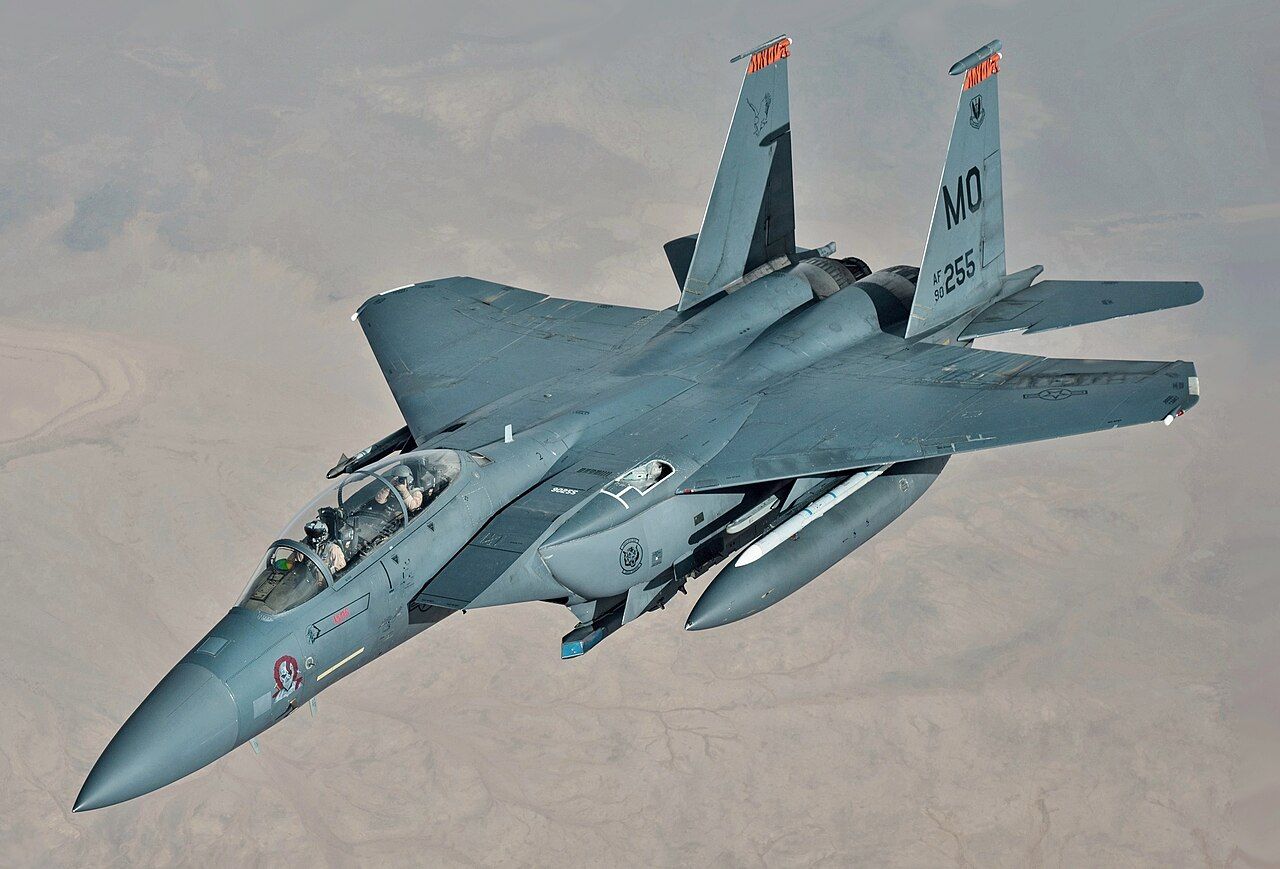
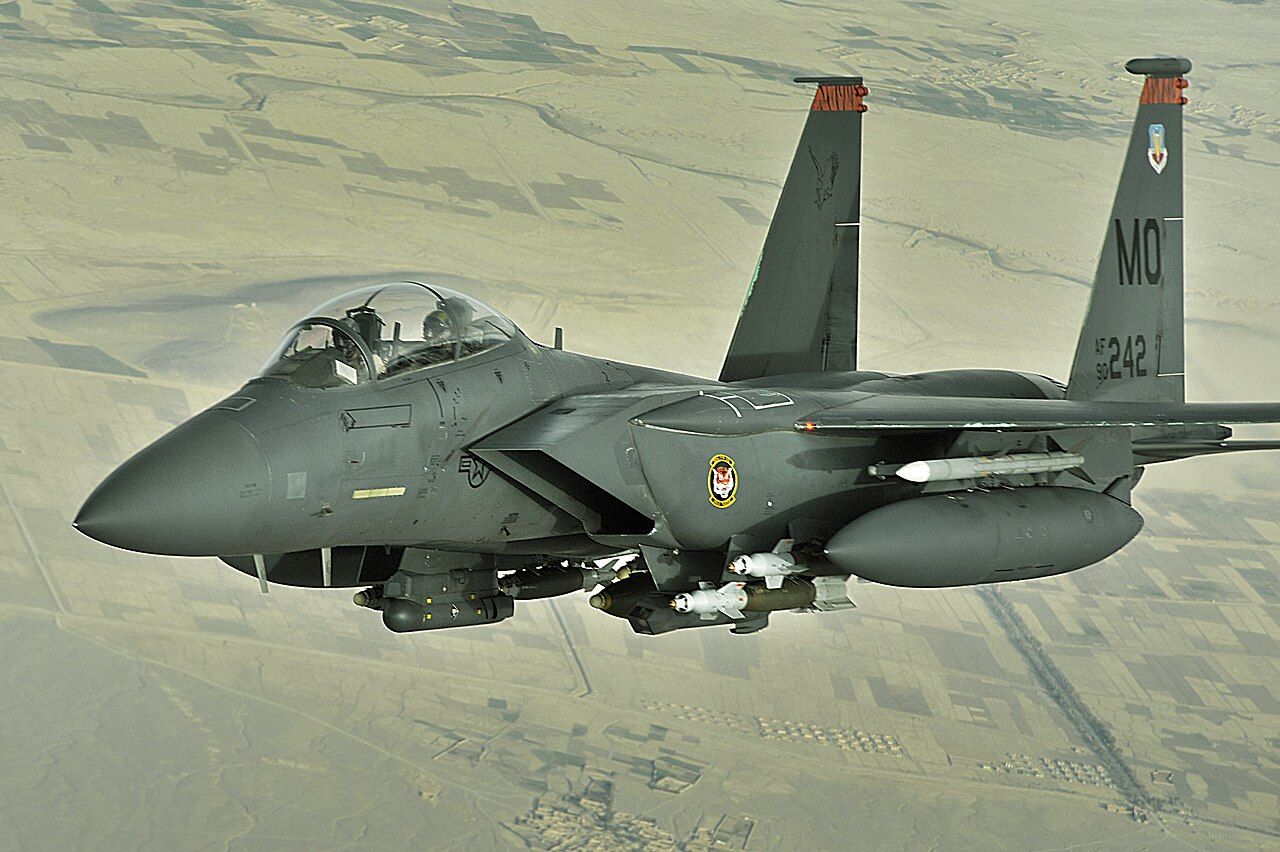
You can tell a Strike Eagle from other Eagles at a glance: darker grey paint, the conformal tanks hugging its fuselage, navigation and targeting pods under its intakes, and a second seat. [1] The pilot flies and fights; the weapon systems officer (WSO) behind works the radar, the targeting pods and the weapons. [1]
Its radar maps the ground in fine detail for attacks at night and in bad weather, and LANTIRN pods gave it low-level navigation and laser targeting in the dark. Later aircraft carry the APG-82 AESA radar and newer targeting pods. [1] A typical load mixes guided bombs or MavericksAGM-65 Maverick OrdnanceThe West's most widely produced precision-guided missile: TV, infrared or laser seekers, launched and left. with AIM-9AIM-9 Sidewinder OrdnanceThe heat-seeking dogfight missile of the US Navy since 1956, copied by the Soviets and still in production as the AIM-9X. and AIM-120AIM-120 AMRAAM OrdnanceThe active-radar "fire and forget" missile that replaced the Sparrow, carried by US fighters of every service since 1991. missiles for self-defence. [2] Heavier strike loads meant the engine bay was designed to take more powerful engines, and later batches have F100-PW-229s of about 29,000 lbf each. [1] It is also the US Air Force’s most capable tactical nuclear delivery aircraft, able to carry up to five B61 Mod 12 bombs. [1]
Scud hunting
The Strike Eagle went to war barely three years after entering service. On the first night of Desert Storm, 17 January 1991, 24 F-15Es struck five fixed Scud sites in western Iraq. For the rest of the war they flew night hunter missions over the western desert, searching for mobile Scud launchers. Two were lost in the first days, one over the heavily defended Basrah area and one to an SA-2SA-2 Guideline Threat systemThe classic six-launcher site around a Fan Song radar: radio-command-guided, and the SAM US crews met over North Vietnam.. [1]
On 14 February a Strike Eagle crew answering a call for help from US Special Forces scored the jet’s only air-to-air kill of the war in the most unusual way. Through their infrared sensor they spotted an Iraqi Mi-24Mi-24P Hind-F AircraftThe Soviet gunship that could also carry eight troops; the Mi-24P has a fixed twin-barrel 30 mm cannon. helicopter unloading troops and dropped a 2,000 lb laser-guidedLGW GlossaryWeapons: Laser-guided weapon. A weapon that uses a seeker to detect laser energy reflected from a laser marked/designated target and through signal processing provides guidance commands to a control system, which guides the… GBU-10GBU-10 Paveway II laser-guided bomb OrdnanceA Mk 84 with a Paveway II laser kit: Desert Storm's bridge and bunker buster, once even credited with an air-to-air kill. bomb on it. The crew thought they had missed and were reaching for a Sidewinder when the helicopter exploded; the Special Forces team estimated it was about 800 ft above the ground when the bomb hit. [1]
After the war, enforcing the no-fly zone over northern Iraq, a flight of F-15Es watched Iraqi helicopters attack Kurdish refugees but were not allowed to fire. Instead they flew high-speed passes as close as they could, buffeting the helicopters with wake turbulence and shining lasers at their cockpits, and one Hind crashed. [1]
Thirty years at war
Since then the Strike Eagle has flown over the Balkans, Afghanistan, Iraq, Libya, Syria and Iran, on deep strikes, combat air patrolsCAP GlossaryJoint terms: Combat air patrol. An aircraft patrol provided over an objective area, the force protected, the critical area of a combat zone, or in an air defense area, for the purpose of intercepting and destroying hostile aircraft… and close air supportCAS GlossaryJoint terms: Close air support. Air action by fixed- and rotary-wing aircraft against hostile targets that are in close proximity to friendly forces and that require detailed integration of each air mission with the fire and movement… for troops on the ground. [1] Its roles keep widening: on 13 April 2024 US F-15Es helped blunt an Iranian attack on Israel, shooting down more than 70 one-way attack drones. [1]
Israel flies it as the F-15I Ra’am (“Thunder”), and Saudi Arabia, South Korea, Singapore and Qatar have their own versions. In US service the F-15E is expected to fly into the 2030s, and the F-15EX Eagle II carries the line on. [1]

Sources
- McDonnell Douglas F-15E Strike Eagle. Wikipedia (secondary source). https://en.wikipedia.org/wiki/McDonnell_Douglas_F-15E_Strike_Eagle (accessed 2026-10-25).
- F-15 Eagle. Federation of American Scientists, Military Analysis Network. https://man.fas.org/dod-101/sys/ac/f-15.htm (accessed 2026-10-25).
Wikipedia articles are secondary sources and can change; they are cited with the date they were read. The Federation of American Scientists (FAS) Military Analysis Network pages largely reproduce US service fact sheets of the late 1990s and early 2000s, so later upgrades are not covered there.