
Drafted — not technically validated
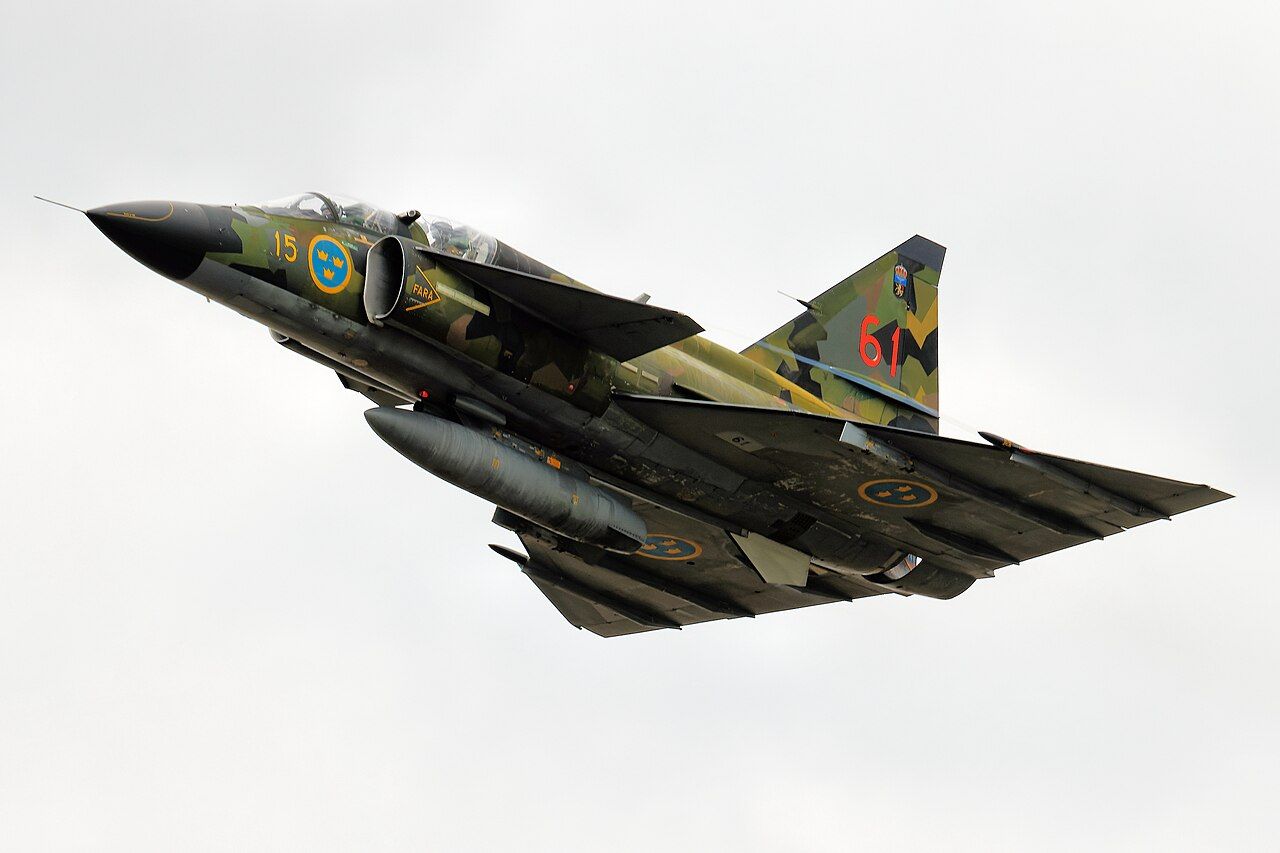
Record revision 1 · A Swedish canard-delta attack aircraft built to fly from road bases, with a thrust reverser and anti-ship missiles.
Real-world aircraft as described in public sources. Figures vary between variants, loads and sources; the data plate names the variant its figures describe, and differences are noted beside the number they affect.
AJS 37 Viggen · Saab AJS 37
- Variant described
- AJS 37, the 1990s multirole upgrade of the AJ 37 attack Viggen; performance figures are for the JA 37 [1]
- Origin
- Sweden
- Manufacturer
- Saab [1]
- First flight
- 8 February 1967 [1]
- Powerplant
- One Volvo RM8 afterburningAfterburner GlossaryFlight: An additional combustion area aft of the turbine section of a turbojet, with fuel nozzles and flameholders, that burns fuel in the engine's large excess of air. It adds only 10 to 20 percent to the engine's weight but 40… turbofan with thrust reverser; RM8B (JA 37) 125 kN (28,100 lbf) with afterburnerAfterburner GlossaryFlight: An additional combustion area aft of the turbine section of a turbojet, with fuel nozzles and flameholders, that burns fuel in the engine's large excess of air. It adds only 10 to 20 percent to the engine's weight but 40… [1]
- Maximum speed
- Mach 2.1, 2,231 km/h (1,205 kt) at 36,100 ft (JA 37) [1]
- Service ceiling
- 18,000 m (59,000 ft) (JA 37) [1]
- Range
- Ferry range 1,820 km (983 NM) on internal fuel (JA 37) [1]
- Armament
- Purchase
- DCS WorldDCS: AJS-37 Viggen by Heatblur SimulationsHeatblur StoreDCS Store
Store pages checked 2026-10-28. Prices and availability change.
The duck and the thunderbolt
Viggen has two meanings in Swedish, and Saab meant both. A vigg is a tufted duck, a nod to the aircraft’s canard foreplane, canard being French for duck. It is also a thunderbolt, from the “thunder wedges” of Nordic folklore, said to come from the lightning strikes of Thor’s hammer. [1]
An air force that hides on roads
Neutral Sweden planned to survive a Soviet attack by scattering its air force. Under the Bas 60 system of the late 1950s, and its successor Bas 90, aircraft would disperse in wartime across many bases, including stretches of ordinary road used as runways, some only 800 m long. Damaged runways would have to be used too. [1] The aircraft that replaced the Lansen attack jet and the Draken fighter therefore had to be supersonicSupersonic GlossaryFlight: The regime of flight from about Mach 1.20 to 5.00, with definite supersonic flow on all parts of the aircraft. Above Mach 5.00 is hypersonic. at low level, reach MachMach number GlossaryFlight: The ratio of the true airspeed to the speed of sound. All compressibility effects depend on it. 2 at height, land short without flaring, stop hard, steer accurately on icy roads in a crosswindCrosswind component GlossaryAirfield and ATC: The wind component measured in knots at 90 degrees to the longitudinal axis of the runway., and be easy to repair by mechanics with little training. [1] Saab studied more than 100 layouts before settling on the design. [1]
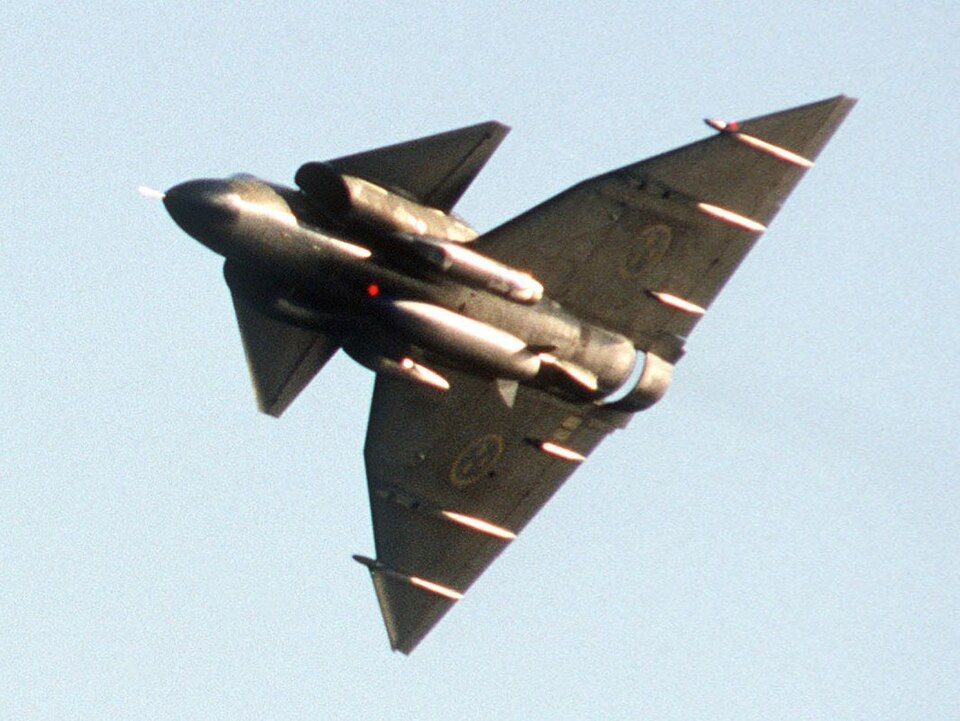
The answer was a delta wing with a fixed foreplane, carrying flaps, ahead of and above it. [2] The engine, the Volvo RM8, was a heavily reworked licence-built version of the Pratt & Whitney JT8D airliner engine, with a Swedish afterburnerAfterburner GlossaryFlight: An additional combustion area aft of the turbine section of a turbojet, with fuel nozzles and flameholders, that burns fuel in the engine's large excess of air. It adds only 10 to 20 percent to the engine's weight but 40…. It was the second operational afterburningAfterburner GlossaryFlight: An additional combustion area aft of the turbine section of a turbojet, with fuel nozzles and flameholders, that burns fuel in the engine's large excess of air. It adds only 10 to 20 percent to the engine's weight but 40… turbofan and the first fitted with a thrust reverser. The reverser could be selected in the air and fired automatically when the nose wheel touched down, and together with the wing it let the Viggen operate from 500 m strips with minimal support. [1] The first of seven prototypes flew on 8 February 1967. [1]
Five conscripts and one chief mechanic could look after a Viggen, and refuelling and rearming took less than ten minutes. [1] Low over Sweden, its most persistent enemy was birds, and the air force paid close attention to their migration routes. [1]
Ship killer
The first production AJ 37, the attack version, reached the Skaraborg Wing in July 1971. [1] It was built to attack an invasion fleet: its main load was two RB 04ERB 04 anti-ship missile OrdnanceSweden's sea-skimming anti-ship missile for the Lansen and Viggen. anti-ship missiles on the inboard wing pylons, with an optional third on the centreline, and RB 05RB 05 air-to-surface missile OrdnanceThe Viggen's supersonic missile, steered by the pilot with a joystick. air-to-surface missiles could go on the fuselage pylons. [1] Reconnaissance versions and the JA 37 fighter followed, and the last of 329 Viggens was delivered in 1990. [2]
In May 1991 Sweden announced an upgrade of AJ 37, SF 37 and SH 37 aircraft to a common multirole standard, the AJS 37; 48 airframes were converted. [1]
Locking on to the Blackbird
The Viggen never went to war, but its pilots did something no one else is acknowledged to have done. In the mid-1980s US SR-71 Blackbirds flew routine, predictable routes over the Baltic, and Swedish JA 37 pilots achieved radar lock on them many times, despite heavy jammingElectromagnetic jamming GlossaryJoint terms: The deliberate radiation, reradiation, or reflection of electromagnetic energy for the purpose of preventing or reducing an enemy's effective use of the electromagnetic spectrum, and with the intent of degrading or…, by feeding their fire-control computers with positions from ground radar. The favourite spot was the narrow strip of international airspace between the islands of Öland and Gotland that the SR-71 used on its way home. [1]
The JAS 39 Gripen replaced the Viggen from the mid-1990s. The last front-line Viggen was retired on 25 November 2005, and a few kept flying for electronic warfareEW GlossaryJoint terms: Electronic warfare. Military action involving the use of electromagnetic and directed energy to control the electromagnetic spectrum or to attack the enemy. training until June 2007. [1]

Sources
- Saab 37 Viggen. Wikipedia (secondary source). https://en.wikipedia.org/wiki/Saab_37_Viggen (accessed 2026-10-25).
- Saab Viggen. Federation of American Scientists, Military Analysis Network. https://man.fas.org/dod-101/sys/ac/row/viggen.htm (accessed 2026-10-25).
Wikipedia articles are secondary sources and can change; they are cited with the date they were read. The Federation of American Scientists (FAS) Military Analysis Network pages largely reproduce US service fact sheets of the late 1990s and early 2000s, so later upgrades are not covered there.