
Drafted — not technically validated
Record revision 1 · The swept-wing day fighter that met the MiG-15 over Korea.
Real-world aircraft as described in public sources. Figures vary between variants, loads and sources; the data plate names the variant its figures describe, and differences are noted beside the number they affect.
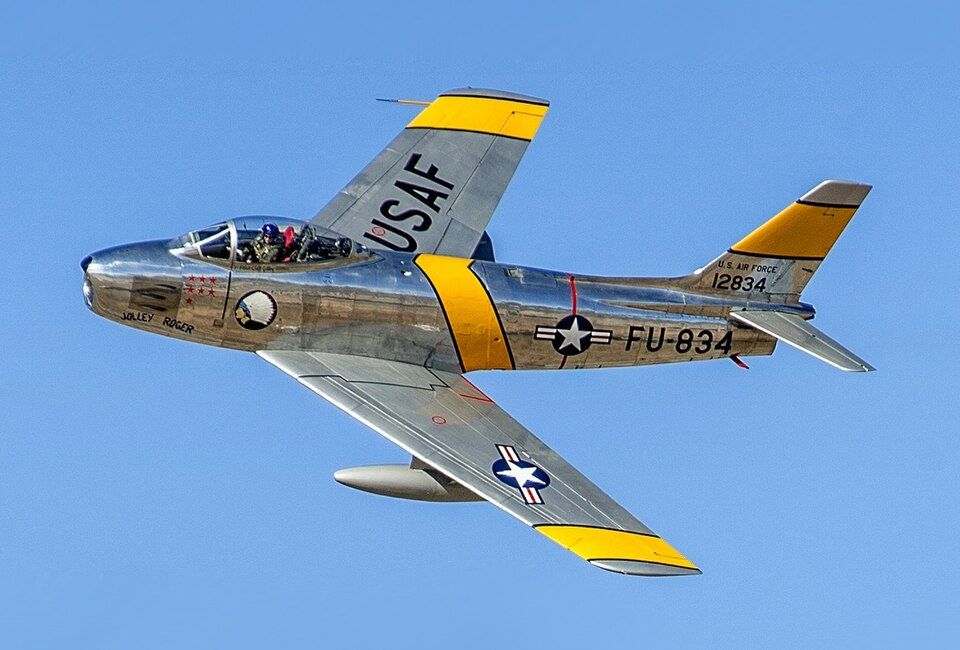
F-86F Sabre · North American F-86F
- Variant described
- F-86F [1]
- Role
- Day fighter and fighter-bomber [1]
- Origin
- United States
- Manufacturer
- North American Aviation; also built in Canada, Australia, Japan and Italy [1]
- Crew
- 1 [1]
- First flight
- 1 October 1947 (XP-86) [1]
- Entered service
- 1949, with the US Air Force; the F-86F was introduced in 1953 [1]
- Status
- Retired; the last, in Bolivia, in 1994. 9,860 Sabres of all variants built [1]
- Powerplant
- One General Electric J47-GE-27 turbojet, 5,910 lbf [1]
- Maximum speed
- 687 mph (597 kt) at sea level at 14,212 lb combat weight [1]
- Service ceiling
- 49,600 ft at combat weight [1]
- Range
- 1,525 mi (1,325 NM); combat radius 414 mi (360 NM) with two 1,000 lb bombs and two drop tanks [1]
- Armament
- Sensors and avionics
- AN/APG-30 radar ranging for the gunsight [1]
Borrowed from Germany
North American Aviation built the P-51 MustangP-51D Mustang AircraftThe long-range escort fighter that took US bombers to Berlin and back; Merlin-powered, with six .50 calibre guns., and its first jet fighter, the Navy’s FJ-1 Fury, still had a straight wing derived from the MustangP-51D Mustang AircraftThe long-range escort fighter that took US bombers to Berlin and back; Merlin-powered, with six .50 calibre guns.’s. The Army Air Forces’ version, the XP-86, looked set to be no better than its rivals and could not reach the required 600 mph. [1] The answer came from captured German research. At the end of the Second World War, American engineers seized wartime German data showing that a thin, swept wing greatly reduced drag near the speed of sound. Over the objections of some senior staff, North American swept the XP-86’s wing back 35 degrees and fitted it with automatic leading-edge slats modelled on those of the Messerschmitt Me 262. It was the first American aircraft to use the German research. [1]
George Welch flew the first XP-86 from Muroc Dry Lake on 1 October 1947. [1] On 15 September 1948 an F-86A set a world speed record of 671 mph, and on 18 May 1953 Jacqueline Cochran, flying a Canadian-built Sabre alongside Chuck Yeager, became the first woman to break the sound barrier. [1]
MiG Alley
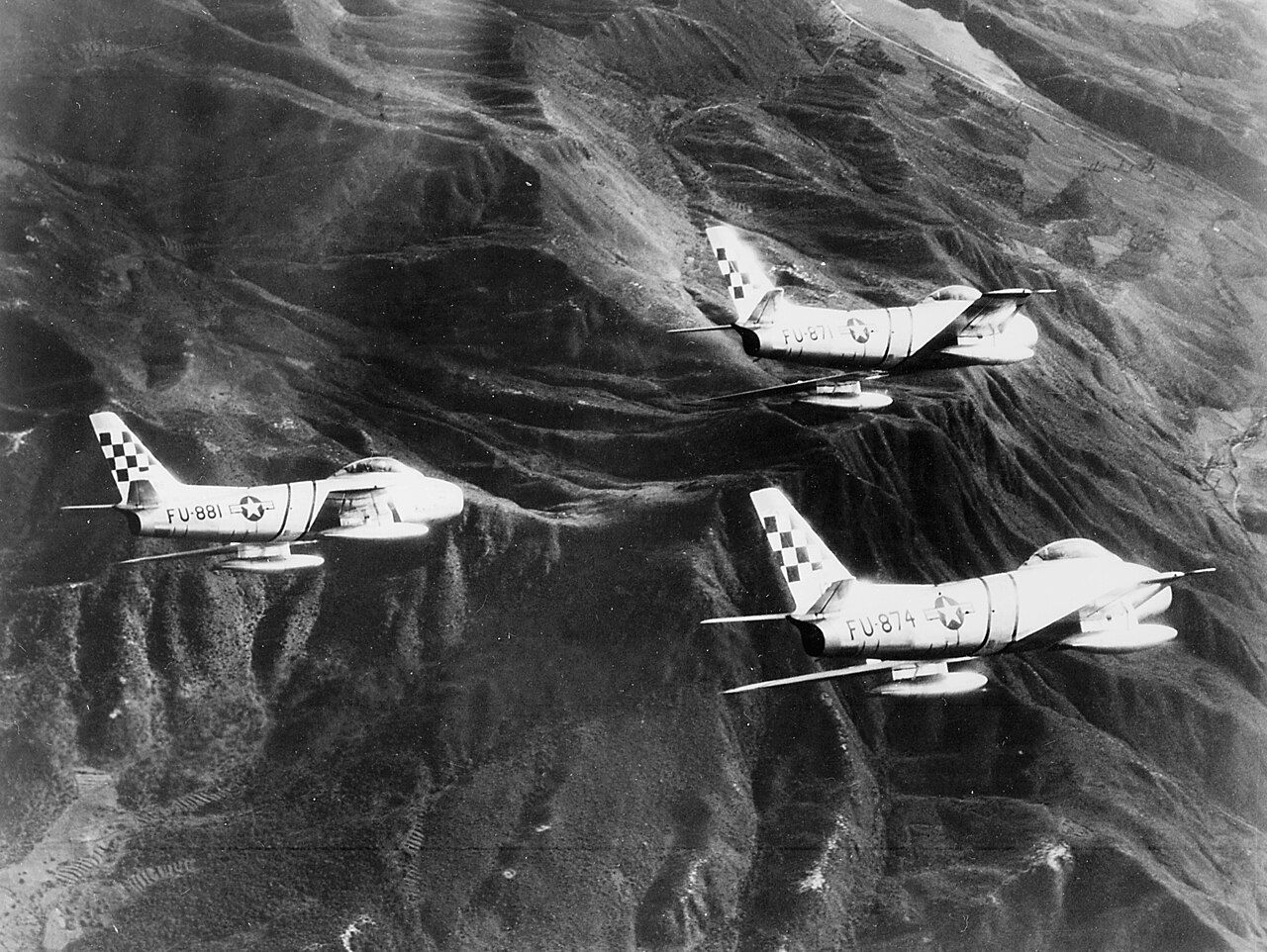
In November 1950 the Soviet MiG-15MiG-15 AircraftThe Soviet swept-wing jet fighter that shocked UN air forces over Korea, armed with 37 mm and 23 mm cannon. appeared over Korea and outclassed every United Nations aircraft there. Three squadronsSquadron GlossaryJoint terms: 1. An organization consisting of two or more divisions of ships, or two or more divisions (Navy) or flights of aircraft. 2. The basic administrative aviation unit of the Army, Navy, Marine Corps, and Air Force. 3… of F-86s were rushed to the Far East the next month. [1] The early Sabre was outmatched in ceiling, firepower, acceleration, climb and turn, but it was slightly faster and could out-dive the MiG, which could not safely exceed MachMach number GlossaryFlight: The ratio of the true airspeed to the speed of sound. All compressibility effects depend on it. 0.92. [1] The fiercest fighting took place in MiG Alley, near the mouth of the Yalu River on the Chinese border. [1]
Pilot quality mattered as much as the aircraft. Many American pilots were Second World War veterans, but the MiGs were at first flown mostly by Soviet pilots, many with wartime combat experience of their own. [1] Sabre training at Nellis was so dangerous that pilots were told, “If you ever see the flag at full staff, take a picture.” [1] The Soviets, studying a Sabre recovered in 1951, concluded that its edge came from its APG-30 radar gunsight, which allowed accurate shooting at longer range. They copied it for the MiG-17. [1]
The F-86F
The F-86F of 1953 had the more powerful J47-GE-27 engine and could carry four drop tanks instead of two; fighter-bomber versions carried bombs and rockets under the wings. [1] With it the Sabre and MiG-15MiG-15 AircraftThe Soviet swept-wing jet fighter that shocked UN air forces over Korea, armed with 37 mm and 23 mm cannon. became closely matched, and by the end of the war many experienced American pilots believed the F-86F had a slight edge. [1] Two fighter-bomber wings converted to it in spring 1953. [1] It kept the Sabre’s six 0.50 in machine guns, though a combat trial of seven F-86Fs fitted with 20 mm cannon, Project Gun-Val, signalled the end of the 0.50 calibre machine gun as an air-to-air weapon. [1]
All but one of the 41 American aces of the Korean War flew Sabres. [1] At the time, Sabre pilots were credited with 792 MiGs for 78 Sabres lost in air combat, but a post-war Air Force review cut the claimed ratio by half, and later research puts it nearer 2:1, both sides having over-claimed. [1]
Sidewinders over the Taiwan Strait
The Sabre’s last great dogfights were fought by Taiwan. By June 1958 the Republic of China Air Force had received 320 F-86Fs, and that August, as China shelled the islands of Quemoy and Matsu, its Sabres met Chinese MiG-15sMiG-15 AircraftThe Soviet swept-wing jet fighter that shocked UN air forces over Korea, armed with 37 mm and 23 mm cannon. and MiG-17s. Under a secret effort called Operation Black Magic, a small US Marine Corps team had fitted Taiwanese Sabres with the new AIM-9 Sidewinder. The MiGs had always held the high ground, cruising above the Sabres and choosing when to fight; the infrared-homing missile took that advantage away and proved devastating. [1]
With 9,860 built, the Sabre is the most-produced Western jet fighter, and it served with air forces around the world. [1] Years later, in Air Force tests of tactics against the MiG-17, Air National Guard F-86Hs played the enemy so well that one pilot judged the supersonicSupersonic GlossaryFlight: The regime of flight from about Mach 1.20 to 5.00, with definite supersonic flow on all parts of the aircraft. Above Mach 5.00 is hypersonic. F-100F-100 Super Sabre AircraftThe first US Air Force fighter supersonic in level flight; a fighter-bomber and fast FAC in Vietnam. and F-105 inferior to the old Sabre in a dogfight “in any envelope except nose down and full throttle”. [1]

Sources
- North American F-86 Sabre. Wikipedia (secondary source). https://en.wikipedia.org/wiki/North_American_F-86_Sabre (accessed 2026-10-25).
Wikipedia articles are secondary sources and can change; they are cited with the date they were read. The Federation of American Scientists (FAS) Military Analysis Network pages largely reproduce US service fact sheets of the late 1990s and early 2000s, so later upgrades are not covered there.