
Drafted — not technically validated
Record revision 1 · The first Soviet fighter supersonic in level flight; the MiG-19P added radar for all-weather interception.
Real-world aircraft as described in public sources. Figures vary between variants, loads and sources; the data plate names the variant its figures describe, and differences are noted beside the number they affect.
MiG-19P · Mikoyan-Gurevich MiG-19P
- Variant described
- MiG-19P all-weather interceptor; performance figures are for the MiG-19S day fighter [1]
- Role
- Fighter; the MiG-19P is the radar-equipped all-weather version [1]
- Origin
- Soviet Union
- Crew
- 1 [1]
- First flight
- 24 May 1952 (SM-2 prototype) [1]
- Entered service
- March 1955; the MiG-19P entered production in 1955 [1]
- Status
- Retired; the Chinese J-6 remains in limited use. 2,172 built in the USSR [1]; perhaps as many as 10,000 in all [2]
- Powerplant
- Two Tumansky RD-9B afterburningAfterburner GlossaryFlight: An additional combustion area aft of the turbine section of a turbojet, with fuel nozzles and flameholders, that burns fuel in the engine's large excess of air. It adds only 10 to 20 percent to the engine's weight but 40… turbojets, 31.8 kN (7,150 lbf) each with afterburnerAfterburner GlossaryFlight: An additional combustion area aft of the turbine section of a turbojet, with fuel nozzles and flameholders, that burns fuel in the engine's large excess of air. It adds only 10 to 20 percent to the engine's weight but 40… [1] [2]
- Maximum speed
- Mach 1.35, 1,452 km/h (784 kt) at 10,000 m [1]
- Service ceiling
- 17,500 m (57,400 ft) [1]
- Range
- 1,390 km (751 NM); ferry range 2,200 km (1,188 NM) with two 760 L drop tanks [1]
- Armament
- Sensors and avionics
- RP-1 Izumrud radar, with antennas in the intake centre body and upper lip (MiG-19P) [1]
- Purchase
- DCS WorldDCS: MiG-19P Farmer by RAZBAMNot on sale: the DCS Store lists this RAZBAM module as not available
Store pages checked 2026-10-28. Prices and availability change.
Through the sound barrier, level
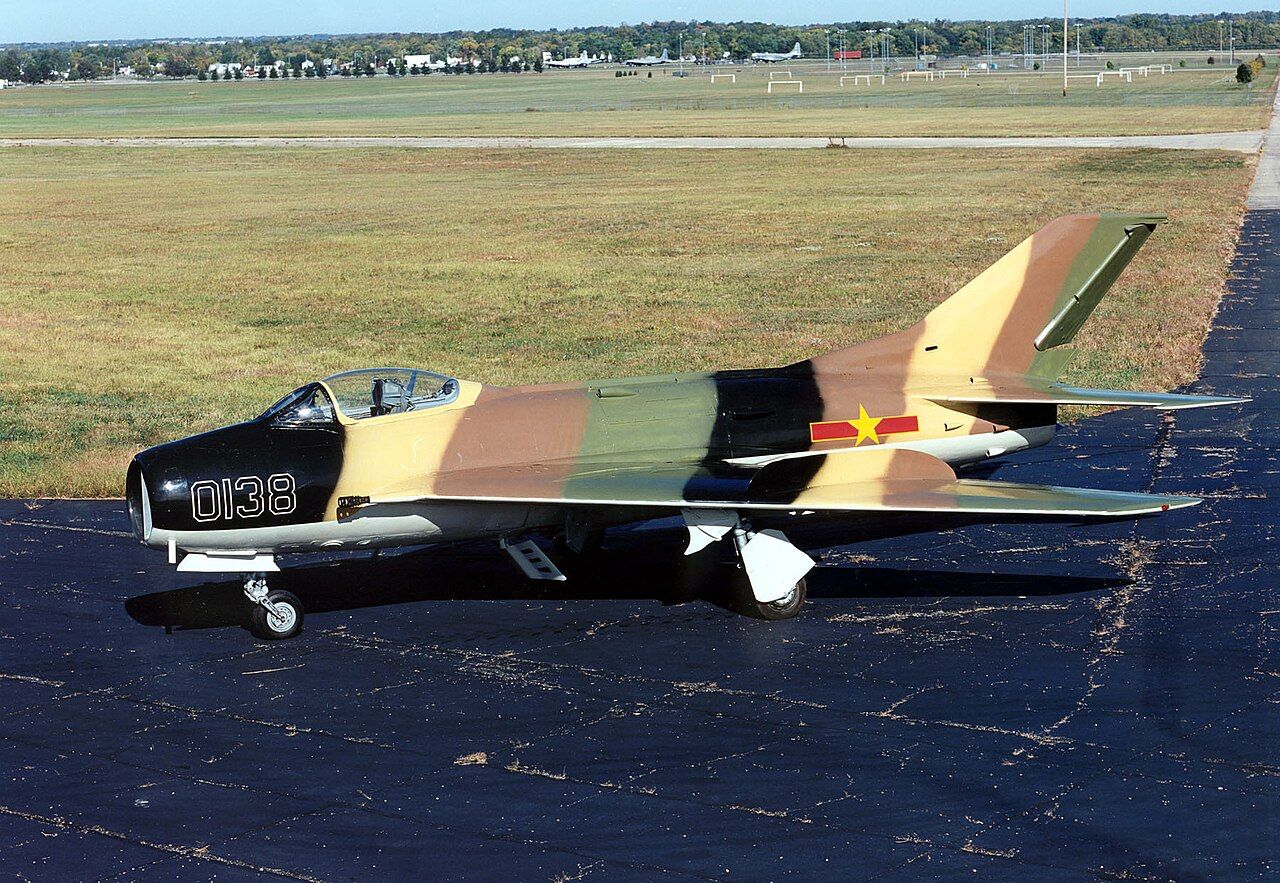
The MiG-15MiG-15 AircraftThe Soviet swept-wing jet fighter that shocked UN air forces over Korea, armed with 37 mm and 23 mm cannon. and MiG-17 could only pass the speed of sound in a dive. In 1950 the Mikoyan-Gurevich bureau began a fighter with more range that could do it in level flight, and chose to power it with two new, small axial-flow engines. A MiG-17 converted to take the pair of engines flew late in 1951 as a test bed, and the real prototype, the SM-2, flew on 24 May 1952 with G. A. Sedov at the controls. Its thin wings, designed at the TsAGI research institute, were swept back at 55 degrees. [1]
The SM-2 still could not go supersonicSupersonic GlossaryFlight: The regime of flight from about Mach 1.20 to 5.00, with definite supersonic flow on all parts of the aircraft. Above Mach 5.00 is hypersonic. in level flight, even with afterburningAfterburner GlossaryFlight: An additional combustion area aft of the turbine section of a turbojet, with fuel nozzles and flameholders, that burns fuel in the engine's large excess of air. It adds only 10 to 20 percent to the engine's weight but 40… engines, and it tended to spin at high angles of attack. The designers lowered the tailplane, deepened the wing fences and moved the air brakes, and the Mikulin bureau produced a stronger engine, the AM-9B, later known as the Tumansky RD-9. Fitted with it, the aircraft flew as the SM-9 on 5 January 1954 and so impressed the authorities that it was ordered into production as the MiG-19 on 17 February 1954, although factory testing had barely begun. [1] It became the first Soviet production aircraft able to fly faster than sound in level flight. [1]
A rushed start
That haste had a price. Early MiG-19s suffered mid-air explosions, eventually traced to poor insulation between the engines and the fuel tanks in the rear fuselage; a metal heat shield partly cured them. The elevators lost their effect at supersonicSupersonic GlossaryFlight: The regime of flight from about Mach 1.20 to 5.00, with definite supersonic flow on all parts of the aircraft. Above Mach 5.00 is hypersonic. speed, so the main production day fighter, the MiG-19S, was given an all-moving tailplane. A radar-equipped all-weather fighter was developed alongside it and entered production in 1955 as the MiG-19P, with an Izumrud radar and its guns in the wing roots; from 1957 the missile-armed MiG-19PM replaced its cannon with four K-5M missiles. [1]
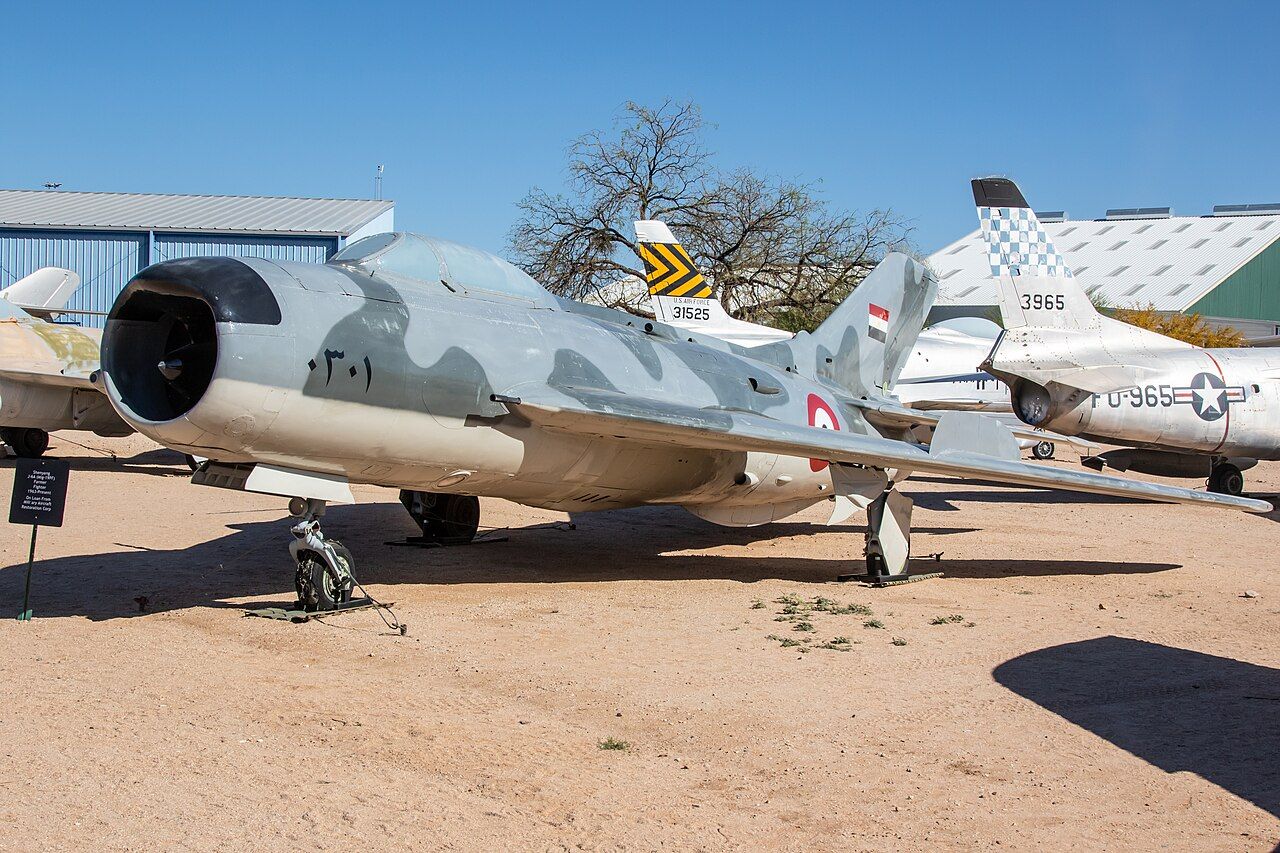
The Soviet public first saw the type on 3 July 1955, when 48 MiG-19s flew past at the Tushino air show in Moscow. [1] Its two engines breathe through what looks like a single round intake in the nose but is divided inside, so each engine has its own duct. [2]
Chasing spy planes
Soviet MiG-19s spent the late 1950s intercepting Western reconnaissanceReconnaissance GlossaryJoint terms: A mission undertaken to obtain, by visual observation or other detection methods, information about the activities and resources of an enemy or adversary, or to secure data concerning the meteorological, hydrographic, or… flights. In the autumn of 1957 a MiG-19 pilot saw a U-2 but could not climb the last 3,000 m to reach it, and a lightened high-altitude version, the MiG-19SV, still fell short. In 1960, when Francis Gary Powers’s U-2 was brought down by surface-to-air missiles, the same salvo hit a pursuing MiG-19P and killed its pilot, Sergei Safronov. On 1 July 1960 a MiG-19 shot down an RB-47H over the Arctic in a hotly disputed incident, and in January 1964 one shot down a T-39 Sabreliner that had entered East German airspace on a training flight. [1]
China’s J-6
The Soviet Union replaced the MiG-19 with the MiG-21MiG-21 AircraftThe small delta-wing Mach 2 fighter: the most-produced supersonic jet in history. in the early 1960s, but the type lived on for decades elsewhere. China built it as the J-6, its first supersonicSupersonic GlossaryFlight: The regime of flight from about Mach 1.20 to 5.00, with definite supersonic flow on all parts of the aircraft. Above Mach 5.00 is hypersonic. fighter, which began flight tests in 1958 and was reportedly still in production in the mid-1990s. Including Chinese, Polish and Czechoslovak production, as many as 10,000 MiG-19s of all versions may have been built. [2] In 1965 a PLAAF J-6 shot down a US Air Force F-104 Starfighter that had flown into Chinese airspace over Hainan Island; its pilot, Captain Philip E. Smith, ejected and was held prisoner until March 1973. [1]
The fighter that out-turned the Phantom
Over North Vietnam the 925th Fighter Regiment flew J-6s from 1969. Air combat there was fought almost entirely at subsonicSubsonic GlossaryFlight: The regime of flight below about Mach 0.75, in which the airflow on all parts of the aircraft is most likely subsonic. speed, where the older fighter was more manoeuvrable than the MiG-21MiG-21 AircraftThe small delta-wing Mach 2 fighter: the most-produced supersonic jet in history. and accelerated well enough. American pilots who tested an export F-6 in 1969 called it an excellent fighter: “like the MiG-17, it could easily out-turn the PhantomF-4 Phantom II AircraftThe big two-seat Cold War fighter-bomber; the F-4E added an internal gun and slats after Vietnam.…and could out-accelerate the F-4F-4 Phantom II AircraftThe big two-seat Cold War fighter-bomber; the F-4E added an internal gun and slats after Vietnam. out to MachMach number GlossaryFlight: The ratio of the true airspeed to the speed of sound. All compressibility effects depend on it. 1.2”. They praised its canopy and its three hard-hitting 30 mm cannon. Its great weakness was range; as one test pilot put it, “after going in full after-burner at low altitude for five minutes, the MiG driver will be looking for a place to land!” Short range and two hard-to-maintain engines made it unpopular with North Vietnamese pilots. [1]
Egypt flew about 80 MiG-19s by 1967. On 29 November 1966 an Israeli Mirage III downed one with a R.530 missile, the French missile’s first aerial kill, and the second with its guns. More than half of Egypt’s MiG-19s were destroyed on the ground in the opening strikes of the Six-Day War, but Israeli pilots regarded the type as a dangerous opponent, and in May 1969 a MiG-19 shot down a Mirage with cannon fire. North Korea was still flying MiG-19s in 2014. [1]

Sources
- Mikoyan-Gurevich MiG-19. Wikipedia (secondary source). https://en.wikipedia.org/wiki/Mikoyan-Gurevich_MiG-19 (accessed 2026-10-25).
- MiG-19 Farmer. Federation of American Scientists, Military Analysis Network. https://nuke.fas.org/guide/russia/airdef/mig-19.htm (accessed 2026-10-25).
Wikipedia articles are secondary sources and can change; they are cited with the date they were read. The Federation of American Scientists (FAS) Military Analysis Network pages largely reproduce US service fact sheets of the late 1990s and early 2000s, so later upgrades are not covered there.