
Drafted — not technically validated
Record revision 1 · A twin-engine Soviet fighter with a helmet sight and R-73 missiles, built to counter the F-15 and F-16.
Real-world aircraft as described in public sources. Figures vary between variants, loads and sources; the data plate names the variant its figures describe, and differences are noted beside the number they affect.
MiG-29 Fulcrum · Mikoyan MiG-29A/S
- Variant described
- MiG-29A (9.12) and MiG-29S (9.13) [1]
- Role
- Air superiority fighter, later multirole [1]
- Origin
- Soviet Union
- Manufacturer
- Mikoyan [1]
- Crew
- 1 (MiG-29UB: 2) [1]
- First flight
- 6 October 1977 [1]
- Entered service
- August 1983 [1]
- Powerplant
- Two Klimov RD-33 afterburningAfterburner GlossaryFlight: An additional combustion area aft of the turbine section of a turbojet, with fuel nozzles and flameholders, that burns fuel in the engine's large excess of air. It adds only 10 to 20 percent to the engine's weight but 40… turbofans, 81.58 kN (18,300 lbf) each with afterburnerAfterburner GlossaryFlight: An additional combustion area aft of the turbine section of a turbojet, with fuel nozzles and flameholders, that burns fuel in the engine's large excess of air. It adds only 10 to 20 percent to the engine's weight but 40… [1]
- Maximum speed
- Mach 2.3+, 2,450 km/h (1,323 kt) at high altitude [1]
- Service ceiling
- 18,000 m (59,100 ft) [1]
- Range
- 1,430 km (772 NM) on internal fuel; combat radius 700–900 km (378–486 NM) with two R-27 and four R-73 at high altitude [1]
- Armament
- Sensors and avionics
An answer to the Eagle
Over Vietnam in the mid-1960s, American fighter-bombers built for low-level strikes proved vulnerable to nimble MiGs, and the US Air Force answered with the F-15 EagleF-15C Eagle AircraftA twin-engine air superiority fighter with more than 104 air-to-air victories and no losses., ordered in 1969. Moscow needed a reply. Its first requirement, for an advanced frontline fighter, asked for almost everything at once: long range, MachMach number GlossaryFlight: The ratio of the true airspeed to the speed of sound. All compressibility effects depend on it. 2-plus, heavy armament, superb agility and the ability to fly from rough strips. By 1971 Soviet planners had split it in two, much as the Americans paired the F-15F-15C Eagle AircraftA twin-engine air superiority fighter with more than 104 air-to-air victories and no losses. with the lightweight F-16F-16 Fighting Falcon AircraftA single-engine multirole fighter: fly-by-wire, 9 g, and the US Air Force's main strike and SEAD aircraft.. The heavy fighter went to Sukhoi and became the Su-27Su-27 Flanker AircraftA large, long-range Soviet air superiority fighter with ten missile stations.; the light one went to Mikoyan and became the MiG-29, which first flew on 6 October 1977. [1]
American reconnaissanceReconnaissance GlossaryJoint terms: A mission undertaken to obtain, by visual observation or other detection methods, information about the activities and resources of an enemy or adversary, or to secure data concerning the meteorological, hydrographic, or… satellites spotted the prototype within weeks at the Zhukovsky flight test centre near Ramenskoye, and dubbed it “Ram-L”. NATO later gave the production fighter the reporting name Fulcrum. Soviet pilots, who had no official name for it, liked the NATO name enough to use it themselves. [1]
Built for a rough war
The MiG-29 shares its aerodynamic roots with the Su-27Su-27 Flanker AircraftA large, long-range Soviet air superiority fighter with ten missile stations.: a swept wing blended into the fuselage by long root extensions, twin tails, and two widely spaced RD-33 turbofans whose broad fuselage between them adds lift. It has hydraulic controls rather than fly-by-wire, yet it is very agile, with excellent turning, good high angle-of-attack handling and a general resistance to spins, and it is stressed for 9 g. [1]
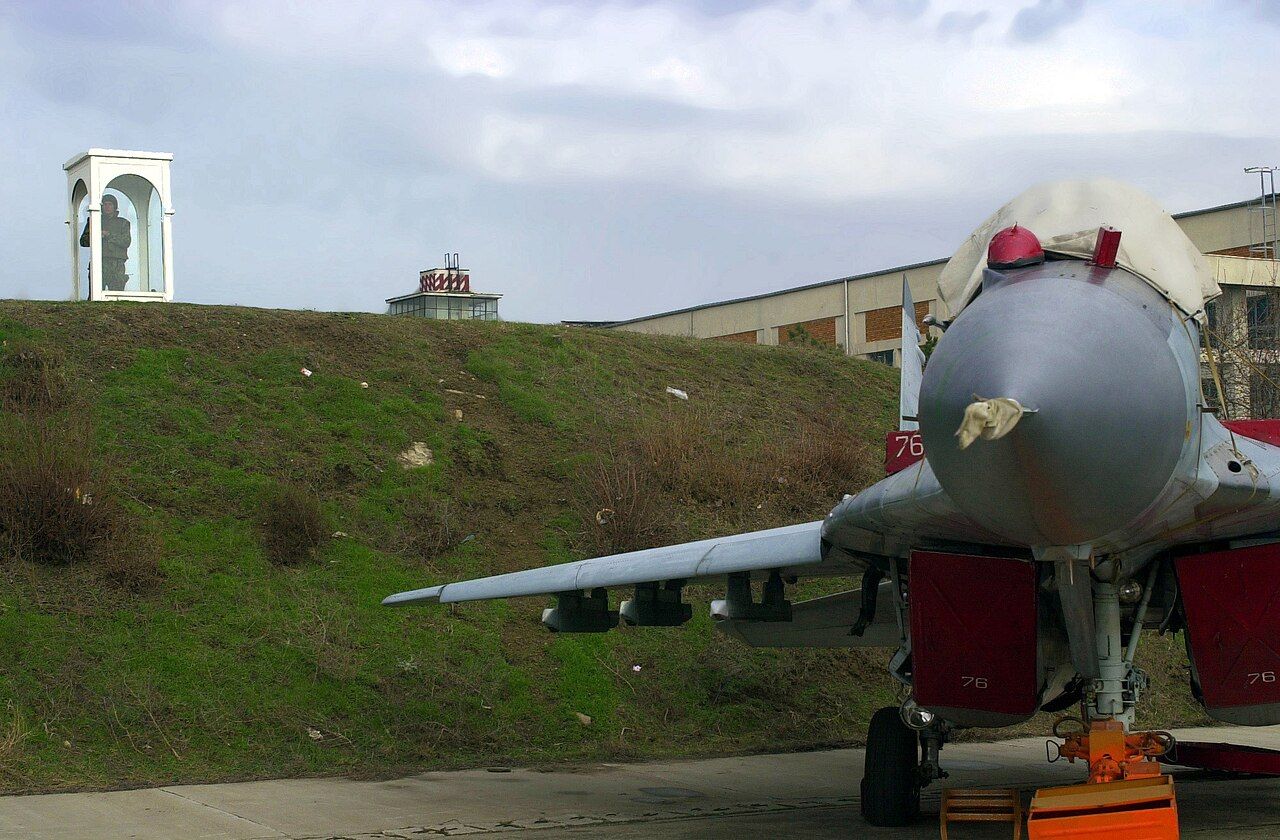
Its most unusual feature is designed for battered frontline airfields. On take-off, landing and low flying the main intakes can close completely, and the engines breathe through louvres on top of the wing roots, so they do not swallow stones and debris from the runway. [1] The cockpit was made deliberately familiar to pilots converting from the MiG-23, with dials, a head-up displayHUD GlossaryJoint terms: Head-up display. A special type of flight viewing screen that allows the pilot to watch the flight instruments and other data while looking through the windshield of the aircraft for other traffic, the approach lights… and a high bubble canopy, but no hands-on-throttle-and-stick controls. [1]
Look at it and shoot
The baseline MiG-29 paired a look-down/shoot-down radar and an infrared search and track sensor with the Shchel helmet-mounted sight, which let the pilot aim the R-73 missile’s seeker simply by looking at a target. [1] A 1990s US analysis judged that American fighters would hold the advantage at 40 miles thanks to their radars and missiles, but that inside 10 miles the edge shifted to the MiG-29, and at five miles its helmet sight and manoeuvrability favoured it clearly. [2]
Stepping out from behind the curtain
The West first saw the MiG-29 when Soviet aircraft visited Finland on 2 July 1986, then at Farnborough in 1988. At the 1989 Paris Air Show, only the second showing of Soviet fighters at an international air show since the 1930s, its agility impressed Western observers, though one crashed, without loss of life, during the first weekend. [1]
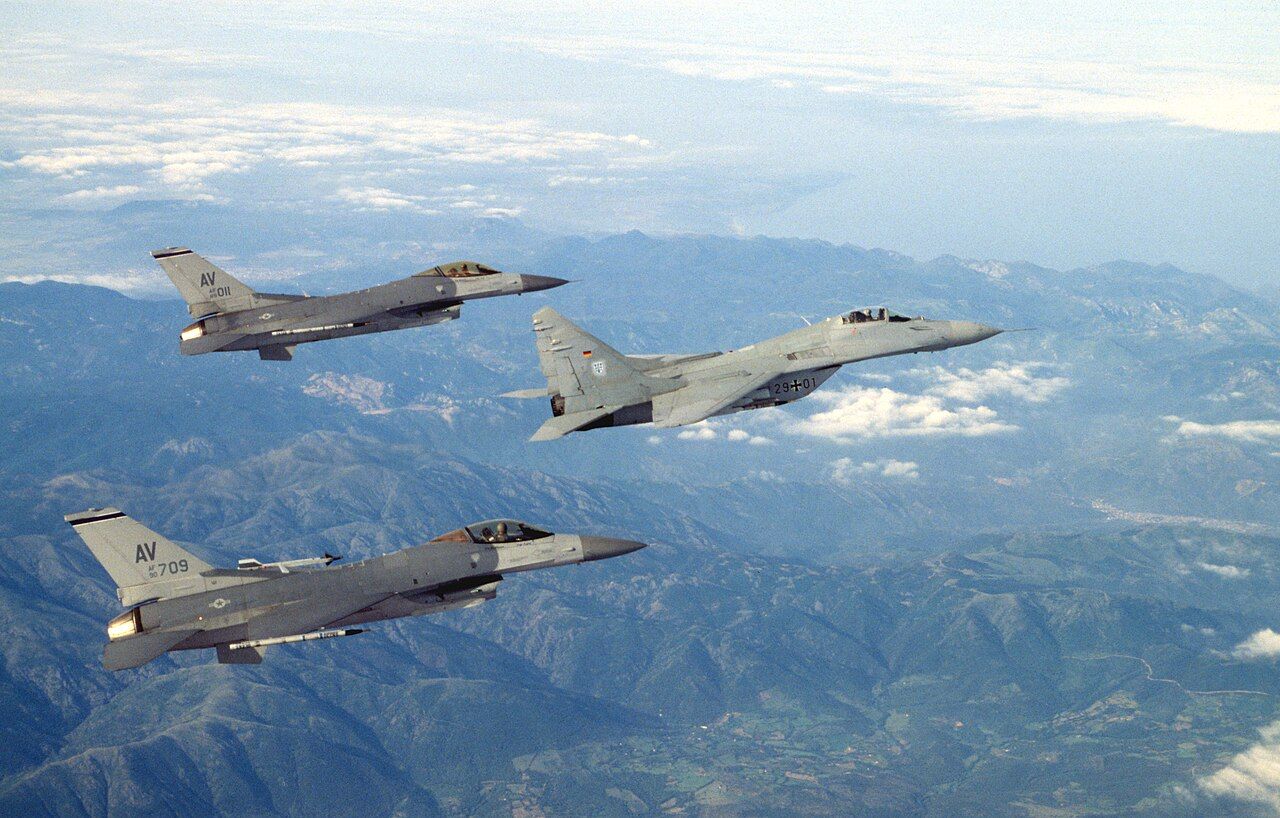
When Germany reunified in 1990, East Germany’s 24 MiG-29s joined the Luftwaffe, putting the Fulcrum into a NATO air force. In mock combat with US fighters the German pilots found the helmet sight let them lock on to targets almost 45 degrees off the nose, and that the MiG out-turned the F-15F-15C Eagle AircraftA twin-engine air superiority fighter with more than 104 air-to-air victories and no losses., F-16F-16 Fighting Falcon AircraftA single-engine multirole fighter: fly-by-wire, 9 g, and the US Air Force's main strike and SEAD aircraft., F-14F-14 Tomcat AircraftThe Navy's swing-wing fleet defence fighter: two crew, AWG-9 radar and AIM-54 Phoenix. and F/A-18F/A-18 Hornet AircraftA carrier-capable fighter and attack aircraft that one pilot can switch between roles on the same sortie. at slow speed. Beyond visual range it was another story: working the R-27 missile while dodging the Americans’ better radars and AIM-120s was hard. After more than 30,000 flying hours, Germany sold 22 of its MiGs to Poland in 2003 for a symbolic €1 each. [1] In 1997 the United States bought 21 Moldovan MiG-29s, partly to keep them from being sold to Iran; some now stand on display at US bases. [1] [2]
At war
Iraq’s MiG-29s fared badly in 1991: five were shot down by US Air Force F-15sF-15C Eagle AircraftA twin-engine air superiority fighter with more than 104 air-to-air victories and no losses.. [1] In the Kargil war of 1999 Indian MiG-29s escorted Mirage 2000sMirage 2000C AircraftFrance's fly-by-wire delta interceptor, armed with Super 530D and Magic II missiles. attacking targets with laser-guidedLGW GlossaryWeapons: Laser-guided weapon. A weapon that uses a seeker to detect laser energy reflected from a laser marked/designated target and through signal processing provides guidance commands to a control system, which guides the… bombs, and the Indian Navy flies the carrier-based MiG-29K. [1] Ukraine inherited up to 240 MiG-29s in 1991. After the Russian invasion of 2022 its MiG-29s flew as air superiorityAir superiority GlossaryJoint terms: That degree of dominance in the air battle by one force that permits the conduct of its operations at a given time and place without prohibitive interference from air and missile threats. fighters, and some were adapted to fire the American AGM-88 HARM anti-radiation missile, apparently with a commercial GPS and a tablet fitted in the cockpit. In October 2022 a Ukrainian pilot destroyed a Shahed drone with his cannon and had to eject when debris struck the jet. [1]
More than 30 nations have flown the MiG-29, and an estimated 728 of the family remain in service, about 5% of the world’s active combat aircraft. [1]

Sources
- Mikoyan MiG-29. Wikipedia (secondary source). https://en.wikipedia.org/wiki/Mikoyan_MiG-29 (accessed 2026-10-25).
- MiG-29 Fulcrum. Federation of American Scientists, Military Analysis Network. https://nuke.fas.org/guide/russia/airdef/mig-29.htm (accessed 2026-10-25).
Wikipedia articles are secondary sources and can change; they are cited with the date they were read. The Federation of American Scientists (FAS) Military Analysis Network pages largely reproduce US service fact sheets of the late 1990s and early 2000s, so later upgrades are not covered there.