
Drafted — not technically validated
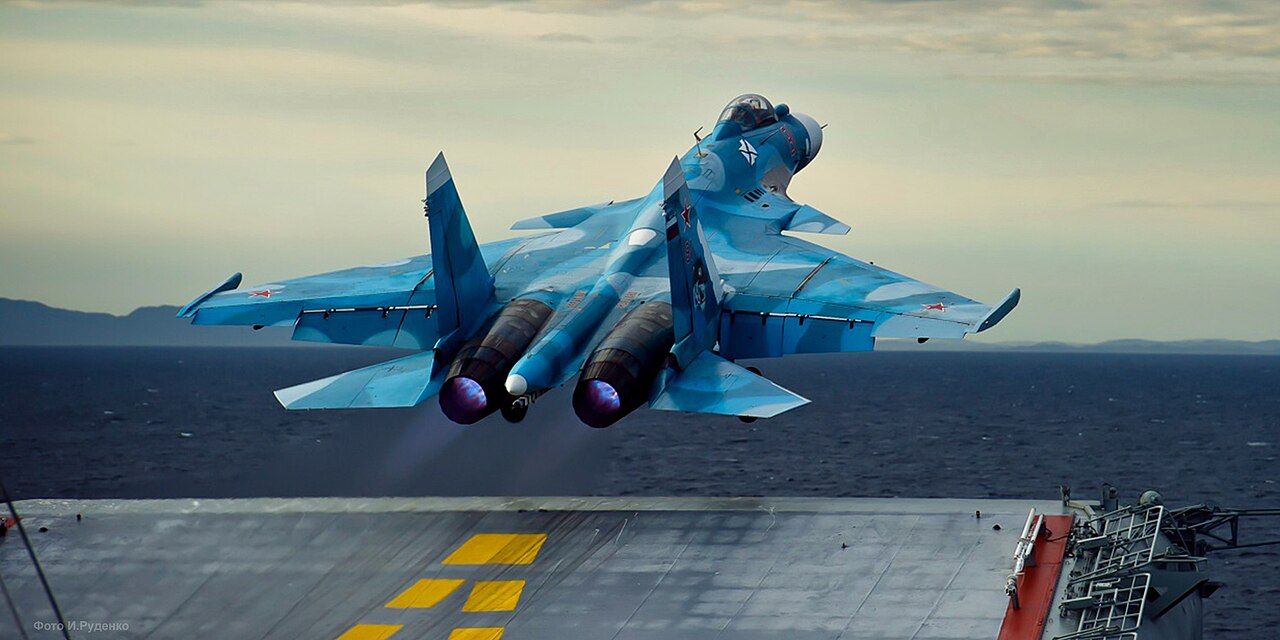
Record revision 1 · The carrier-based Flanker: canards, folding wings and a ski-jump launch from Admiral Kuznetsov.
Real-world aircraft as described in public sources. Figures vary between variants, loads and sources; the data plate names the variant its figures describe, and differences are noted beside the number they affect.
Su-33 Flanker-D · Sukhoi Su-33
- Variant described
- Su-33 [1]
- Role
- Carrier-based air superiority fighter with multirole capability [1]
- Origin
- Soviet Union and Russia
- Manufacturer
- Sukhoi and the Komsomolsk-on-Amur Aircraft Production Association [1]
- Crew
- 1 [1]
- First flight
- 17 August 1987 [1]
- Entered service
- 31 August 1998 (officially); first operations aboard Admiral Kuznetsov in 1995 [1]
- Status
- In service with the Russian Navy; 24 built [1]
- Powerplant
- Two Saturn AL-31F3 afterburningAfterburner GlossaryFlight: An additional combustion area aft of the turbine section of a turbojet, with fuel nozzles and flameholders, that burns fuel in the engine's large excess of air. It adds only 10 to 20 percent to the engine's weight but 40… turbofans, 125.5 kN (28,200 lbf) each with afterburnerAfterburner GlossaryFlight: An additional combustion area aft of the turbine section of a turbojet, with fuel nozzles and flameholders, that burns fuel in the engine's large excess of air. It adds only 10 to 20 percent to the engine's weight but 40… [1]
- Maximum speed
- Mach 2.17, 2,300 km/h (1,242 kt) at 10,000 m [1]
- Service ceiling
- 17,000 m (55,800 ft) [1]
- Range
- 3,000 km (1,620 NM) [1]
- Armament
- Sensors and avionics
- Purchase
- DCS WorldSu-33 Flaming Cliffs by Eagle DynamicsDCS Store
Store pages checked 2026-10-28. Prices and availability change.
A navy without a real fighter
Through the 1970s the Soviet Navy’s only fixed-wing carrier combat aircraft was the Yak-38 jump jet, whose short range and small payload hobbled its carriers. The navy wanted a bigger ship that could fly conventional fighters, and after several abandoned carrier designs it settled on a larger version of its existing class, to carry navalised MiG-29sMiG-29 Fulcrum AircraftA twin-engine Soviet fighter with a helmet sight and R-73 missiles, built to counter the F-15 and F-16. and Su-27sSu-27 Flanker AircraftA large, long-range Soviet air superiority fighter with ten missile stations.. Pilots began training at a new shore facility in Crimea called NITKA, while a steam catapult, arresting gearArresting gear GlossaryAirfield and ATC: A pendant cable across a military runway that an aircraft's tailhook engages to stop it. A line of yellow retroreflective disks is painted across the runway at the cable, and yellow-circle signs mark it. and landing aids were developed for the ship. [1]
Then, in 1981, the government cancelled the catapults to save money. The fighters would have to launch under their own power. NITKA was given a take-off ramp, test flights showed the ramp needed a ski-jump profile, and Sukhoi’s Su-27K, the aircraft that became the Su-33, was designed around it. [1]
Viktor Pugachyov’s landings
The first Su-27K prototype flew on 17 August 1987, piloted by Viktor Pugachyov, the test pilot who also first showed the Su-27Su-27 Flanker AircraftA large, long-range Soviet air superiority fighter with ten missile stations.’s Cobra manoeuvre. On 1 November 1989 he became the first Russian pilot to make a conventional landing on an aircraft carrier, aboard the ship then called Tbilisi and later renamed Admiral Kuznetsov. [1]
The first launches did not go smoothly. The ship’s jet blast deflectors stood too close to the engine nozzles and had to be lowered to 45 degrees, and when the fighter sat in front of one for longer than six seconds its water pipes burst. Pugachyov throttled back, the restraining blocks accidentally retracted, and the fighter crept forward until it was stopped. He then took off without either deflector or blocks, and from then on a Ka-27 rescue helicopter flew near the carrier during flight operations. In the following three weeks the test team flew 227 sortiesSortie GlossaryJoint terms: In air operations, an operational flight by one aircraft. and made 35 deck landings. [1]
Built for the deck
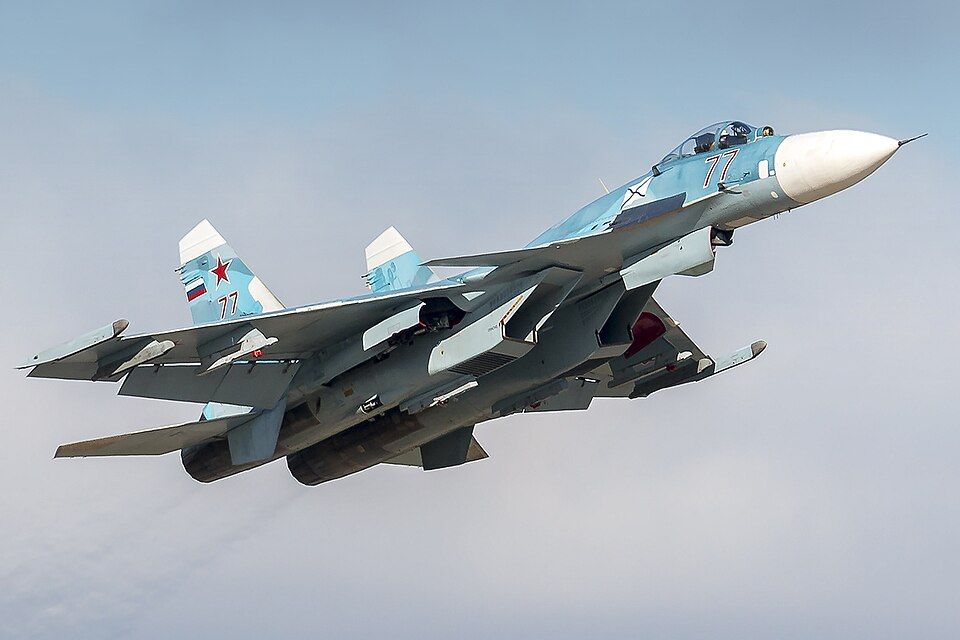
Turning the Su-27Su-27 Flanker AircraftA large, long-range Soviet air superiority fighter with ten missile stations. into a carrier fighter meant a stronger structure and undercarriage for no-flare landings, where the aircraft slams onto the deck without slowing its descent. Bigger slats, flaperons and double-slotted flaps add 10–12% of wing area for low-speed handling, and the wings and tailplanes fold to save space below deck. Canards in front of the wing shorten the take-off run, the tail cone is cut back so it does not strike the deck in nose-high landings, and an in-flight refuellingAR GlossaryJoint terms: Air refueling. The refueling of an aircraft in flight by another aircraft. probe and more powerful engines were added. [1] It can fly as slowly as 240 km/h, and it carries more than twice the fuel of the rival MiG-29KMiG-29 Fulcrum AircraftA twin-engine Soviet fighter with a helmet sight and R-73 missiles, built to counter the F-15 and F-16., which lets it fly 80% further at altitude. [1]
Two dozen Flanker-Ds
The collapse of the Soviet Union shrank the navy. Had the planned carriers been completed, 72 production aircraft would have been built; only 24 were. Admiral Kuznetsov took 13 of them on her first Mediterranean cruise in the winter of 1995–96, and the type formally entered service on 31 August 1998 as the Su-33, NATO’s Flanker-D. [1]
Its first combat came on 15 November 2016, when Su-33s flying from Admiral Kuznetsov struck targets in Syria’s Idlib and Homs provinces, using a newly fitted SVP-24 sighting system that let them drop unguided bombs with near-guided accuracy. Less than three weeks later a Su-33 was lost when an arresting cable snapped on its second landing attempt; the pilot ejected unhurt, and the carrier’s aircraft moved ashore to a Syrian air base to continue operations. [1] China acquired one of the Su-27K prototypes from Ukraine, and its J-15 carrier fighter is widely believed to be directly related to it. [1]

Sources
- Sukhoi Su-33. Wikipedia (secondary source). https://en.wikipedia.org/wiki/Sukhoi_Su-33 (accessed 2026-10-25).
Wikipedia articles are secondary sources and can change; they are cited with the date they were read. The Federation of American Scientists (FAS) Military Analysis Network pages largely reproduce US service fact sheets of the late 1990s and early 2000s, so later upgrades are not covered there.