
Drafted — not technically validated
Record revision 1 · A small, cheap supersonic fighter for US allies, and a long-serving adversary aircraft that stands in for the MiG-21.
Real-world aircraft as described in public sources. Figures vary between variants, loads and sources; the data plate names the variant its figures describe, and differences are noted beside the number they affect.
F-5E Tiger II · Northrop F-5E
- Role
- Light fighter [1]
- Origin
- United States
- Manufacturer
- Northrop Corporation [1]
- Crew
- 1 (F-5F: 2) [1]
- First flight
- F-5A: 30 July 1959; F-5E: 11 August 1972 [1]
- Entered service
- F-5A from 1964 [1]; the F-5E was ordered after winning the International Fighter Aircraft competition in November 1970 [2]
- Status
- In service; 1,399 F-5E/F built, production ending in 1987 [1]
- Powerplant
- Two General Electric J85-GE-21 afterburningAfterburner GlossaryFlight: An additional combustion area aft of the turbine section of a turbojet, with fuel nozzles and flameholders, that burns fuel in the engine's large excess of air. It adds only 10 to 20 percent to the engine's weight but 40… turbojets, 5,000 lbf each with afterburnerAfterburner GlossaryFlight: An additional combustion area aft of the turbine section of a turbojet, with fuel nozzles and flameholders, that burns fuel in the engine's large excess of air. It adds only 10 to 20 percent to the engine's weight but 40… [1] [2]
- Maximum speed
- Mach 1.63 at 36,000 ft (about 935 kt) [1]
- Range
- 481 NM clean; combat radius 120 NM with two Sidewinders and 5,200 lb of ordnance [1]
- Armament
- Sensors and avionics
- Air-to-air radar, added with the F-5E upgrade [1]
Small on purpose
Edgar Schmued had already designed two of the most famous American fighters, the P-51 MustangP-51D Mustang AircraftThe long-range escort fighter that took US bombers to Berlin and back; Merlin-powered, with six .50 calibre guns. and the F-86 SabreF-86 Sabre AircraftThe swept-wing day fighter that met the MiG-15 over Korea., when he moved to Northrop. In late 1954 his team toured Europe and Asia to see what NATO and SEATO allies actually needed, and Schmued came back with a goal that ran against the trend of the time: instead of making fighters ever bigger and heavier, build one that was small, agile, reliable and cheap, with room to grow so it could serve for more than ten years. [1]
The key was an engine. General Electric’s tiny J85 had been designed to power a decoyDecoy GlossaryWeapons: An imitation in any sense of a person, object, or phenomenon which is intended to deceive enemy surveillance devices or mislead enemy evaluation. missile carried by B-52 bombers, and for its size it was remarkably powerful. Two of them, buried in a slim fuselage, gave Northrop its design. [1] Chief engineer Welko Gasich added an idea that was new in fighter design, “life cycle cost”: designing from the start for low running costs over a long life. [1]
The Air Force bought the two-seat version first, as the T-38 Talon trainer. [2] The single-seat fighter nearly died, until the Kennedy administration wanted a low-cost fighter it could supply to allies and chose it in April 1962 as the F-5A Freedom Fighter. [1] The F-5A was optimised for ground attack and had no fire-control radar. [2]
Skoshi Tiger
In October 1965 the US Air Force sent twelve F-5As to Vietnam for a combat evaluation code-named Skoshi Tiger, after fitting them with air-refuelling probes and armour as F-5Cs. They flew more than 2,600 sortiesSortie GlossaryJoint terms: In air operations, an operational flight by one aircraft. from Bien Hoa and Da Nang, and were judged as capable at ground attack as the F-100F-100 Super Sabre AircraftThe first US Air Force fighter supersonic in level flight; a fighter-bomber and fast FAC in Vietnam., though with shorter range. The trial was as much about selling F-5s abroad as about Air Force service, and in 1967 the surviving aircraft were handed to the South Vietnamese air force. [1] The name “Tiger” stuck. [2]
Tiger II
In 1970 Northrop won the International Fighter Aircraft competition for a successor that could take on the Soviet MiG-21MiG-21 AircraftThe small delta-wing Mach 2 fighter: the most-produced supersonic jet in history.. [1] The F-5E Tiger II, first flown on 11 August 1972, had more powerful J85-21 engines, a longer fuselage holding more fuel, enlarged leading-edge extensions for better turning, and at last a radar. It kept the F-5A’s two M39 cannons in the nose. [1] Northrop built 792 F-5Es, and more were made under licence in Switzerland, South Korea and Taiwan. [1]
The enemy in training
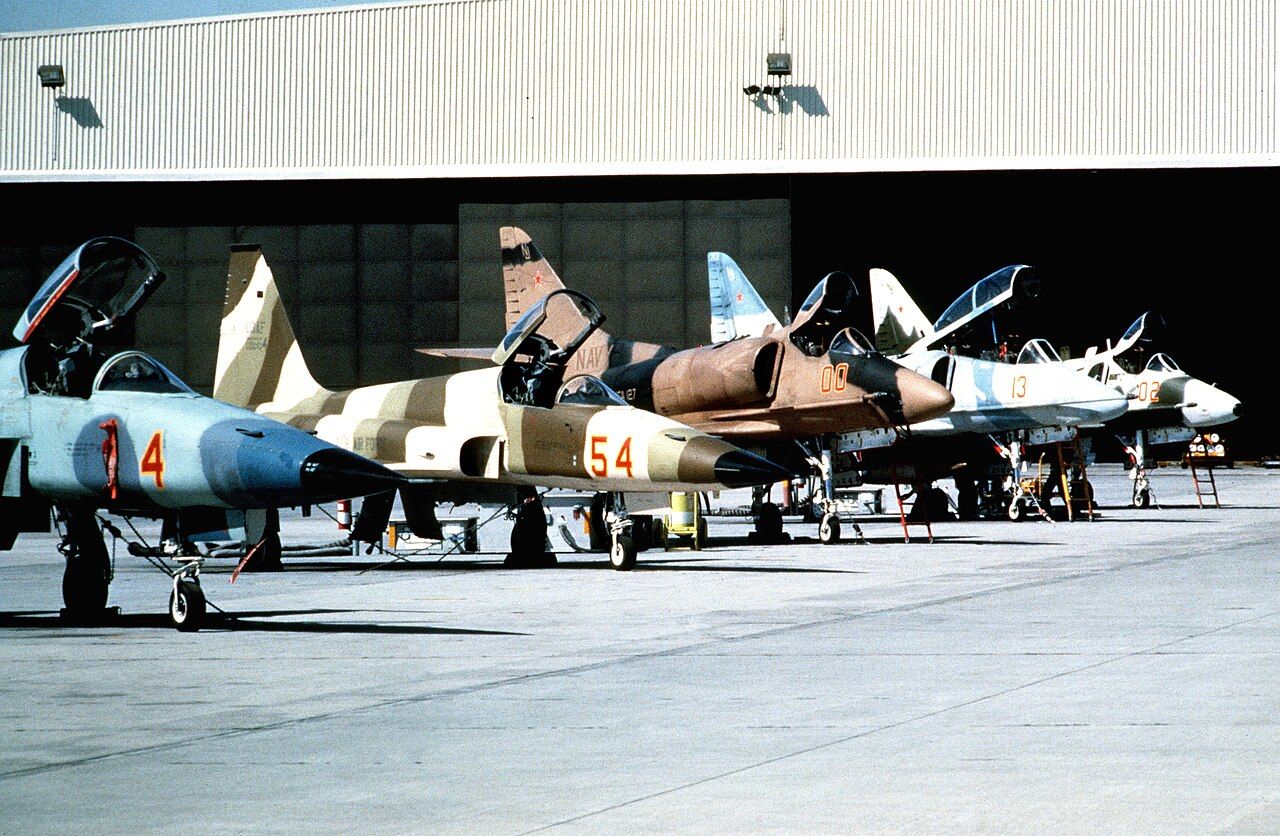
The F-5E never fought for the US Air Force, but it spent its American career playing the enemy. Its size and performance were close to the MiG-21MiG-21 AircraftThe small delta-wing Mach 2 fighter: the most-produced supersonic jet in history.’s, so from 1975 to 1990 the Air Force flew it with aggressor squadronsSquadron GlossaryJoint terms: 1. An organization consisting of two or more divisions of ships, or two or more divisions (Navy) or flights of aircraft. 2. The basic administrative aviation unit of the Army, Navy, Marine Corps, and Air Force. 3… at Nellis in Nevada, in England and in the Philippines, teaching its fighter pilots what a small, agile opponent looked like. [1] In the 1977 AIMVAL/ACEVAL trials at Nellis, F-14sF-14 Tomcat AircraftThe Navy's swing-wing fleet defence fighter: two crew, AWG-9 radar and AIM-54 Phoenix. and F-15sF-15C Eagle AircraftA twin-engine air superiority fighter with more than 104 air-to-air victories and no losses. flew against F-5s carrying the new all-aspect AIM-9L; by one account the bigger fighters were “hopelessly outclassed and demoralized” for the first three weeks. [1]
The US Navy’s Fighter Weapons School, TOPGUN, flew F-5Es as adversaries, and the Marines bought used Air Force F-5s in 1989 for the same job. [1] In the 1990s the Navy moved more adversary flying to the F-5, which cost about a third as much to operate as an F/A-18F/A-18 Hornet AircraftA carrier-capable fighter and attack aircraft that one pilot can switch between roles on the same sortie.. [2] In 2006 it bought 36 low-hour F-5E/Fs from Switzerland and modernised them as F-5Ns, and in 2024 the Marine Corps began collecting 22 more retired Swiss Tigers. One Navy two-seater, nicknamed the “FrankenTiger”, was made by grafting the front of an old F-5F onto the back of a newer Swiss F-5E. [1]
More than 3,800 F-5s and closely related T-38s were built, most of the fighters for American allies. The design also had a famous descendant: a series of Northrop studies that started from the F-5 led to the YF-17 and then the F/A-18 HornetF/A-18 Hornet AircraftA carrier-capable fighter and attack aircraft that one pilot can switch between roles on the same sortie.. [1]
Sources
- Northrop F-5. Wikipedia (secondary source). https://en.wikipedia.org/wiki/Northrop_F-5 (accessed 2026-10-25).
- F-5 Freedom Fighter / Tiger. Federation of American Scientists, Military Analysis Network. https://man.fas.org/dod-101/sys/ac/f-5.htm (accessed 2026-10-25).
Wikipedia articles are secondary sources and can change; they are cited with the date they were read. The Federation of American Scientists (FAS) Military Analysis Network pages largely reproduce US service fact sheets of the late 1990s and early 2000s, so later upgrades are not covered there.