
Drafted — not technically validated
Record revision 1 · The first US Air Force fighter supersonic in level flight; a fighter-bomber and fast FAC in Vietnam.
Real-world aircraft as described in public sources. Figures vary between variants, loads and sources; the data plate names the variant its figures describe, and differences are noted beside the number they affect.
F-100D Super Sabre · North American F-100D
- Variant described
- F-100D [1]
- Role
- Fighter-bomber [1]
- Origin
- United States
- Manufacturer
- North American Aviation [1]
- Crew
- 1 (F-100F: 2) [1]
- First flight
- 25 May 1953 (YF-100A); first F-100D 24 January 1956 [1]
- Entered service
- 27 September 1954 (F-100A); the F-100D on 29 September 1956 [1]
- Status
- Retired: 1979 from the US Air National Guard, 1988 from Taiwan's air force. 2,294 built [1]
- Powerplant
- One Pratt & Whitney J57-P-21/21A afterburningAfterburner GlossaryFlight: An additional combustion area aft of the turbine section of a turbojet, with fuel nozzles and flameholders, that burns fuel in the engine's large excess of air. It adds only 10 to 20 percent to the engine's weight but 40… turbojet, 16,000 lbf with afterburnerAfterburner GlossaryFlight: An additional combustion area aft of the turbine section of a turbojet, with fuel nozzles and flameholders, that burns fuel in the engine's large excess of air. It adds only 10 to 20 percent to the engine's weight but 40… [1]
- Maximum speed
- Mach 1.4, 924 mph (803 kt) [1]
- Service ceiling
- 50,000 ft [1]
- Range
- 1,995 mi (1,734 NM) [1]
- Armament
- Purchase
- DCS WorldDCS: F-100D Super Sabre by Grinnelli DesignsGrinnelli DesignsDCS Store
Store pages checked 2026-10-28. Prices and availability change.
Supersonic, and dangerous
On 25 May 1953 North American’s chief test pilot, George Welch, took the YF-100A up for its first flight, seven months ahead of schedule. Levelling off at 35,000 ft, he opened the throttle and went supersonicSupersonic GlossaryFlight: The regime of flight from about Mach 1.20 to 5.00, with definite supersonic flow on all parts of the aircraft. Above Mach 5.00 is hypersonic., leaving his chase pilot in an F-86DF-86 Sabre AircraftThe swept-wing day fighter that met the MiG-15 over Korea. far behind. The F-100 became the first US Air Force fighter able to fly faster than sound in level flight, and the first of the “Century Series” fighters. [1]
It had begun in 1949 as the “Sabre 45”, a company study for an F-86F-86 Sabre AircraftThe swept-wing day fighter that met the MiG-15 over Korea. with wings swept at 45 degrees, and the Air Force was in such a hurry that it ordered the fighter in quantity before it had flown. [1] The haste showed. The F-100 suffered from yaw instability that could produce inertia coupling: a sudden yaw and roll, too fast for the pilot to correct, that could overstress the airframe until it broke up. On 12 October 1954 Welch himself was killed when an early F-100A came apart during a dive test. After six major accidents in its first weeks of service, the whole fleet was grounded from November 1954 to February 1955. [1] Even when fixed, the F-100 could bite: at low speed the wingtips could lose lift and pitch the nose violently up, a deadly trait near the ground that pilots called the “Sabre dance”. [1]
From day fighter to fighter-bomber
Tactical Air Command wanted a fighter-bomber that could deliver nuclear weapons, which led to the F-100C and then the definitive F-100D, a ground-attack aircraft with fighter capability as a secondary role. The D gained an autopilot and better avionics, a longer wing and a much larger fin, and first flew on 24 January 1956. [1] It entered service with the 405th Fighter Wing at Langley on 29 September 1956. [1] The two-seat F-100F was a supersonicSupersonic GlossaryFlight: The regime of flight from about Mach 1.20 to 5.00, with definite supersonic flow on all parts of the aircraft. Above Mach 5.00 is hypersonic. trainer. [1]
The “Hun”, from “one hundred”, collected firsts. An F-100C set a supersonicSupersonic GlossaryFlight: The regime of flight from about Mach 1.20 to 5.00, with definite supersonic flow on all parts of the aircraft. Above Mach 5.00 is hypersonic. world speed record in 1955; in December 1956 two F-100Ds made the first ever buddy air refuellingAR GlossaryJoint terms: Air refueling. The refueling of an aircraft in flight by another aircraft., one fighter passing fuel to another; and in 1959 two F-100Fs became the first jet fighters to fly over the North Pole. [1] The Thunderbirds flew Super Sabres from 1956 to 1968. [1]
The longest war
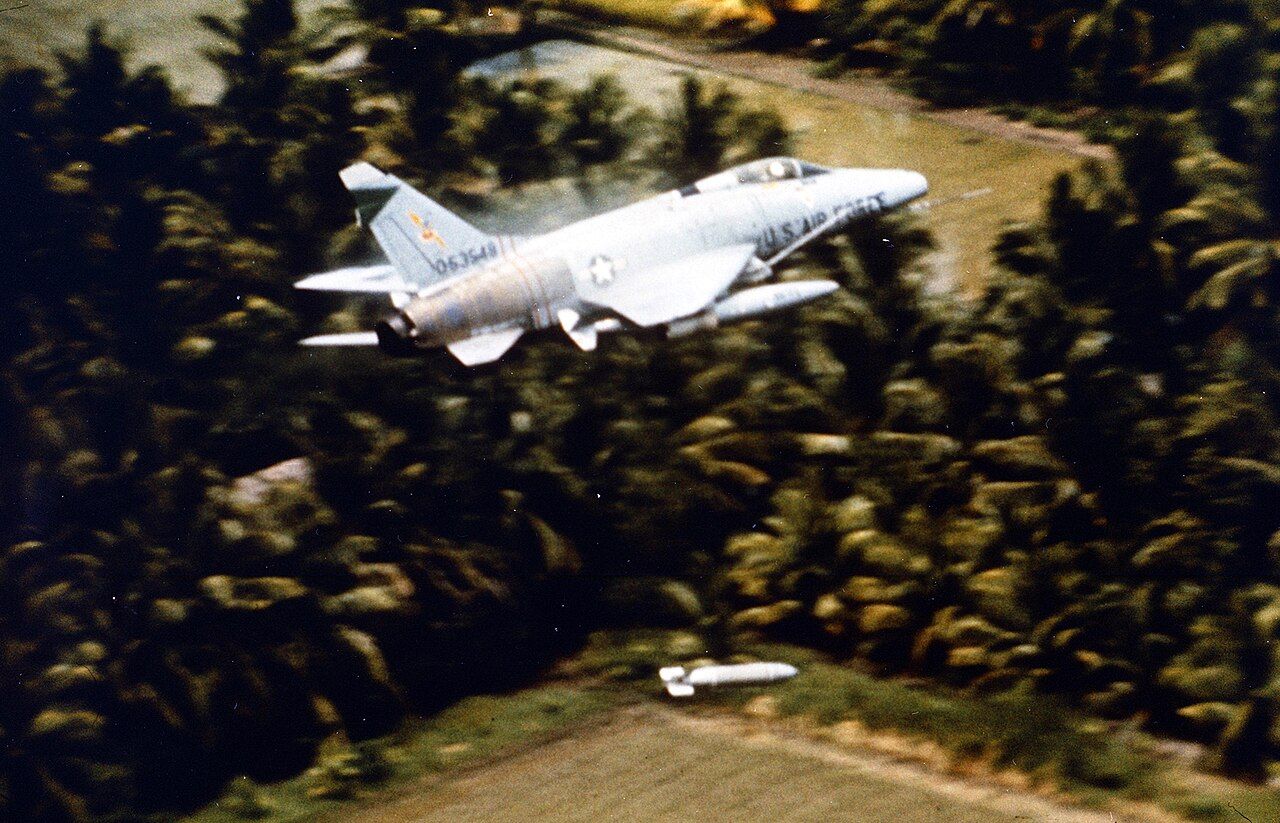
Six F-100s reached Thailand on 16 April 1961, the first US combat jets of the Vietnam War, and the Hun stayed until July 1971, longer than any other US jet fighter-bomber in that war. [1] On 4 April 1965, escorting F-105s against the Thanh Hoa Bridge, Captain Donald Kilgus shot at a MiG-17 with his cannon in the US Air Force’s first jet air combat of the war, recorded as a probable kill. [1] F-100s also flew combat air patrolCAP GlossaryJoint terms: Combat air patrol. An aircraft patrol provided over an objective area, the force protected, the critical area of a combat zone, or in an air defense area, for the purpose of intercepting and destroying hostile aircraft…, forward air control and Wild Weasel missions over North Vietnam before moving to close air supportCAS GlossaryJoint terms: Close air support. Air action by fixed- and rotary-wing aircraft against hostile targets that are in close proximity to friendly forces and that require detailed integration of each air mission with the fire and movement… in the South. [1]
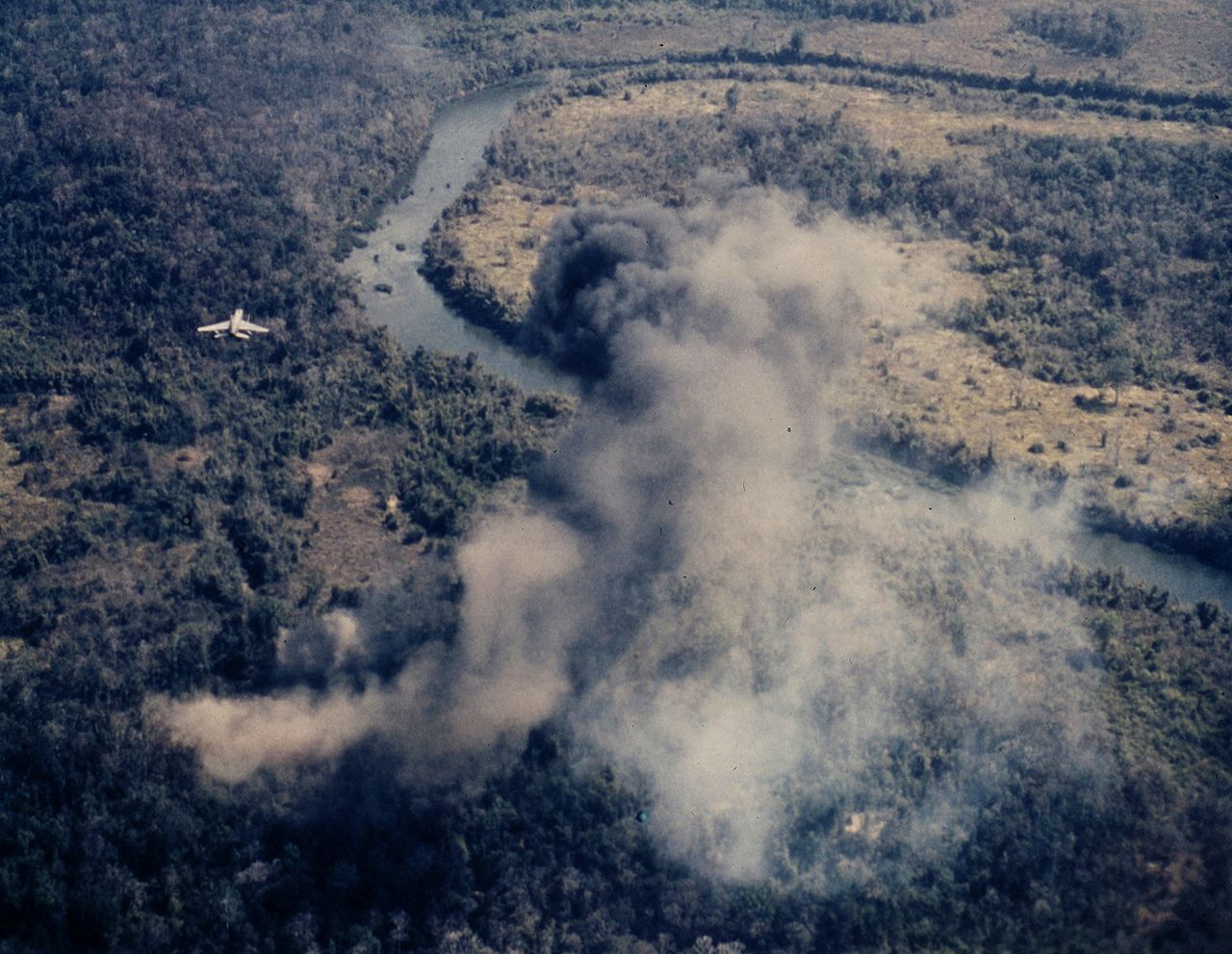
There they worked hardest. Air National Guard squadronsSquadron GlossaryJoint terms: 1. An organization consisting of two or more divisions of ships, or two or more divisions (Navy) or flights of aircraft. 2. The basic administrative aviation unit of the Army, Navy, Marine Corps, and Air Force. 3… sent to Vietnam were among the best: the Air Force commander there later said five of the finest F-100 squadronsSquadron GlossaryJoint terms: 1. An organization consisting of two or more divisions of ships, or two or more divisions (Navy) or flights of aircraft. 2. The basic administrative aviation unit of the Army, Navy, Marine Corps, and Air Force. 3… came from the Guard. [1] Two-seat F-100Fs flew as “Misty” fast forward air controllersFAC GlossaryJoint terms: Forward air controller. An officer (aviator/pilot) member of the tactical air control party who, from a forward ground or airborne position, controls aircraft in close air support of ground troops. over North Vietnam and Laos, spotting targets for other fighter-bombers. [1] By the end the Hun had flown 360,283 combat sortiesSortie GlossaryJoint terms: In air operations, an operational flight by one aircraft.; its four fighter wings flew more combat sortiesSortie GlossaryJoint terms: In air operations, an operational flight by one aircraft. in Vietnam than over 15,000 P-51 MustangsP-51D Mustang AircraftThe long-range escort fighter that took US bombers to Berlin and back; Merlin-powered, with six .50 calibre guns. had flown in the Second World War. 242 F-100s were lost. [1] It remained the Air Force’s main close air supportCAS GlossaryJoint terms: Close air support. Air action by fixed- and rotary-wing aircraft against hostile targets that are in close proximity to friendly forces and that require detailed integration of each air mission with the fire and movement… aircraft over South Vietnam until the A-7 Corsair II, the F-111 and the F-4 PhantomF-4 Phantom II AircraftThe big two-seat Cold War fighter-bomber; the F-4E added an internal gun and slats after Vietnam. took over. [1]

Sources
- North American F-100 Super Sabre. Wikipedia (secondary source). https://en.wikipedia.org/wiki/North_American_F-100_Super_Sabre (accessed 2026-10-25).
Wikipedia articles are secondary sources and can change; they are cited with the date they were read. The Federation of American Scientists (FAS) Military Analysis Network pages largely reproduce US service fact sheets of the late 1990s and early 2000s, so later upgrades are not covered there.