
Drafted — not technically validated
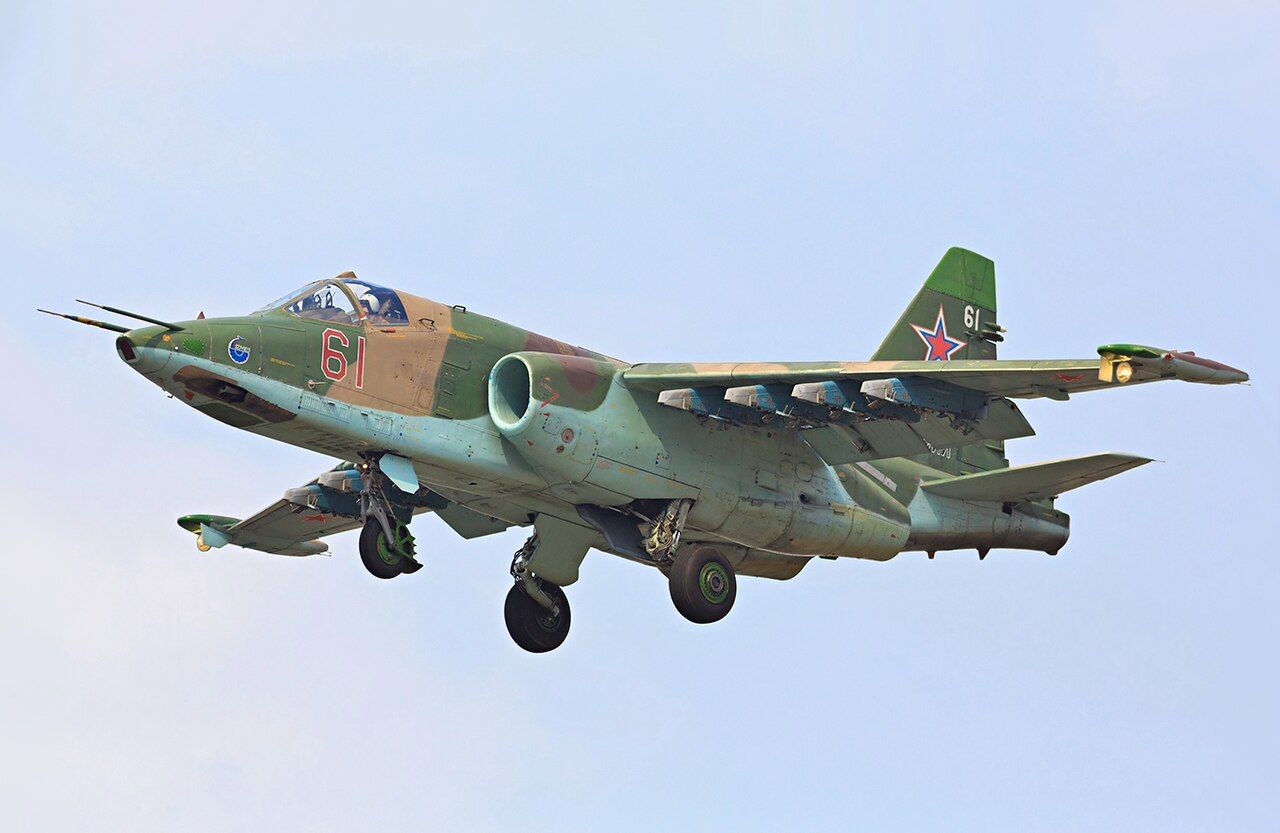
Record revision 1 · An armoured Soviet close air support jet; the Su-25T adds Vikhr anti-tank missiles.
Real-world aircraft as described in public sources. Figures vary between variants, loads and sources; the data plate names the variant its figures describe, and differences are noted beside the number they affect.
Su-25 Frogfoot · Sukhoi Su-25/Su-25T
- Origin
- Soviet Union
- Manufacturer
- Sukhoi [1]
- Crew
- 1 (Su-25UB: 2) [1]
- First flight
- 22 February 1975 [1]
- Entered service
- 19 July 1981 [1]
- Status
- In service; more than 1,000 built [1]
- Powerplant
- Two Soyuz/Tumansky R-195 turbojets, 44.18 kN (9,930 lbf) each [1]
- Maximum speed
- 975 km/h (526 kt) at sea level [1]
- Service ceiling
- 7,000 m (23,000 ft) [1]
- Range
- 1,000 km (540 NM) at altitude; combat radius 750 km (405 NM) at sea level with 4,400 kg of ordnance and two tanks [1]
- Armament
- One 30 mm GSh-30-2 twin-barrel cannon in the lower fuselage, 250 rounds [1] [2]
- Eight underwing pylons for about 4,000 kg of bombs and 57 mm to 330 mm rockets; two outboard pylons for R-60 or R-3 self-defence missiles [2]
- Su-25T: Vikhr laser-guidedLGW GlossaryWeapons: Laser-guided weapon. A weapon that uses a seeker to detect laser energy reflected from a laser marked/designated target and through signal processing provides guidance commands to a control system, which guides the… anti-tank missiles, Kh-29T and Kh-58, R-73 and R-77 [1] [2]
A flying tank for the army
In early 1968 the Soviet Ministry of Defence decided it needed a shturmovik, a specialised armoured assault aircraft, to support troops on the battlefield. The idea came from studying ground-attack aviation from the 1940s to the 1960s. The fighter-bombers of the day, the Su-7, Su-17, MiG-21MiG-21 AircraftThe small delta-wing Mach 2 fighter: the most-produced supersonic jet in history. and MiG-23, were the wrong tools: they had no armour to protect the pilot from ground fire, and they flew too fast for the pilot to keep a target in sight. Pavel Sukhoi’s bureau worked up its T-8 design, beat Ilyushin’s Il-102 in the competition, and flew the first prototype on 22 February 1975. Series production began in 1978 at Tbilisi in Soviet Georgia. [1]
The result was the Su-25 Grach, Russian for “rook”; NATO called it the Frogfoot. [1] It is a subsonicSubsonic GlossaryFlight: The regime of flight below about Mach 0.75, in which the airflow on all parts of the aircraft is most likely subsonic., twin-engined attack jet with a high, moderately swept wing, built to take punishment; US analysts list the A-10 Thunderbolt IIA-10 Thunderbolt II AircraftThe Warthog: a straight-wing, armoured close air support jet built around the 30 mm GAU-8 cannon. among comparable aircraft. [1] [2]
The titanium bathtub
The pilot sits low in a bathtub of welded titanium sheets, with a 6 mm steel plate behind the head. The armour makes the cockpit cramped and the view poor; a periscope on top of the canopy helps the pilot see behind. [1] A twin-barrel 30 mm cannon sits under the cockpit, and ten wing hardpoints carry about 4,000 kg of bombs and rockets, with small outboard pylons for self-defence missiles. [1] [2] The wingtip pods split open as air brakes. [1]
Just as important, the Su-25 was built to keep fighting from primitive bases. Its servicing equipment packs into containers that the aircraft can carry itself, so a squadronSquadron GlossaryJoint terms: 1. An organization consisting of two or more divisions of ships, or two or more divisions (Navy) or flights of aircraft. 2. The basic administrative aviation unit of the Army, Navy, Marine Corps, and Air Force. 3… can move forward and look after its jets without a large ground support train. [2]
Afghanistan
Combat came quickly. On 19 July 1981 the 200th Independent Attack Squadron deployed to Shindand in western Afghanistan, the first Su-25 unit sent there, to strike rebel positions in the mountains. Each aircraft flew an average of 360 sortiesSortie GlossaryJoint terms: In air operations, an operational flight by one aircraft. a year, more than any other combat aircraft in the war, and by 1989 nearly 50 Su-25s based in Afghanistan had flown 60,000 sortiesSortie GlossaryJoint terms: In air operations, an operational flight by one aircraft.. Between 21 and 23 were lost in combat. [1] The lessons learned there shaped the next generation of the aircraft. [2]
The tank hunter
The Su-25T turned the two-seat Su-25UB trainer airframe into a single-seat anti-tank aircraft, with the rear cockpit replaced by fuel and avionics. [2] Its enlarged nose houses the Shkval TV targeting system with a laser rangefinder and designator, and its main anti-tank weapon is the tube-launched, laser-guidedLGW GlossaryWeapons: Laser-guided weapon. A weapon that uses a seeker to detect laser energy reflected from a laser marked/designated target and through signal processing provides guidance commands to a control system, which guides the… Vikhr missile. It gave the aircraft all-weather and night attack capability and was combat-tested with notable success in Chechnya, but only three prototypes and eight production aircraft were built before the programme was cancelled in 2000 in favour of upgrading existing Su-25s. [1] The Su-25TM development, also called the Su-39, added a Kopyo radar pod and reduced the aircraft’s heat signature fourfold. [2]
Wherever there is a ground war
Iraq flew Su-25s in the last year of the Iran–Iraq War, sometimes 15 sortiesSortie GlossaryJoint terms: In air operations, an operational flight by one aircraft. a day per aircraft, and Saddam Hussein awarded all of his Su-25 pilots the country’s highest military decoration. In 1991 most of them never got airborne against Coalition air power, and seven fled to Iran. [1] Since then the Su-25 has fought in Abkhazia, Chechnya, Macedonia, Darfur and Syria, and in 2008 Georgia and Russia flew it against each other, with Russian Su-25s bombing the Tbilisi factory where the type was built. Russia and Ukraine both fly it in the war that began in 2022, and both have lost many. Production ended in Georgia in 2010. [1]
Sources
- Sukhoi Su-25. Wikipedia (secondary source). https://en.wikipedia.org/wiki/Sukhoi_Su-25 (accessed 2026-10-25).
- Su-25 Frogfoot. Federation of American Scientists, Military Analysis Network. https://man.fas.org/dod-101/sys/ac/row/su-25.htm (accessed 2026-10-25).
Wikipedia articles are secondary sources and can change; they are cited with the date they were read. The Federation of American Scientists (FAS) Military Analysis Network pages largely reproduce US service fact sheets of the late 1990s and early 2000s, so later upgrades are not covered there.