
Drafted — not technically validated
Record revision 1 · The Warsaw Pact's standard jet trainer, with armed light-attack versions.
Real-world aircraft as described in public sources. Figures vary between variants, loads and sources; the data plate names the variant its figures describe, and differences are noted beside the number they affect.
L-39 Albatros · Aero L-39C/ZA
- Role
- Military jet trainer and light ground-attack aircraft [1]
- Origin
- Czechoslovakia
- Manufacturer
- Aero Vodochody [1]
- Crew
- 2 [1]
- Entered service
- 28 March 1972 (Czechoslovak Air Force) [1]
- Status
- In service; about 2,900 built [1]
- Powerplant
- One Ivchenko AI-25TL turbofan, 16.87 kN (3,790 lbf) [1]
- Maximum speed
- 750 km/h (405 kt) at 5,000 m [1]
- Service ceiling
- 11,000 m (36,100 ft) [1]
- Range
- 1,100 km (594 NM) on internal fuel; ferry range 1,750 km (945 NM) [1]
- Armament
- Purchase
- DCS WorldDCS: L-39 Albatros by Eagle DynamicsDCS Store
Store pages checked 2026-10-28. Prices and availability change.
The Warsaw Pact’s classroom
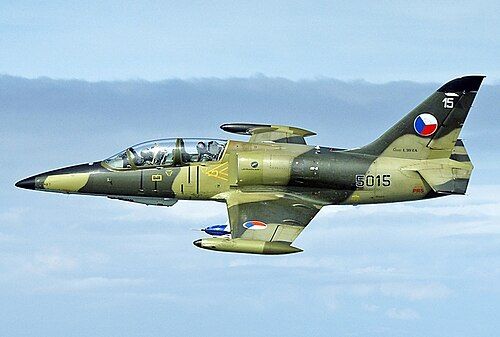
In 1964 Aero Vodochody in Czechoslovakia set out to replace its own L-29 Delfín, one of the early jet trainers, and its design team aimed high: a two-seat, single-engined trainer that every Warsaw Pact air force would use. [1] They got their wish. In 1972 most of the Warsaw Pact countries adopted the L-39 Albatros as their standard trainer, with large orders from the Soviet Air Forces, and thousands were built. [1] [2] It was the first trainer in the world to be powered by a turbofan. [1] Curiously, although it came from behind the Iron Curtain, it never received a NATO reporting name. [1]
Easy to fly, hard to break
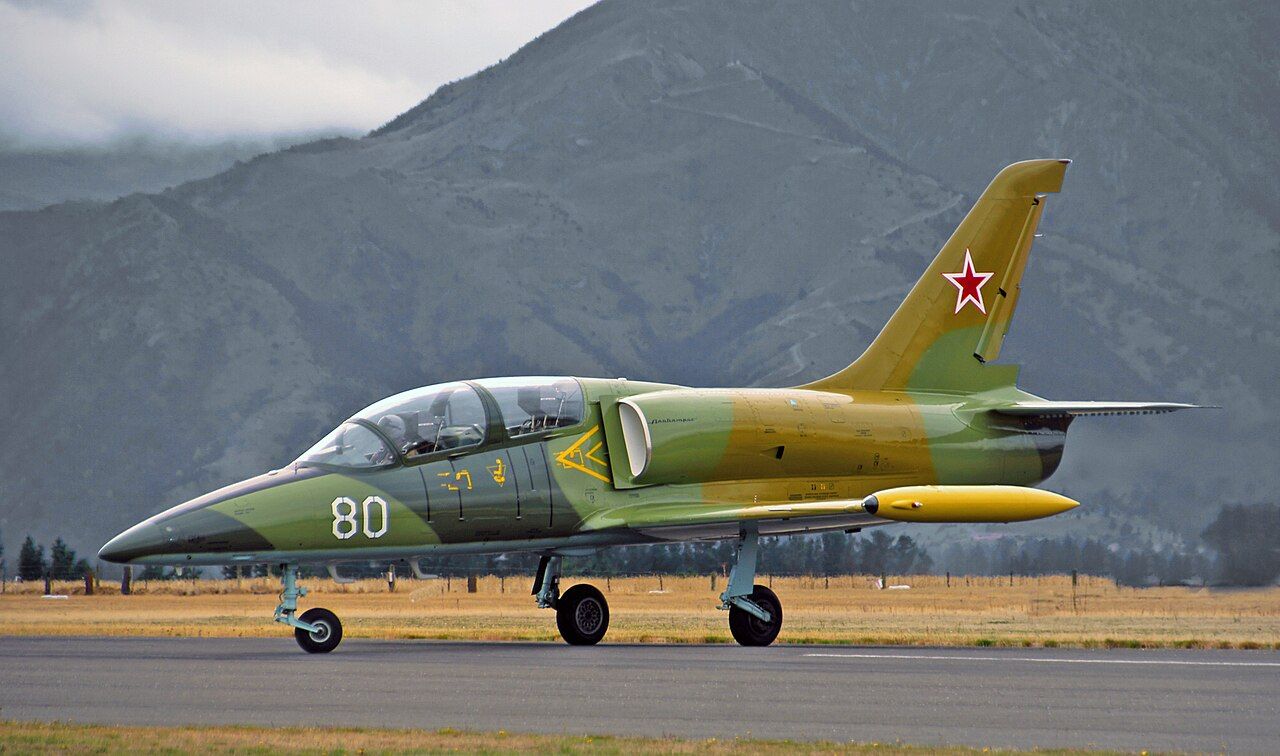
Everything about the L-39 was meant to be simple, cheap to maintain and forgiving of inexperienced crews. Its rugged landing gear and low landing speed let it fly from rough strips, grass and even frozen lakes, and its quick throttle response made it easy for students who had never flown a jet. [1] The straight wing carries fixed fuel tanks on its tips, and a single Ivchenko AI-25TL turbofan in the rear fuselage breathes through intakes on the shoulders behind the cockpit. [1] Student and instructor sit in tandem under separate canopies, the instructor’s seat slightly raised. The cockpit deliberately mirrors Soviet combat aircraft; even the ejection procedure is the same as in the MiG-29MiG-29 Fulcrum AircraftA twin-engine Soviet fighter with a helmet sight and R-73 missiles, built to counter the F-15 and F-16.. [1]
Armed versions came soon. The L-39ZO, first flown in 1975, has four underwing hardpoints and a reinforced wing, and the L-39ZA, the light-attack version, adds a GSh-23 cannon under the fuselage. [1] [2]
Small wars
Because so many air forces had them, L-39s turned up in conflicts across the former Soviet Union and the Middle East. Azerbaijan used them for ground attack in the First Nagorno-Karabakh War, Abkhaz separatists flew them against Georgia, and the Taliban flew a handful against the Northern Alliance. [1] In 1983 Brazilian officials searching Libyan transport aircraft that had diverted to Manaus, declared as carrying medical supplies, found the first of 17 L-39s bound for Nicaragua. [1] In Syria’s civil war, armed L-39ZAs became favourite ground-attack aircraft because they were slower and more agile than anything else in the inventory; on 3 March 2020 a Turkish F-16F-16 Fighting Falcon AircraftA single-engine multirole fighter: fly-by-wire, 9 g, and the US Air Force's main strike and SEAD aircraft. shot one down over Idlib. [1] In Ukraine, an L-39 was shot down by a Russian aircraft in the first hours of the 2022 invasion. [1]
Afterlife
By the end of the century more than 2,800 L-39s had served with over 30 air forces, and production ended in 1996. [1] The design lived on in the L-159 light combat aircraft, in production from 1997, and in the modernised L-39NG Skyfox. [1] [2] Hundreds of retired Albatroses now fly in private hands, especially in the United States, and the Reno Air Races created a jet class for them in 2002. [1]

Sources
- Aero L-39 Albatros. Wikipedia (secondary source). https://en.wikipedia.org/wiki/Aero_L-39_Albatros (accessed 2026-10-25).
- L-39 Albatros. Federation of American Scientists, Military Analysis Network. https://man.fas.org/dod-101/sys/ac/row/l-39.htm (accessed 2026-10-25).
Wikipedia articles are secondary sources and can change; they are cited with the date they were read. The Federation of American Scientists (FAS) Military Analysis Network pages largely reproduce US service fact sheets of the late 1990s and early 2000s, so later upgrades are not covered there.