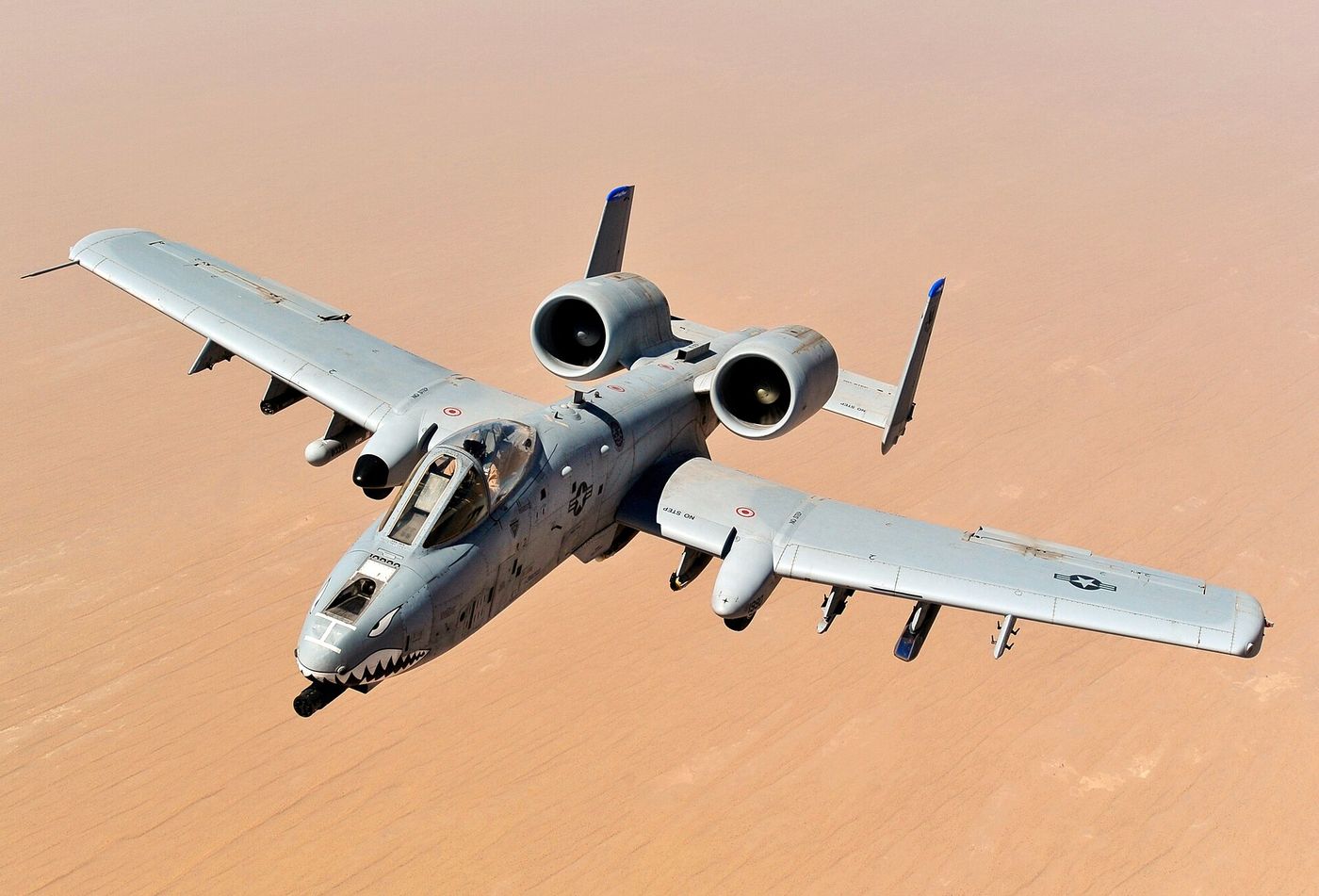

Drafted — not technically validated
Record revision 1 · The Warthog: a straight-wing, armoured close air support jet built around the 30 mm GAU-8 cannon.
Real-world aircraft as described in public sources. Figures vary between variants, loads and sources; the data plate names the variant its figures describe, and differences are noted beside the number they affect.
A-10C Thunderbolt II · Fairchild Republic A-10A/C
- Origin
- United States
- Crew
- 1 [1]
- First flight
- 10 May 1972 [1]
- Entered service
- October 1977 [1]
- Status
- In service with the US Air Force; 716 built [1]
- Maximum speed
- 381 kt at sea level, clean; never exceed 450 kt at 5,000 ft with 18 Mk 82 bombs [1]; the FAS sheet gives 420 mph (Mach 0.56) [2]
- Armament
- One 30 mm GAU-8/A Avenger seven-barrel rotary cannon, 1,174 rounds [1] [2]
- Up to 16,000 lb on eight underwing and three underfuselage stations [1] [2]
- AGM-65 Maverick, laser-guidedLGW GlossaryWeapons: Laser-guided weapon. A weapon that uses a seeker to detect laser energy reflected from a laser marked/designated target and through signal processing provides guidance commands to a control system, which guides the… and general-purpose bombs, cluster munitions, 2.75 in rockets, illumination flares, AIM-9 Sidewinder for self-defence [2]
- Sensors and avionics
A gun with an aeroplane around it
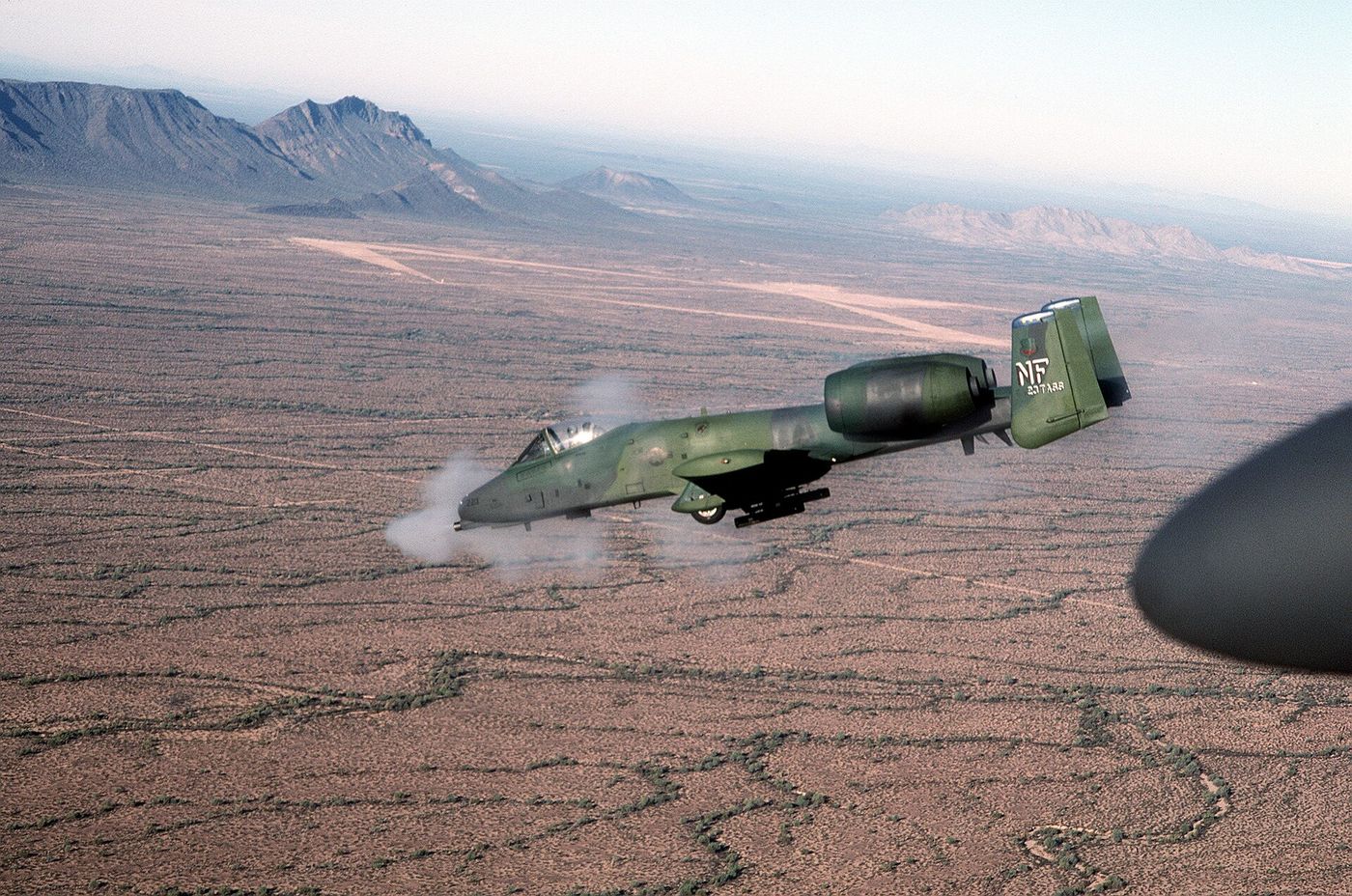
Most aircraft are designed first and armed afterwards. The A-10 was the other way round. When the US Air Force asked for a new close air supportCAS GlossaryJoint terms: Close air support. Air action by fixed- and rotary-wing aircraft against hostile targets that are in close proximity to friendly forces and that require detailed integration of each air mission with the fire and movement… aircraft in 1970, it required that the aircraft be designed specifically around a 30 mm rotary cannon, and it ran a separate competition for the gun itself. [1] The result, General Electric’s GAU-8/A AvengerGAU-8 Avenger OrdnanceThe A-10’s seven-barrel cannon: rotary operation, ammunition, aircraft integration and the meaning of its published firing figures., is one of the most powerful aircraft cannons ever flown: a hydraulically driven seven-barrel gun firing about 3,900 rounds a minute. It takes half a second to spin up, and the drum behind it is nearly six feet long. The fuselage was laid out around it, with the gun set slightly to the left so that the firing barrel lines up with the aircraft’s centreline. [1]
Why the Air Force needed it
After the Second World War, American attack aircraft design stalled while designers chased fast jets built to deliver nuclear weapons. In Vietnam the Air Force’s main ground-attack aircraft was still the propeller-driven A-1 Skyraider, a Korean War design that was now slow, vulnerable to ground fire and short of firepower; the Air Force and Navy lost some 266 of them in action, largely to small-arms fire. [1] The Army’s growing fleet of attack helicopters added urgency, because they looked set to take the close support mission from the Air Force. In 1966 the Air Force’s chief of staff ordered a specialised, inexpensive close air supportCAS GlossaryJoint terms: Close air support. Air action by fixed- and rotary-wing aircraft against hostile targets that are in close proximity to friendly forces and that require detailed integration of each air mission with the fire and movement… aircraft. [1]
Fairchild Republic’s YA-10 first flew on 10 May 1972, beat Northrop’s YA-9 in a fly-off, and was chosen for production on 18 January 1973. It then had to win a second fly-off, against the A-7D Corsair II, to prove a new attack aircraft was needed at all. [1] It is the only production aircraft designed solely for close air supportCAS GlossaryJoint terms: Close air support. Air action by fixed- and rotary-wing aircraft against hostile targets that are in close proximity to friendly forces and that require detailed integration of each air mission with the fire and movement… to have served with the US Air Force. [1]
Built to be hit
The A-10 expects to be shot at. The pilot sits in a “bathtub” of titanium armour weighing about 1,200 lb, tested against 23 mm cannon shells, and the aircraft has two separate hydraulic systems plus a mechanical backup. It is designed to keep flying with one engine, half of the tail, one elevator and half of a wing missing. [1] On 7 April 2003, over Baghdad, Captain Kim Campbell’s A-10 was badly hit by anti-aircraft fire that damaged an engine and crippled the hydraulics. Campbell flew it home in manual reversion, using the mechanical backup controls, for nearly an hour and landed safely. [1]
Everything else serves the same idea. The engines sit high on the rear fuselage, away from debris on rough strips, and the ground crew can rearm the aircraft with the engines running. The straight wing gives it agility at low level, long loiter time and short take-offs, at the price of a top speed below 400 kt. [1] Some A-10s even carry a false canopy painted on their undersides, to confuse an enemy about which way the aircraft is turning. [1]
The Warthog
It was named Thunderbolt II after the P-47P-47D Thunderbolt AircraftThe heaviest single-engined fighter of the war: eight .50 calibre guns, a turbosupercharged radial, and a fearsome fighter-bomber. of the Second World War, but its crews called it the Warthog, and the name stuck. It is the last of a line of Republic “hogs”: the F-84 Thunderjet was the Hog, the F-84F the Superhog and the F-105 the Ultra Hog. [1]
Night eyes and smart weapons
The original A-10A had no radar and very few sensors. In Desert Storm its pilots flew at night by watching the infrared picture from the seeker of a MaverickAGM-65 Maverick OrdnanceThe West's most widely produced precision-guided missile: TV, infrared or laser seekers, launched and left. missile on the wing, a “poor man’s FLIR”. [1] The A-10C upgrade brought precision-guidedPGM GlossaryWeapons: Precision-guided munition. A guided weapon intended to destroy a point target and minimize collateral damage. Also called a smart weapon or smart munition. weapons and targeting pods such as Litening and Sniper. [1] A typical load mixes Mavericks, guided or unguided bombs, cluster munitions and rockets, with a pair of SidewindersAIM-9 Sidewinder OrdnanceThe heat-seeking dogfight missile of the US Navy since 1956, copied by the Soviets and still in production as the AIM-9X. for self-defence. [2]
In combat
The A-10 first went to war in the 1991 Gulf War, when 132 were deployed. Captain Robert Swain scored its first air-to-air victory on 6 February 1991, shooting down an Iraqi helicopter with the gun. Losses to missiles and gunfire were heavy enough that from mid-February the A-10s were kept close to the Saudi border. [1] It has since fought over Bosnia and Kosovo, in Afghanistan and Iraq, against the Islamic State, over Libya and, in 2026, against Iran. [1]
Its future has been argued over for decades. The Air Force has repeatedly tried to retire it in favour of multirole aircraft, and Congress has repeatedly stopped it; the current plan is to retire the fleet by about 2028 or 2029. [1] A saying attached to the aircraft sums up its reputation: “Go Ugly Early”, meaning call in the A-10 early when troops are fighting on the ground. [1]

Sources
- Fairchild Republic A-10 Thunderbolt II. Wikipedia (secondary source). https://en.wikipedia.org/wiki/Fairchild_Republic_A-10_Thunderbolt_II (accessed 2026-10-25).
- A-10/OA-10 Thunderbolt II. Federation of American Scientists, Military Analysis Network. https://man.fas.org/dod-101/sys/ac/a-10.htm (accessed 2026-10-25).
Wikipedia articles are secondary sources and can change; they are cited with the date they were read. The Federation of American Scientists (FAS) Military Analysis Network pages largely reproduce US service fact sheets of the late 1990s and early 2000s, so later upgrades are not covered there.