
Drafted — not technically validated
Record revision 1 · The Navy's swing-wing fleet defence fighter: two crew, AWG-9 radar and AIM-54 Phoenix.
Real-world aircraft as described in public sources. Figures vary between variants, loads and sources; the data plate names the variant its figures describe, and differences are noted beside the number they affect.
F-14 Tomcat · Grumman F-14A/B
- Variant described
- F-14A and F-14B; performance figures are for F110-engined aircraft (F-14B/D) unless marked [1] [2]
- Origin
- United States
- Manufacturer
- Grumman [1]
- First flight
- 21 December 1970 [1]
- Entered service
- 22 September 1974; first deployed aboard USS Enterprise [1]
- Status
- Retired by the US Navy on 22 September 2006; in service with Iran; 712 built [1]
- Powerplant
- F-14A: two Pratt & Whitney TF30-P-414A afterburningAfterburner GlossaryFlight: An additional combustion area aft of the turbine section of a turbojet, with fuel nozzles and flameholders, that burns fuel in the engine's large excess of air. It adds only 10 to 20 percent to the engine's weight but 40… turbofans, 20,900 lb each; F-14B/D: two General Electric F110-GE-400, 27,000 lb each [2]
- Maximum speed
- Mach 2.34 (1,544 mph, 1,342 kt) at 40,000 ft [1]; the Navy fact sheet reproduced by FAS gives Mach 1.88 [2]
- Range
- Mission radius 500 NM hi-med-hi or 380 NM hi-lo-lo-hi on a strike [2]; 503 NM as a fighter escort [1]
- Armament
- One 20 mm M61A1 Vulcan cannon, 675 rounds [1]
- Up to six AIM-54 Phoenix, six AIM-7 Sparrow and four AIM-9 Sidewinder, in combinations [2]
- Bombs including Mk 80-series and GBU-10, -12, -16 and -24 laser-guidedLGW GlossaryWeapons: Laser-guided weapon. A weapon that uses a seeker to detect laser energy reflected from a laser marked/designated target and through signal processing provides guidance commands to a control system, which guides the… bombs, up to 13,000 lb [2]
- Sensors and avionics
- Purchase
- DCS WorldDCS: F-14 Tomcat (F-14A and F-14B) by Heatblur SimulationsHeatblur StoreDCS Store
- DCS WorldDCS: F-14B(U), an upgrade that needs the F-14 module by Heatblur SimulationsHeatblur StoreDCS Store
- Microsoft Flight SimulatorF-14 Tomcat by Heatblur Simulations and IndiaFoxtEchoHeatblur Store
Store pages checked 2026-10-28. Prices and availability change.
Guarding the fleet
From the late 1950s the US Navy had a nightmare: Soviet jet bombers and submarines firing long-range anti-ship missiles at its carrier battle groups from beyond the reach of their fighters. It wanted a fleet air defenceAir defense GlossaryJoint terms: Defensive measures designed to destroy attacking enemy aircraft or missiles in the atmosphere, or to nullify or reduce the effectiveness of such attack. fighter with a bigger radar and longer-range missiles than the F-4 PhantomF-4 Phantom II AircraftThe big two-seat Cold War fighter-bomber; the F-4E added an internal gun and slats after Vietnam., able to shoot down both the bombers and their missiles far out from the carrier. [1]
The first answer was forced on the Navy. Defense Secretary Robert McNamara wanted the Navy and Air Force to share one aircraft, and the result, the F-111B, was heavy and underpowered. Vice Admiral Thomas Connolly flew an F-111, found it struggled to go supersonicSupersonic GlossaryFlight: The regime of flight from about Mach 1.20 to 5.00, with definite supersonic flow on all parts of the aircraft. Above Mach 5.00 is hypersonic. and was poor at carrier landings, and told Congress so, against the Navy’s official line. In May 1968 Congress stopped funding the F-111B. [1] The new fighter’s nickname, “Tom’s Cat”, honoured Connolly, and as the Tomcat it joined Grumman’s long line of feline fighters, from the Wildcat and Hellcat of the Second World War to the Panther and Cougar jets. [1]
Swing wings and Phoenix missiles
Grumman won the contract in January 1969, and to save time and avoid cancellation the Navy skipped prototypes and went straight to full-scale development. The F-14 first flew on 21 December 1970, just 22 months later. [1] It was the largest and heaviest US fighter ever to fly from a carrier, because it had to carry the huge AWG-9 radar and the AIM-54 PhoenixAIM-54 Phoenix OrdnanceThe F-14 Tomcat's long-range fleet-defence missile: up to six fired at once, each guided to a different target. missile. [1]
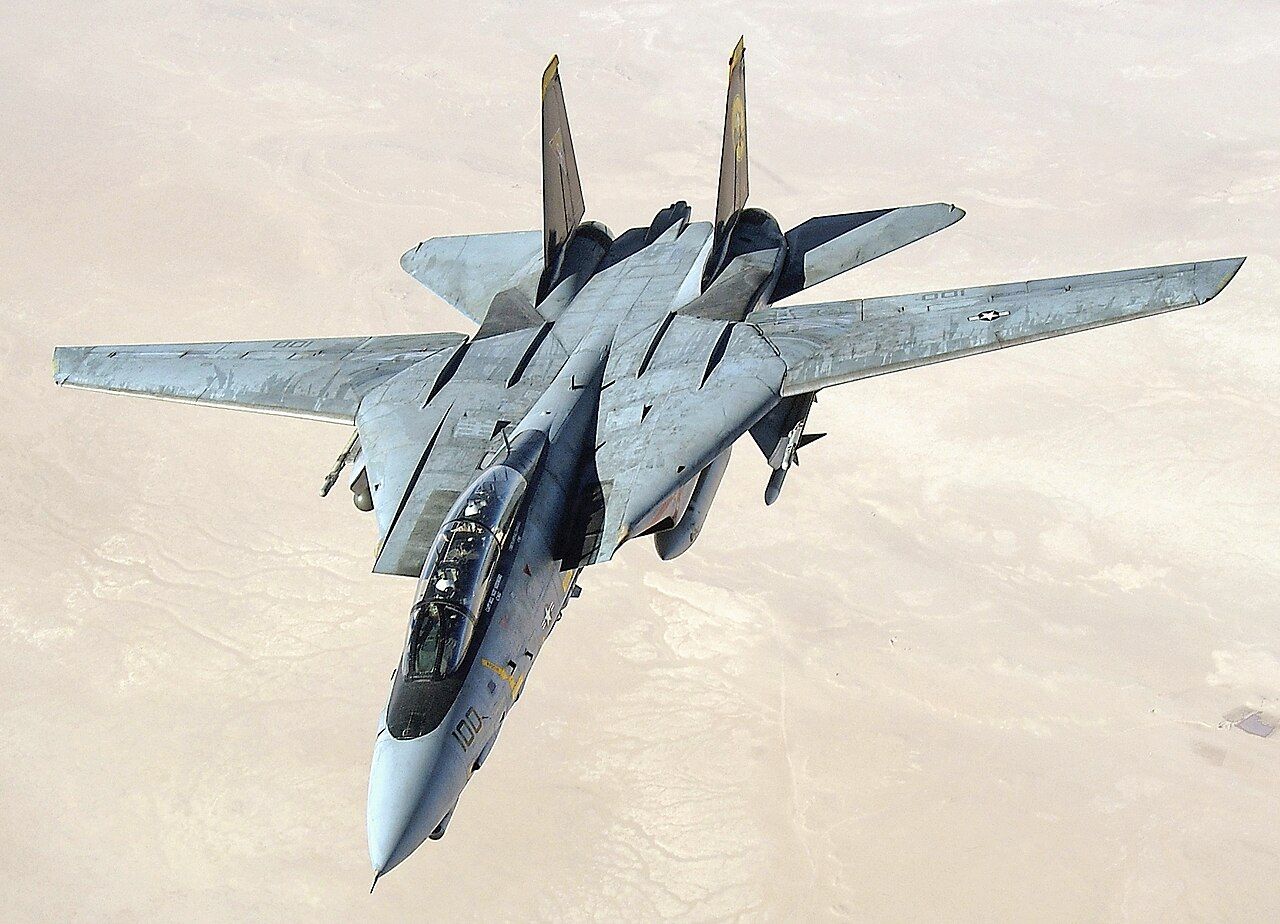
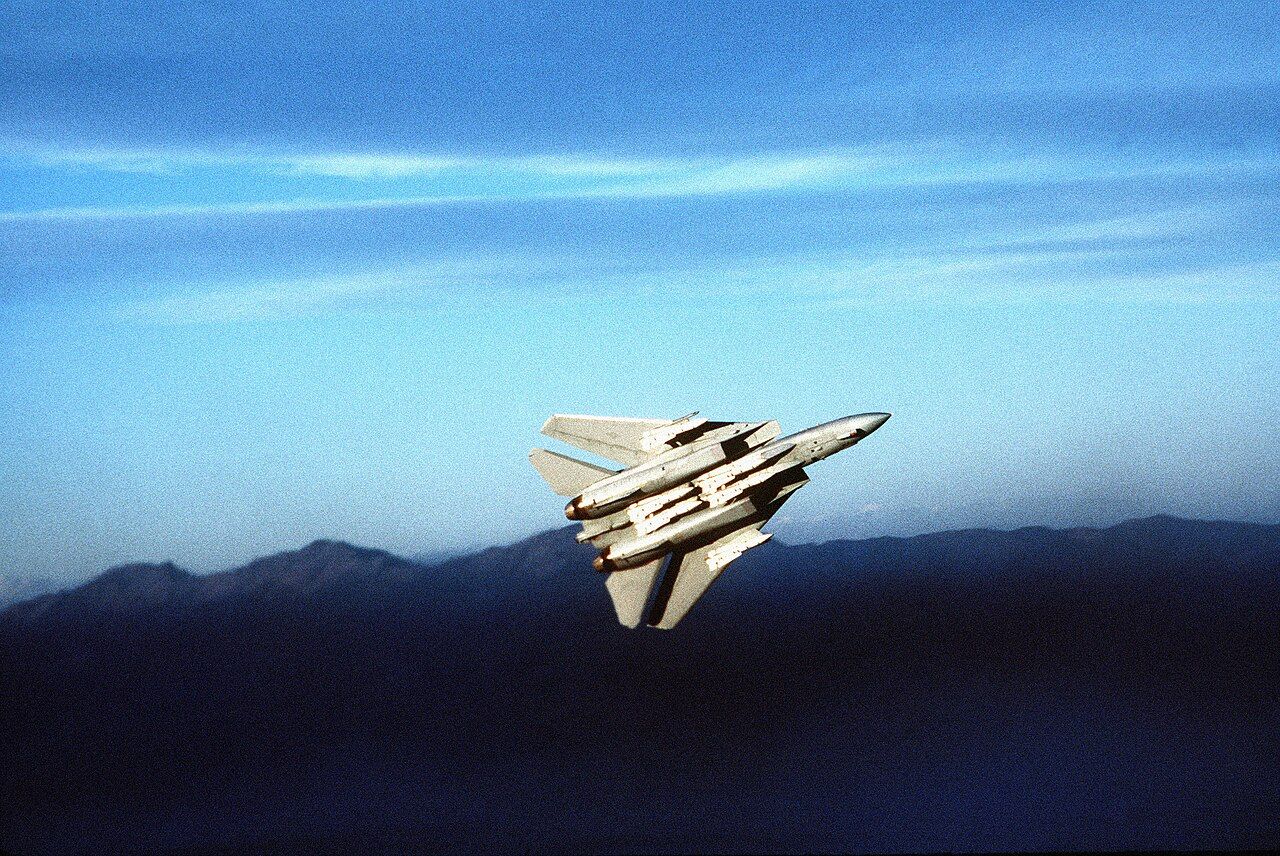
Its variable-sweep wings are the answer to the carrier fighter’s oldest problem. Spread to 64 ft, they let the Tomcat approach the carrier at about 125 kt; swept back to 38 ft, they let it dash. [2] The pilot sits in front, and the radar intercept officer (RIO) behind runs the radar and the missiles. [1] [2] In tests in 1973 a Phoenix hit a target 110 nautical miles away, and six were fired within 38 seconds at six targets, scoring four direct hits. [1] In practice no Tomcat ever deployed with six Phoenixes: there was no threat that called for it, and the load was too heavy to land back aboard the carrier if the missiles were not fired. A typical Cold War load was two Phoenixes, three SparrowsAIM-7 Sparrow OrdnanceThe West's main radar-guided missile from the late 1950s to the 1990s, which homes on radar energy the fighter reflects off its target. and two SidewindersAIM-9 Sidewinder OrdnanceThe heat-seeking dogfight missile of the US Navy since 1956, copied by the Soviets and still in production as the AIM-9X., plus the internal M61M61 Vulcan OrdnanceThe six-barrel 20 mm Gatling gun that has armed US fighters of every service since 1959. gun. [1]
The F-14A’s TF30 engines were its weak point. From the late 1980s the F-14B and F-14D replaced them with the much more powerful General Electric F110. [1] [2]
Over the Gulf of Sidra
Tomcats replaced PhantomsF-4 Phantom II AircraftThe big two-seat Cold War fighter-bomber; the F-4E added an internal gun and slats after Vietnam. in the fleet from September 1974 and flew cover for the evacuation of Saigon. [1] Their first kills came on 19 August 1981, when two F-14s of VF-41 “Black Aces” were fired on by two Libyan Su-22s over the Gulf of Sidra, evaded the missile and shot both down with Sidewinders. On 4 January 1989, in the same waters, two F-14s of VF-32 shot down two Libyan MiG-23s. [1]
In the 1990s the Tomcat learned to bomb. With the LANTIRN pod, which the RIO used to guide laser-guidedLGW GlossaryWeapons: Laser-guided weapon. A weapon that uses a seeker to detect laser energy reflected from a laser marked/designated target and through signal processing provides guidance commands to a control system, which guides the… bombs, the “Bombcat” flew precision strikes until the end of its career. [1] The 1986 film Top Gun made it famous far beyond the Navy; the film so boosted interest in naval aviation that the Navy set up recruiting desks outside some cinemas. [1]
The Tomcat’s official farewell came on 22 September 2006 at NAS Oceana, flown in a backup aircraft after the primary jet developed a fault. The Super Hornet took over its missions. [1] The retired Tomcats were later shredded so that their parts could not reach the only other country that flew them. [1]
Iran’s Tomcats
That country was Iran. The Shah wanted a fighter that could catch Soviet MiG-25 reconnaissanceReconnaissance GlossaryJoint terms: A mission undertaken to obtain, by visual observation or other detection methods, information about the activities and resources of an enemy or adversary, or to secure data concerning the meteorological, hydrographic, or… flights, and in 1974 Iran ordered 80 Tomcats and 714 Phoenix missiles; the first arrived in January 1976. [1] After the 1979 revolution Iran’s air force flew them through the Iran–Iraq War, and Iran claimed its F-14s shot down at least 160 Iraqi aircraft, 55 of them confirmed, for the loss of 16 Tomcats. [1] Cut off from American spares, Iran kept a few flying for decades; several of the survivors were destroyed on the ground in Israeli air strikes in 2025 and 2026. [1]

Sources
- Grumman F-14 Tomcat. Wikipedia (secondary source). https://en.wikipedia.org/wiki/Grumman_F-14_Tomcat (accessed 2026-10-25).
- F-14 Tomcat. Federation of American Scientists, Military Analysis Network. https://man.fas.org/dod-101/sys/ac/f-14.htm (accessed 2026-10-25).
Wikipedia articles are secondary sources and can change; they are cited with the date they were read. The Federation of American Scientists (FAS) Military Analysis Network pages largely reproduce US service fact sheets of the late 1990s and early 2000s, so later upgrades are not covered there.