
Drafted — not technically validated
Record revision 1 · The Soviet swept-wing jet fighter that shocked UN air forces over Korea, armed with 37 mm and 23 mm cannon.
Real-world aircraft as described in public sources. Figures vary between variants, loads and sources; the data plate names the variant its figures describe, and differences are noted beside the number they affect.
MiG-15bis · Mikoyan-Gurevich MiG-15bis
- Origin
- Soviet Union
- Manufacturer
- Mikoyan-Gurevich; licence-built in China, Czechoslovakia and Poland [1]
- Crew
- 1 [1]
- Status
- In limited service with North Korea; 13,130 built in the USSR and at least 4,180 under licence [1]
- Powerplant
- One Klimov VK-1 centrifugal-flow turbojet, 5,950 lbf [1]; about 1,000 lb more than the RD-45 of the first MiG-15 [2]
- Maximum speed
- 1,076 km/h (581 kt), Mach 0.87, at sea level [1]
- Service ceiling
- 15,500 m (50,900 ft) [1]
- Range
- Ferry range 2,520 km (1,361 NM) at 12,000 m with two 600 L drop tanks [1]
- Armament
- Purchase
- DCS WorldDCS: MiG-15bis by BelsimtekDCS Store
- DCS WorldMiG-15bis Flaming Cliffs by Eagle DynamicsDCS Store
- Microsoft Flight SimulatorMiG-15 Bis by Bear StudiosJust Flight
Store pages checked 2026-10-28. Prices and availability change.
“What fool will sell us his secrets?”
In 1946 Soviet jet engines lagged far behind the West’s. The aviation minister Mikhail Khrunichev and the designer Alexander Yakovlev suggested that the USSR simply buy Britain’s reliable Rolls-Royce Nene and copy it. Stalin is said to have replied, “What fool will sell us his secrets?” He agreed to try anyway, and to his amazement the British Labour government and its trade minister, Sir Stafford Cripps, were perfectly willing to sell sample engines, blueprints and a licence. Adapted and mass-produced as the Klimov RD-45, the Nene became the heart of the MiG-15. [1]
A bomber killer with swept wings
The Mikoyan-Gurevich bureau was ordered to build a high-altitude day interceptor to defend against bombers. Its team had studied captured German swept-wing research, and the design that emerged had a mid-mounted wing and tail swept at 35 degrees, a nose intake and a tailplane set high on the fin. Western analysts saw a resemblance to Kurt Tank’s unbuilt Focke-Wulf Ta 183, though the two differ in structure and proportions. The prototype, the I-310, first flew on 30 December 1947, about two months after the American F-86 SabreF-86 Sabre AircraftThe swept-wing day fighter that met the MiG-15 over Korea., and reached 1,042 km/h at 3,000 m. [1]
Its guns were chosen to destroy B-29s. War experience had shown that four-engined bombers needed guns larger than 20 mm, [2] so the MiG carried a 37 mm cannon with 40 rounds and two 23 mm cannon with 80 rounds each. They hit hard but fired slowly, and the two calibres flew on such different trajectories that some UN pilots in Korea saw 23 mm shells pass over them while the 37 mm rounds went underneath. The whole gun pack winched down out of the nose, so ground crews could quickly swap in a loaded one. Early production jets tended to roll one way or the other because of manufacturing variations, and ground crews corrected each one by adjusting small trim tabs nicknamed nozhi, “knives”. [1]
The improved MiG-15bis entered service in early 1950 with the VK-1, a Nene development with better metallurgy and about 1,000 lb more thrust, and with hydraulically boosted ailerons. [1] [2]
MiG Alley
The MiG-15 first fought over China, where Soviet pilots defended Shanghai against Nationalist bombers in the spring of 1950. On 1 November 1950 Soviet-flown MiGs with red-painted noses and North Korean markings joined the Korean War, and by Soviet records that same day saw the first jet-against-jet combat, when an F-80 Shooting Star was shot down. [1] American accounts date the first all-jet dogfight to 8 November, when Lt. Russell Brown in an F-80 claimed a MiG-15. [2] It was soon clear that the MiG outclassed every straight-winged jet the UN had, and three squadronsSquadron GlossaryJoint terms: 1. An organization consisting of two or more divisions of ships, or two or more divisions (Navy) or flights of aircraft. 2. The basic administrative aviation unit of the Army, Navy, Marine Corps, and Air Force. 3… of F-86F-86 Sabre AircraftThe swept-wing day fighter that met the MiG-15 over Korea. Sabres were rushed to Korea in December. [1] Britain’s Chief of the Air Staff, Sir John Slessor, warned that the MiG was “faster than anything we are building today”, and already in mass production. [1]
Moscow denied for decades that its pilots fought in Korea. They flew in Korean or Chinese markings, wore North Korean uniforms or civilian clothes, and were given cards of Korean flying words spelled out in Cyrillic, but in the heat of a dogfight they often slipped back into Russian. Forbidden to fly over the sea or south of a line from Wonsan to Pyongyang, they waited high above the Chinese side of the Yalu and dived on UN aircraft entering the north-west corner of North Korea, the area pilots called “MiG Alley”. [1]
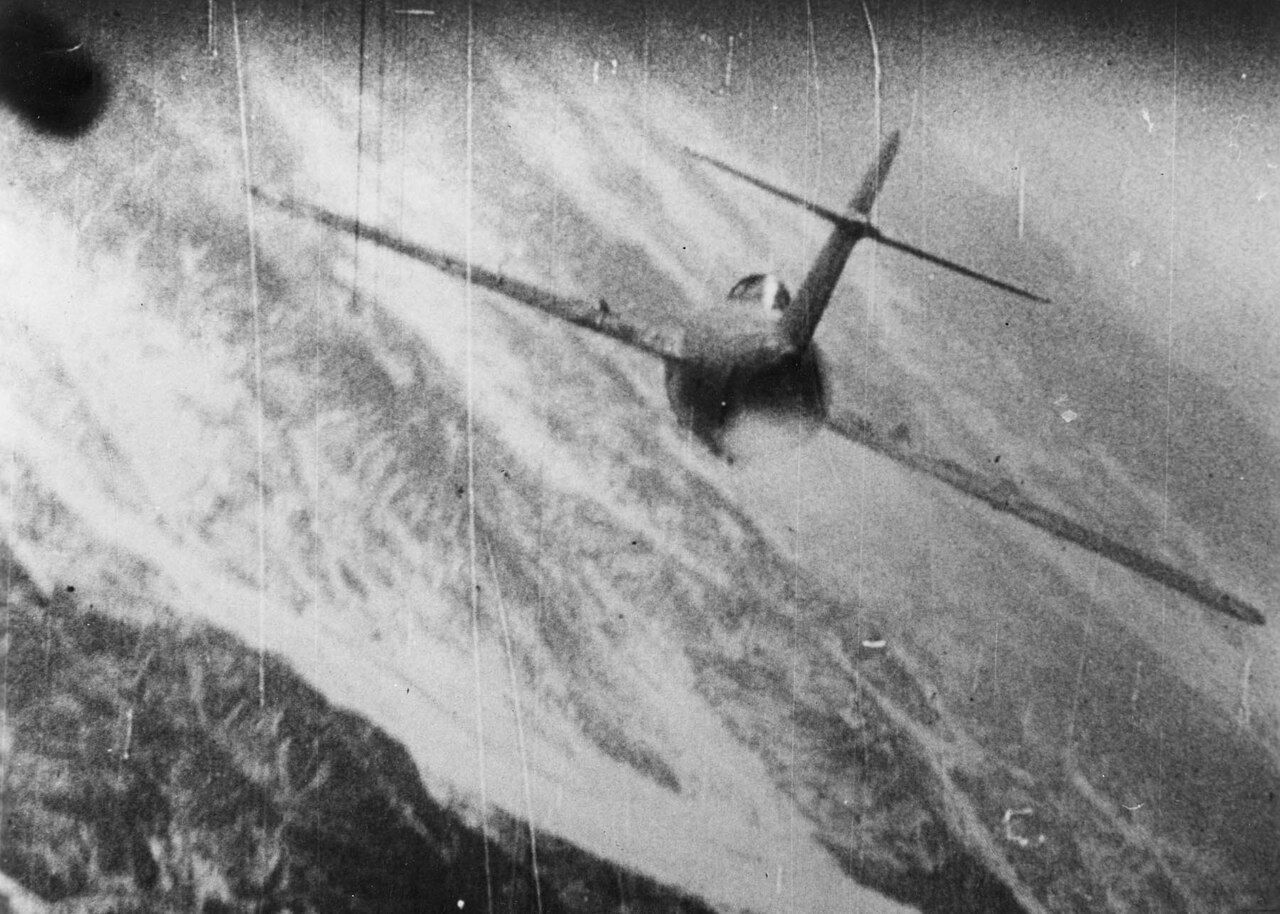
The two swept-wing fighters were evenly matched in different ways. The MiG had a higher ceiling and a faster climb than most Sabres and turned better above about 10,000 m; the F-86F-86 Sabre AircraftThe swept-wing day fighter that met the MiG-15 over Korea. was faster low down and turned tighter below about 8,000 m. A MiG pilot in trouble could climb away to heights the Sabre could not reach. [1] In the dogfight, poor turning performance and instability near MachMach number GlossaryFlight: The ratio of the true airspeed to the speed of sound. All compressibility effects depend on it. 1 cost the MiG dearly against the Sabre. [2] Both sides’ claims remain disputed: a RAND report on recent scholarship put the Sabre’s kill-to-loss ratio at about 1.8 to 1 overall, and nearer 1.3 to 1 against Soviet pilots. [1]
Black Tuesday
Against bombers, the MiG did what it was built for. On 12 April 1951 Soviet pilots attacked 48 B-29s and their escorts over the Yalu bridges, and shot down or damaged beyond repair ten bombers for the loss of one MiG. On 23 October 1951, a day American crews called “Black Tuesday”, 56 MiGs shot down or wrecked eight of nine B-29s despite more than 80 escorting fighters. The Far East Air Forces stopped daylight precision bombing with B-29s and switched to radar-directed raids at night. [1] [2]
The $100,000 MiG
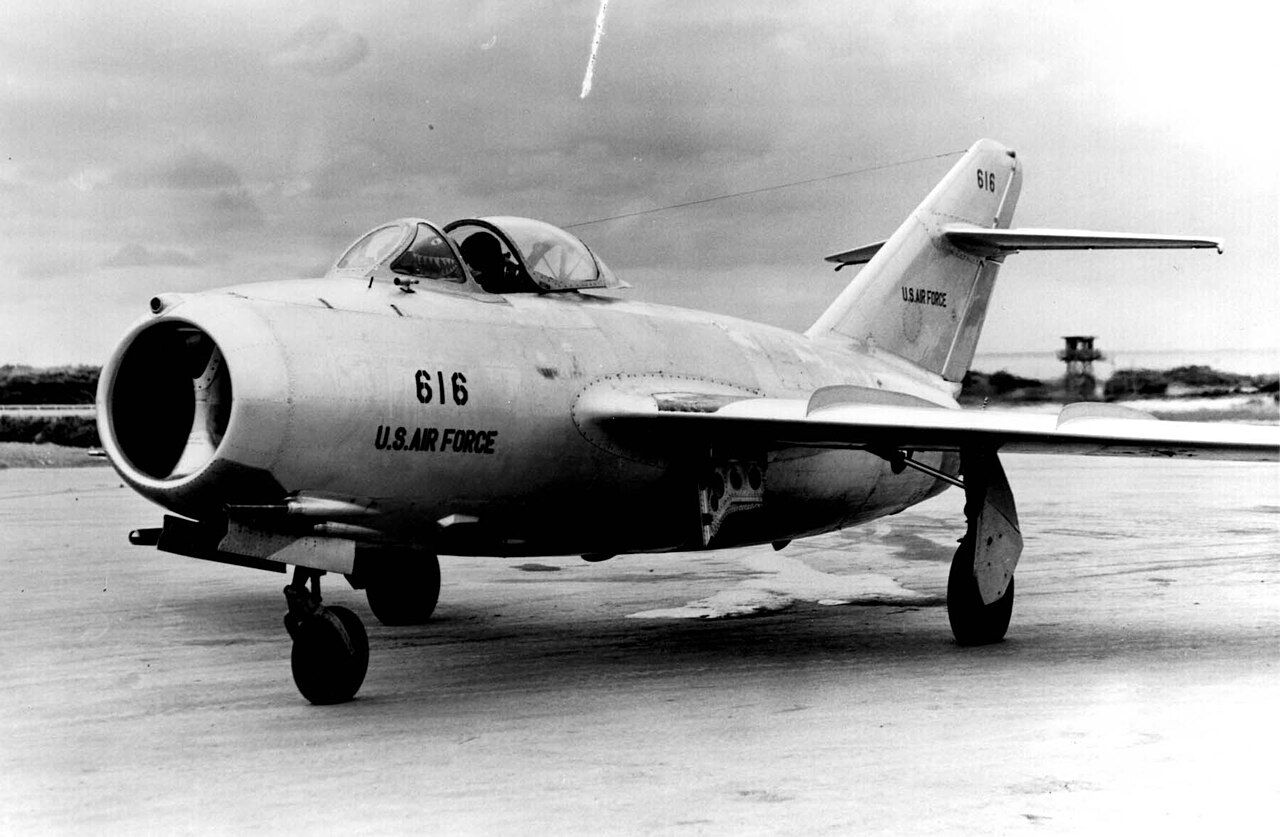
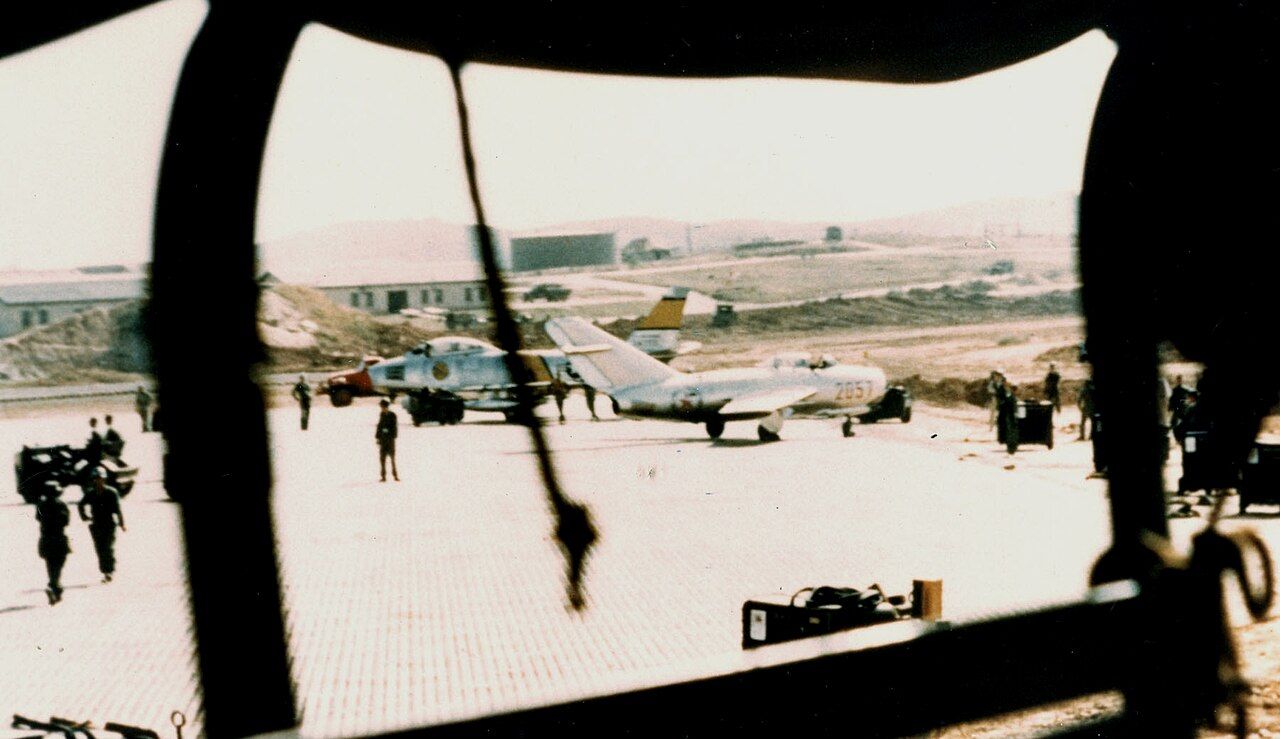
The West badly wanted an intact MiG. Operation Moolah offered asylum and US$100,000 to any pilot who brought one over. On 5 March 1953, the day Stalin died, the Polish pilot Franciszek Jarecki flew his MiG-15 to the Danish island of Bornholm, navigating with a school atlas because no military map showed foreign coastlines. On 21 September 1953 the North Korean Lieutenant No Kum-sok landed his MiG at Kimpo, saying he had not known about the reward. [1]
Chuck Yeager was among the test pilots who flew No’s aircraft. Without an all-moving tailplane the MiG lost control effectiveness as it neared MachMach number GlossaryFlight: The ratio of the true airspeed to the speed of sound. All compressibility effects depend on it. 1: in a full-power dive Yeager reached MachMach number GlossaryFlight: The ratio of the true airspeed to the speed of sound. All compressibility effects depend on it. 0.98, lost roll control, and only recovered after descending into the dense air below 12,000 ft. The MiG also spun readily after a stall, with little warning; UN pilots saw MiGs enter spins in combat 56 times, and North Korean pilots were told to eject if they could not recover within three turns. Yeager called it “a flying booby trap”. No’s MiG is now displayed at the National Museum of the United States Air Force in Ohio. [1]
Everywhere at once
More than 13,000 were built in the Soviet Union and over 4,000 more under licence in China, Czechoslovakia and Poland, which makes the MiG-15 one of the most-produced jet aircraft ever. Through the 1950s Soviet and Warsaw Pact MiG-15s intercepted Western reconnaissanceReconnaissance GlossaryJoint terms: A mission undertaken to obtain, by visual observation or other detection methods, information about the activities and resources of an enemy or adversary, or to secure data concerning the meteorological, hydrographic, or… aircraft along their borders, several of them fatally. Egypt flew them in the 1956 Suez crisis, and Yuri Gagarin, the first person in space, was killed in a MiG-15UTI two-seat trainer in March 1968. Its successor, the MiG-17, would surprise the West again over Vietnam, and North Korea still flies the MiG-15 as a trainer. [1]


Sources
- Mikoyan-Gurevich MiG-15. Wikipedia (secondary source). https://en.wikipedia.org/wiki/Mikoyan-Gurevich_MiG-15 (accessed 2026-10-25).
- MiG-15 Fagot. Federation of American Scientists, Military Analysis Network. https://nuke.fas.org/guide/russia/airdef/mig-15.htm (accessed 2026-10-25).
Wikipedia articles are secondary sources and can change; they are cited with the date they were read. The Federation of American Scientists (FAS) Military Analysis Network pages largely reproduce US service fact sheets of the late 1990s and early 2000s, so later upgrades are not covered there.