
Drafted — not technically validated
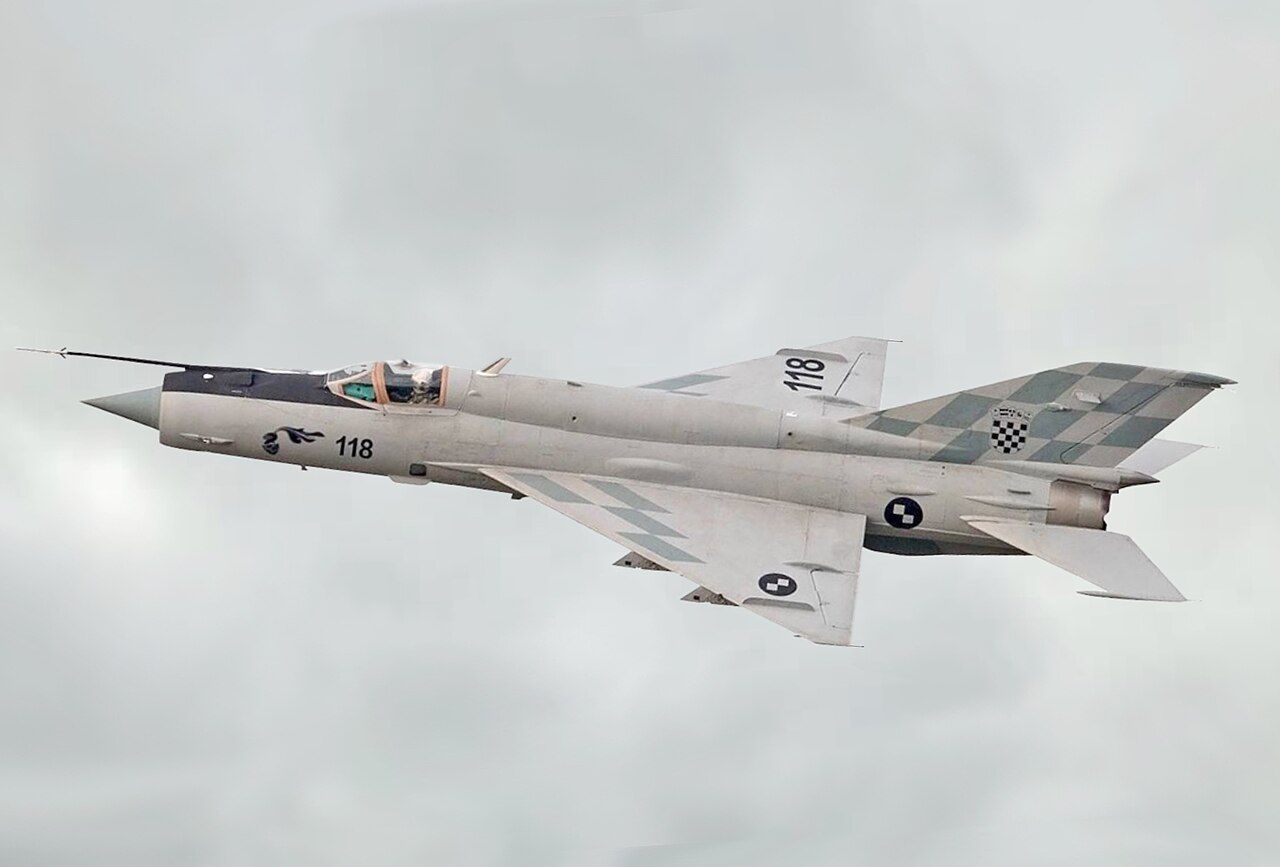
Record revision 1 · The small delta-wing Mach 2 fighter: the most-produced supersonic jet in history.
Real-world aircraft as described in public sources. Figures vary between variants, loads and sources; the data plate names the variant its figures describe, and differences are noted beside the number they affect.
MiG-21bis · Mikoyan-Gurevich MiG-21bis
- Variant described
- MiG-21bis [1]
- Role
- Fighter and interceptor [1]
- Origin
- Soviet Union
- Manufacturer
- Mikoyan-Gurevich; licence-built in India and Czechoslovakia, copied in China as the J-7 [1] [2]
- Crew
- 1 [1]
- First flight
- 14 February 1955 (Ye-2 prototype) [1]
- Entered service
- 1959 (MiG-21F) [1]
- Status
- In service; 11,496 built, the most-produced supersonicSupersonic GlossaryFlight: The regime of flight from about Mach 1.20 to 5.00, with definite supersonic flow on all parts of the aircraft. Above Mach 5.00 is hypersonic. jet aircraft [1]
- Powerplant
- One Tumansky R-25-300 afterburningAfterburner GlossaryFlight: An additional combustion area aft of the turbine section of a turbojet, with fuel nozzles and flameholders, that burns fuel in the engine's large excess of air. It adds only 10 to 20 percent to the engine's weight but 40… turbojet, 69.58 kN (15,600 lbf) with afterburnerAfterburner GlossaryFlight: An additional combustion area aft of the turbine section of a turbojet, with fuel nozzles and flameholders, that burns fuel in the engine's large excess of air. It adds only 10 to 20 percent to the engine's weight but 40… [1]
- Maximum speed
- Mach 2.05, 2,175 km/h (1,174 kt) at 13,000 m [1]
- Service ceiling
- 17,500 m (57,400 ft) [1]
- Range
- 660 km (356 NM) clean at 11,000 m [1]
- Armament
- Sensors and avionics
- Sapfir-family nose radar (RP-21 Sapfir on earlier models) [1]
- Purchase
- DCS WorldDCS: MiG-21bis by Magnitude 3DCS Store
Store pages checked 2026-10-28. Prices and availability change.
The balalaika
Seen from below, the MiG-21’s triangular wing and slim fuselage look like a stringed instrument, and Soviet pilots nicknamed it the Balalaika. Poles called it Ołówek, “pencil”, and the Vietnamese Én Bạc, “silver swallow”. About 60 countries on four continents have flown it, and 11,496 were built: more than any other supersonicSupersonic GlossaryFlight: The regime of flight from about Mach 1.20 to 5.00, with definite supersonic flow on all parts of the aircraft. Above Mach 5.00 is hypersonic. jet in history. [1]
From swept wing to delta
The MiG-21 grew out of the MiG-15MiG-15 AircraftThe Soviet swept-wing jet fighter that shocked UN air forces over Korea, armed with 37 mm and 23 mm cannon., MiG-17 and supersonicSupersonic GlossaryFlight: The regime of flight from about Mach 1.20 to 5.00, with definite supersonic flow on all parts of the aircraft. Above Mach 5.00 is hypersonic. MiG-19MiG-19 AircraftThe first Soviet fighter supersonic in level flight; the MiG-19P added radar for all-weather interception.. Mikoyan’s first prototypes of the early 1950s had swept wings; the Ye-4 of 1955 was the first with the tailed delta wing of the production aircraft, and it appeared in public at the Tushino air show in July 1956. [1] Western intelligence had so little to go on that Jane’s All the World’s Aircraft for 1960–61 listed the “Fishbed” as a Sukhoi design and illustrated it with a picture of a different fighter. [1]
It was the first successful Soviet aircraft to combine fighter and interceptor in one airframe: a lightweight that reached MachMach number GlossaryFlight: The ratio of the true airspeed to the speed of sound. All compressibility effects depend on it. 2 on a modest engine, comparable to the American F-104 and F-5F-5 Tiger II AircraftA small, cheap supersonic fighter for US allies, and a long-serving adversary aircraft that stands in for the MiG-21. and the French Mirage III. Its controls, engine and avionics were simple, its tail helped keep it controllable at the edges of the envelope, and it was cheap to build and run; a MiG-21MF cost less than a BMP-1 infantry fighting vehicle. That made it ideal for air forces with small budgets and short training programmes. [1]
Simplicity had costs. Fuel tanks sat ahead of the centre of gravity, so as fuel burned the aircraft became unstable, and endurance without external tanks was only about 45 minutes. The delta wing climbed superbly but bled speed quickly in a turning fight. The final MiG-21bis answered with brute force: its R-25 engine had an emergency rating, usable for two minutes, that gave it a thrust-to-weight ratio slightly better than 1:1 and a climb rate close to an early F-16F-16 Fighting Falcon AircraftA single-engine multirole fighter: fly-by-wire, 9 g, and the US Air Force's main strike and SEAD aircraft.’s. The Soviets called it the “diamond regime”, after the shock diamonds glowing in its 10–12 m exhaust flame. [1]
Silver swallows over Vietnam
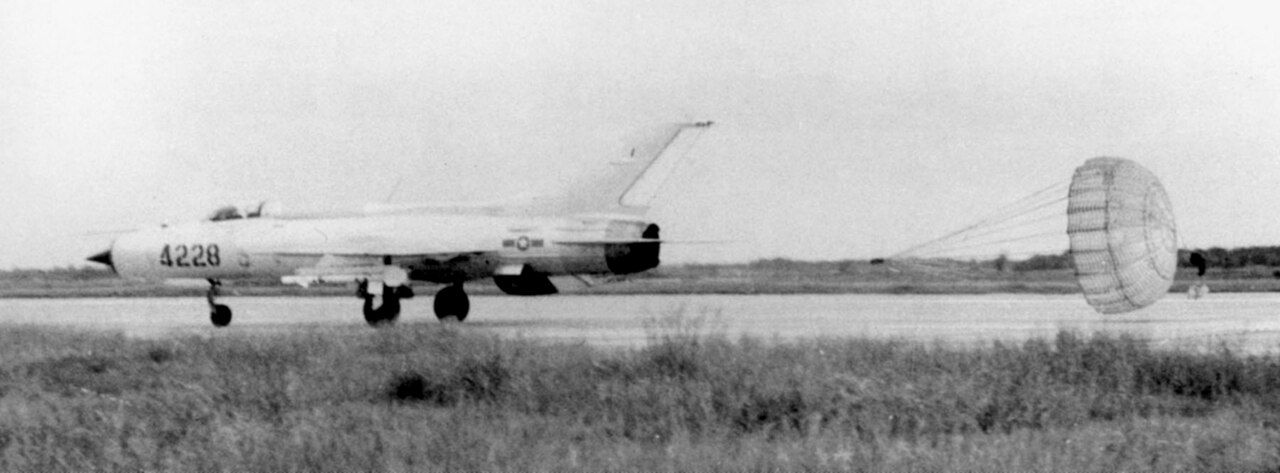
The first MiG-21s reached North Vietnam by ship in April 1966 and went to the 921st Fighter Regiment. On 7 July 1966 a rocketRocket GlossaryWeapons: A weapon propelled by the sustained reaction of a discharging jet of gas against the container of gas. Rockets answered the need for a large weapon that could be fired from an aircraft without recoil.-armed MiG-21 shot down an F-105D near Phuc Yen, the type’s first victory over a piloted US aircraft in the war. [1] Built for short, ground-controlled interceptions, it became a dangerous adversary in experienced hands, making high-speed hit-and-run attacks on F-105 strike formations that downed some and forced others to jettison their bombs. Thirteen North Vietnamese pilots became aces in MiG-21s; the most successful, Nguyễn Văn Cốc, scored nine kills. The ace Nguyễn Nhật Chiêu said: “In general combat conditions, I was always confident of a kill over an F-4 PhantomF-4 Phantom II AircraftThe big two-seat Cold War fighter-bomber; the F-4E added an internal gun and slats after Vietnam. when flying a MiG-21.” [1] US Air Force F-4sF-4 Phantom II AircraftThe big two-seat Cold War fighter-bomber; the F-4E added an internal gun and slats after Vietnam. and B-52s claimed 68 MiG-21s between April 1965 and January 1973. [2]
Deserts and mountains
Egyptian, Syrian and Iraqi MiG-21s fought Israel from 1964. In the 1967 Six-Day War Egypt lost about 100 of its roughly 110 MiG-21s, almost all of them on the ground. In 1970 Soviet pilots flew MiG-21MFs over Egypt during the War of Attrition and shot down several Israeli aircraft. Syrian MiG-21 pilots independently discovered the Cobra manoeuvre, which they called the “zero speed manoeuvre”. [1]
India chose the MiG-21 in 1961 and inducted more than 1,200 of them. In the 1971 war Indian MiG-21FLs fought the subcontinent’s first supersonicSupersonic GlossaryFlight: The regime of flight from about Mach 1.20 to 5.00, with definite supersonic flow on all parts of the aircraft. Above Mach 5.00 is hypersonic. dogfight and claimed four Pakistani F-104As. It also earned a darker nickname, the “flying coffin”, after more than 170 Indian pilots were killed in MiG-21 accidents from 1970 on. India retired its last MiG-21 Bisons in August 2025, with a farewell ceremony at Chandigarh on 26 September. [1]
Copied in China
The Soviets licensed the MiG-21F and its engine to China in 1961, and the first Shenyang-built J-7 flew on 17 January 1966. The J-7 became China’s most-produced fighter, and by 1989 the factories were turning out as many as 14 a month, mostly for export; Pakistan took F-7s from 1988. [2] Romanian, Israeli and Russian companies still offer upgrades to keep MiG-21s flying, seven decades after the first flight. [1]

Sources
- Mikoyan-Gurevich MiG-21. Wikipedia (secondary source). https://en.wikipedia.org/wiki/Mikoyan-Gurevich_MiG-21 (accessed 2026-10-25).
- MiG-21 Fishbed / J-7. Federation of American Scientists, Military Analysis Network. https://man.fas.org/dod-101/sys/ac/row/mig-21.htm (accessed 2026-10-25).
Wikipedia articles are secondary sources and can change; they are cited with the date they were read. The Federation of American Scientists (FAS) Military Analysis Network pages largely reproduce US service fact sheets of the late 1990s and early 2000s, so later upgrades are not covered there.