
Drafted — not technically validated
Record revision 1 · A large, long-range Soviet air superiority fighter with ten missile stations.
Real-world aircraft as described in public sources. Figures vary between variants, loads and sources; the data plate names the variant its figures describe, and differences are noted beside the number they affect.
Su-27 Flanker · Sukhoi Su-27S
- Variant described
- Su-27S (Flanker-B) [1]
- Origin
- Soviet Union
- Manufacturer
- Sukhoi [1]
- Entered service
- 22 June 1985 [1]
- Status
- In service; 680 built [1]
- Powerplant
- Two Saturn AL-31F afterburningAfterburner GlossaryFlight: An additional combustion area aft of the turbine section of a turbojet, with fuel nozzles and flameholders, that burns fuel in the engine's large excess of air. It adds only 10 to 20 percent to the engine's weight but 40… turbofans, 122.6 kN (27,560 lbf) each with afterburnerAfterburner GlossaryFlight: An additional combustion area aft of the turbine section of a turbojet, with fuel nozzles and flameholders, that burns fuel in the engine's large excess of air. It adds only 10 to 20 percent to the engine's weight but 40… [1]
- Maximum speed
- Mach 2.35, 2,500 km/h (1,350 kt) at altitude [1]
- Service ceiling
- 18,500 m (60,700 ft) without external stores [1]
- Range
- 3,530 km (1,906 NM) at cruising altitude [1]
- Armament
- Sensors and avionics
- Purchase
- DCS WorldSu-27 Flaming Cliffs by Eagle DynamicsDCS Store
- Microsoft Flight SimulatorSu-27 Flanker by DC DesignsJust Flight
Store pages checked 2026-10-28. Prices and availability change.
The heavy half of the answer
In 1969 the Soviet Union learned of the US Air Force’s F-X programme, which produced the F-15 EagleF-15C Eagle AircraftA twin-engine air superiority fighter with more than 104 air-to-air victories and no losses., and realised the new American fighter would outclass anything it had. Its requirement for an advanced frontline fighter proved too demanding and too costly for one aircraft in the numbers needed, so it was split. Mikoyan got the lightweight half, which became the MiG-29MiG-29 Fulcrum AircraftA twin-engine Soviet fighter with a helmet sight and R-73 missiles, built to counter the F-15 and F-16.; Sukhoi got the heavy half, a long-range fighter with sophisticated avionics, heavy armament and high agility, built to take on the F-14F-14 Tomcat AircraftThe Navy's swing-wing fleet defence fighter: two crew, AWG-9 radar and AIM-54 Phoenix. and F-15F-15C Eagle AircraftA twin-engine air superiority fighter with more than 104 air-to-air victories and no losses.. [1] The mid-1970s arrival of the F-15F-15C Eagle AircraftA twin-engine air superiority fighter with more than 104 air-to-air victories and no losses. and F-16F-16 Fighting Falcon AircraftA single-engine multirole fighter: fly-by-wire, 9 g, and the US Air Force's main strike and SEAD aircraft. had left Eastern Bloc fighter pilots at a distinct disadvantage; the Su-27 and MiG-29MiG-29 Fulcrum AircraftA twin-engine Soviet fighter with a helmet sight and R-73 missiles, built to counter the F-15 and F-16. levelled the field. [2]
Starting again
Sukhoi’s T-10 prototype first flew on 20 May 1977, and Western satellites spotted it at the Ramenskoye test airfield near Zhukovsky, so intelligence analysts called it “Ram-K” before it became NATO’s Flanker. [1] Testing went badly. The aerodynamics were unsatisfactory, the second prototype broke up in flight in July 1978 and killed its pilot, and the Mech radar had serious deficiencies. Sukhoi redesigned the aircraft almost from scratch. The new T-10S, completed in 1980, looked only superficially like the T-10, and its early prototypes suffered crashes and structural failures of their own; one landed in 1983 after losing part of a wing and a tail fin. [1]
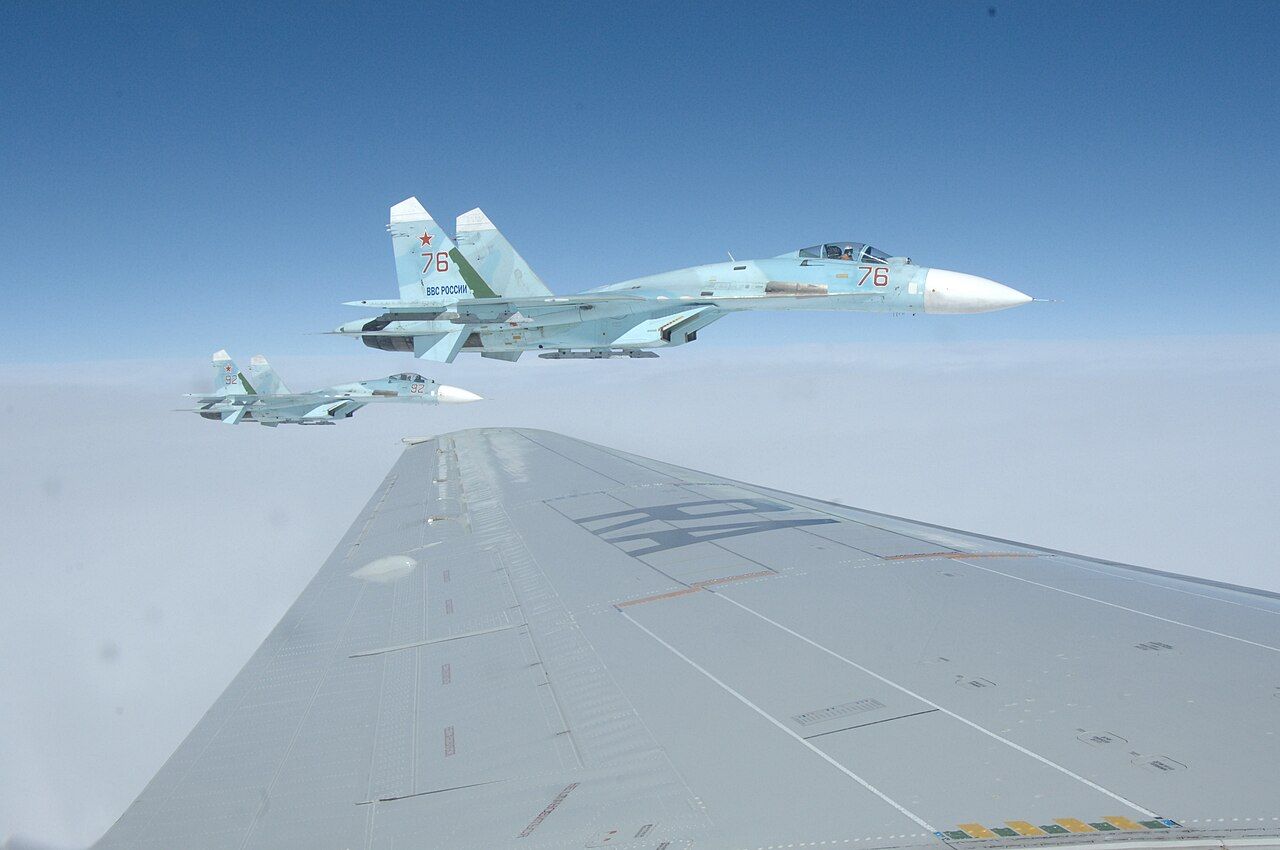
What emerged was the Soviet Union’s first operational fly-by-wire fighter. Its large, cropped semi-delta wing blends into the fuselage through leading-edge extensions, the two engines sit in separate pods with a tunnel between them that adds lift, and the twin tails stand outboard of the engines. [1] The fly-by-wire control, low wing loading and powerful controls make it exceptionally agile, controllable even at very low speed and high angle of attackAOA GlossaryJoint terms: Angle of attack. The angle at which relative wind meets an airfoil. It is the angle that is formed by the chord of the airfoil and the direction of the relative wind or between the chord line and the flight path.. [1]
Records and the Cobra
A stripped Su-27 prototype, the P-42 “Streak Flanker”, was polished bare, had every gap sealed and its engines boosted, and between 1986 and 1988 it took a series of time-to-climb records from the F-15F-15C Eagle AircraftA twin-engine air superiority fighter with more than 104 air-to-air victories and no losses. “Streak Eagle”. Several still stood in 2019. [1] Test pilot Viktor Pugachev first demonstrated the Cobra manoeuvre in an Su-27 in 1989: the fighter pitches up past the vertical to an angle of attackAOA GlossaryJoint terms: Angle of attack. The angle at which relative wind meets an airfoil. It is the angle that is formed by the chord of the airfoil and the direction of the relative wind or between the chord line and the flight path. of about 120 degrees, holds level flight for a moment, then drops its nose again. [1] The Su-27 and its family set more than 40 world records in all. [2]
On guard
The Su-27 joined Soviet units from June 1985, although production difficulties kept it from appearing in strength until 1990. [1] Its job was long-range air defenceAir defense GlossaryJoint terms: Defensive measures designed to destroy attacking enemy aircraft or missiles in the atmosphere, or to nullify or reduce the effectiveness of such attack.: to meet American B-1B and B-52 bombers, to protect the coast from aircraft carriers, and to escort Soviet heavy bombers far from home. Its very large internal fuel load gives it a range of about 3,530 km without tanks. [1]
Some of its intercepts have come too close. On 13 September 1987 an armed Su-27 intercepting a Norwegian P-3 Orion over the Barents Sea collided with it on its third close pass; both aircraft landed safely. In March 2023 a Russian Su-27 dumped fuel on an American MQ-9 Reaper drone over the Black Sea and struck its propeller, forcing the operators to ditch it. [1]
A family of Flankers
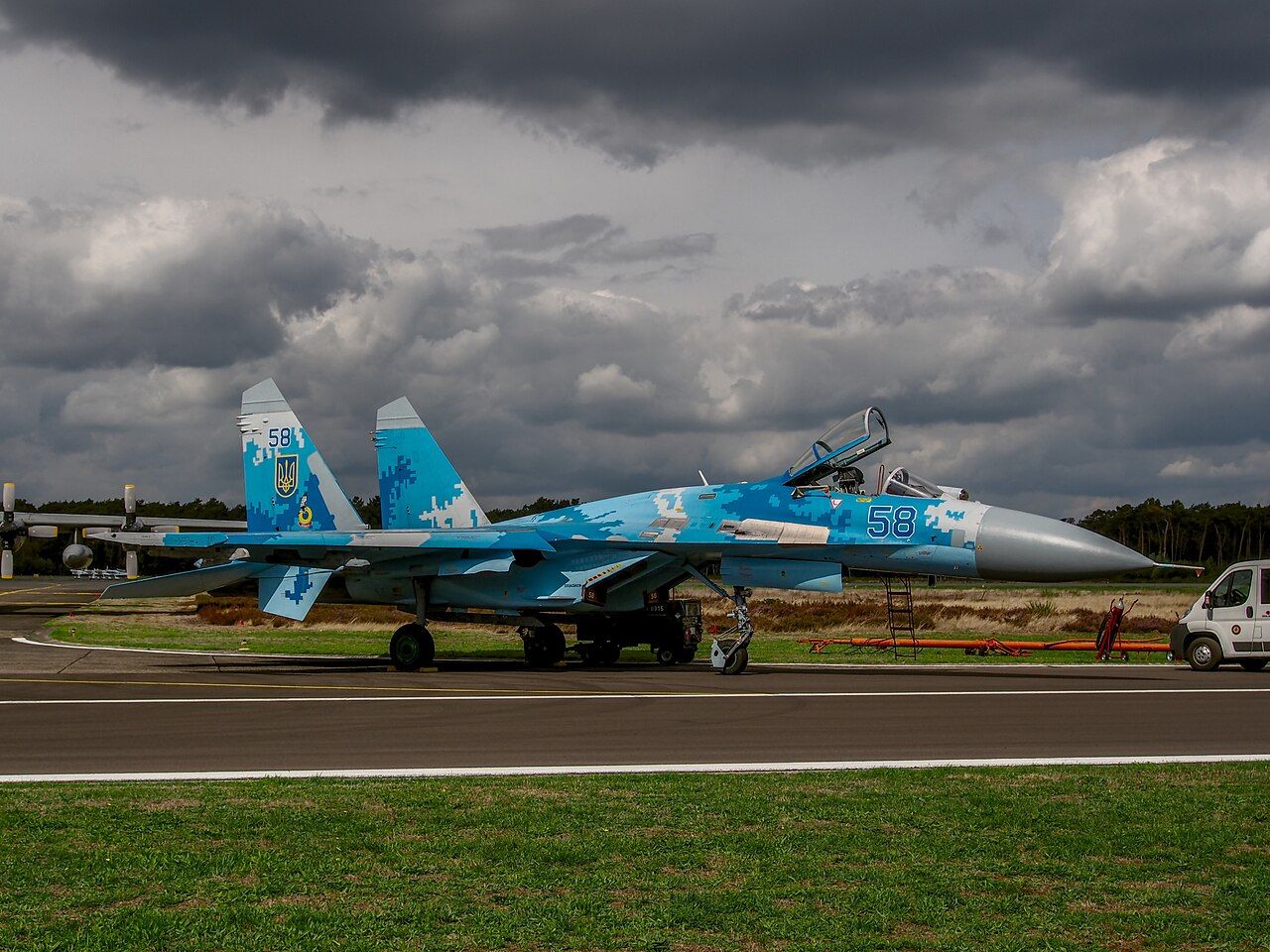
The Su-27 became the parent of a whole family: the two-seat Su-30, the carrier-borne Su-33Su-33 Flanker-D AircraftThe carrier-based Flanker: canards, folding wings and a ski-jump launch from Admiral Kuznetsov., the side-by-side Su-34 strike aircraft and the Su-35, and China builds its own version as the J-11J-11A AircraftChina's licence-assembled Su-27SK, with new displays and the R-77 missile.. [1] Ethiopian Su-27s shot down at least two Eritrean MiG-29sMiG-29 Fulcrum AircraftA twin-engine Soviet fighter with a helmet sight and R-73 missiles, built to counter the F-15 and F-16. in 1999. Ukraine inherited about 66 to 70 Su-27s in 1991 and has flown them against Russia since 2022; on 7 May 2022 a pair made a high-speed, low-level bombing run on Russian-held Snake Island, filmed by a drone. [1]

Sources
- Sukhoi Su-27. Wikipedia (secondary source). https://en.wikipedia.org/wiki/Sukhoi_Su-27 (accessed 2026-10-25).
- Su-27 Flanker. Federation of American Scientists, Military Analysis Network. https://nuke.fas.org/guide/russia/airdef/su-27.htm (accessed 2026-10-25).
Wikipedia articles are secondary sources and can change; they are cited with the date they were read. The Federation of American Scientists (FAS) Military Analysis Network pages largely reproduce US service fact sheets of the late 1990s and early 2000s, so later upgrades are not covered there.