
Drafted — not technically validated
Record revision 1 · A carrier-capable fighter and attack aircraft that one pilot can switch between roles on the same sortie.
Real-world aircraft as described in public sources. Figures vary between variants, loads and sources; the data plate names the variant its figures describe, and differences are noted beside the number they affect.
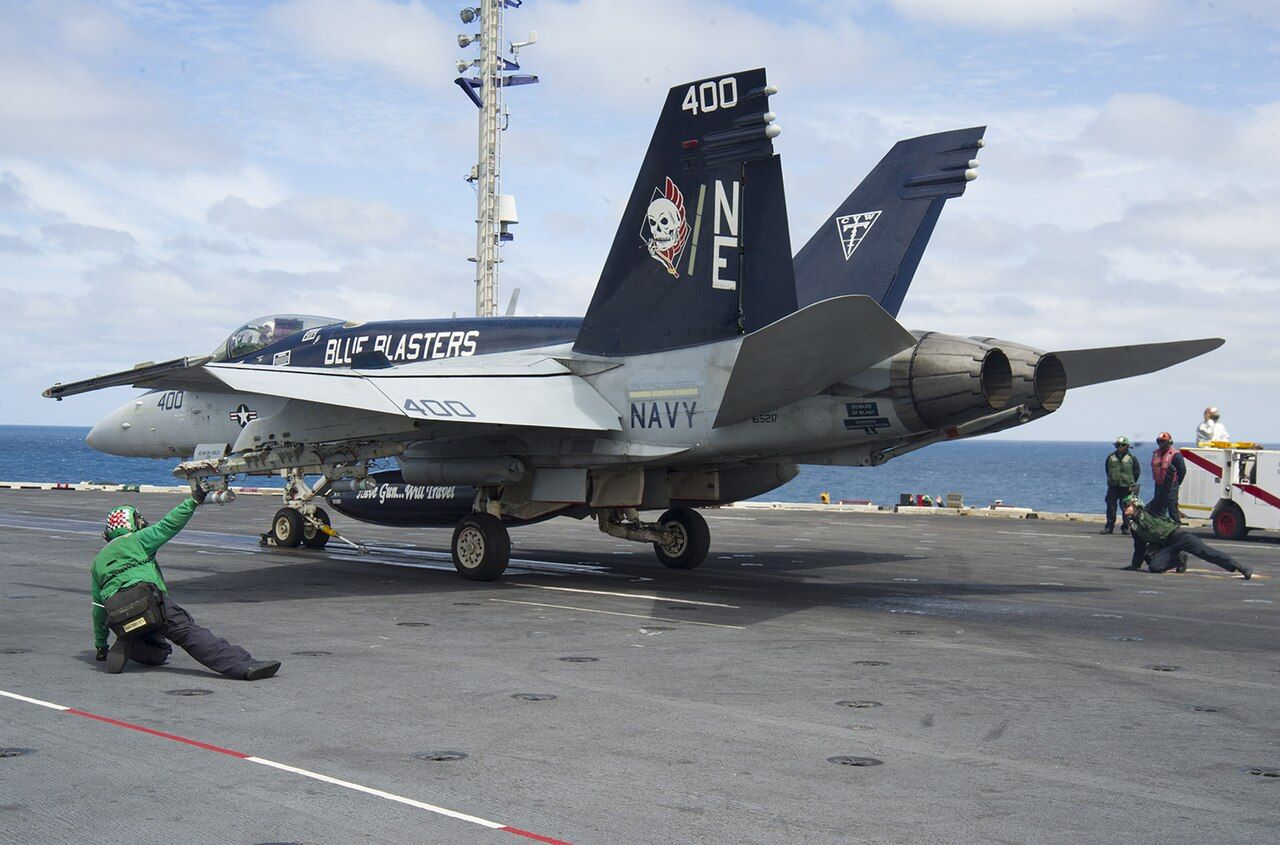
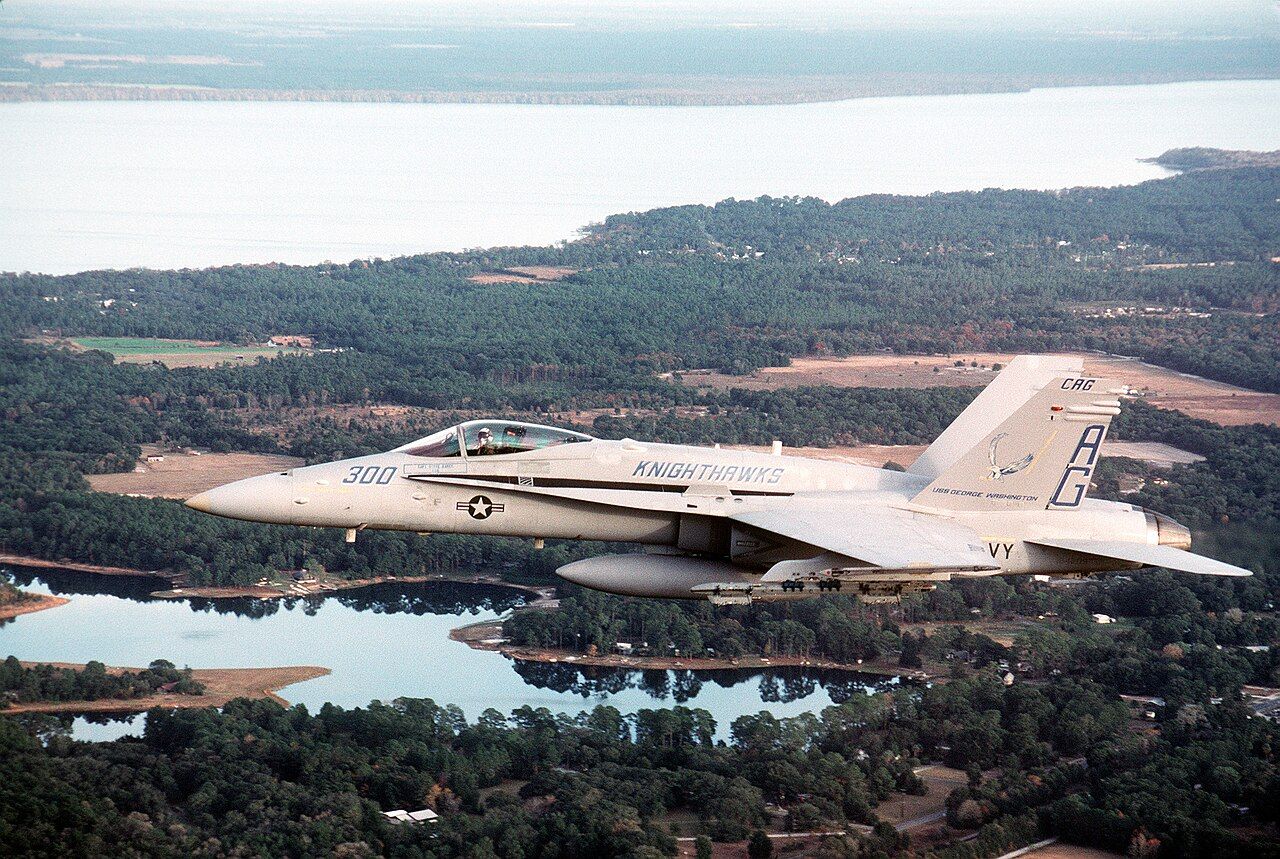
F/A-18C Hornet · McDonnell Douglas F/A-18C
- Role
- Carrier-capable multirole fighter and attack aircraft [1]
- Origin
- United States
- Manufacturer
- McDonnell Douglas with Northrop, later Boeing [1]
- First flight
- 18 November 1978 [1]
- Entered service
- 7 January 1983 (US Marine Corps); 1 July 1984 (US Navy) [1]
- Status
- In service with other air forces and the US Marine Corps; retired by the US Navy in 2019; 1,480 F/A-18A/B/C/D built [1]
- Powerplant
- Two General Electric F404-GE-402 afterburningAfterburner GlossaryFlight: An additional combustion area aft of the turbine section of a turbojet, with fuel nozzles and flameholders, that burns fuel in the engine's large excess of air. It adds only 10 to 20 percent to the engine's weight but 40… turbofans, 17,750 lbf each with afterburnerAfterburner GlossaryFlight: An additional combustion area aft of the turbine section of a turbojet, with fuel nozzles and flameholders, that burns fuel in the engine's large excess of air. It adds only 10 to 20 percent to the engine's weight but 40… [1]; 18,000 lb thrust class [2]
- Service ceiling
- 50,000 ft [1]
- Range
- Combat radius 400 NM on an air-to-air mission [1], greater than 500 NM depending on load [2]; ferry range 1,800 NM with three tanks [1]
- Armament
- One 20 mm M61A1 Vulcan cannon in the nose, 578 rounds [1]
- Nine stations: two wingtip rails, four underwing, three underfuselage; up to 13,700 lb of fuel and weapons [1]
- Air-to-air: AIM-9 Sidewinder, AIM-7 Sparrow, AIM-120 AMRAAM [1]
- Air-to-ground: AGM-65 Maverick, AGM-88 HARM, AGM-84 Harpoon, laser- and GPS-guided bombs, Mk 80-series bombs [1]
- Sensors and avionics
- Purchase
- DCS WorldDCS: F/A-18C by Eagle DynamicsDCS Store
Store pages checked 2026-10-28. Prices and availability change.
Forty seconds over Iraq
On 17 January 1991, the first day of the Gulf War, four Navy Hornets launched from USS Saratoga in the Red Sea to bomb an Iraqi airfield. Each carried four 2,000 lb bombs. On the way in, an E-2C radar aircraft warned them of approaching Iraqi MiG-21sMiG-21 AircraftThe small delta-wing Mach 2 fighter: the most-produced supersonic jet in history.. Lieutenant Commander Mark Fox and Lieutenant Nick Mongilio shot both MiGs down with SparrowAIM-7 Sparrow OrdnanceThe West's main radar-guided missile from the late 1950s to the 1990s, which homes on radar energy the fighter reflects off its target. and SidewinderAIM-9 Sidewinder OrdnanceThe heat-seeking dogfight missile of the US Navy since 1956, copied by the Soviets and still in production as the AIM-9X. missiles; just 40 seconds passed between the MiGs appearing on the E-2’s radar and both going down. Then the Hornets carried on, bombed their target and flew back to the carrier. [1] That one sortieSortie GlossaryJoint terms: In air operations, an operational flight by one aircraft. is the whole idea of the aircraft: a fighter and an attack aircraft in the same airframe, hence the name F/A-18. [1]
The loser that won
The Hornet began as a runner-up. Northrop’s twin-engined YF-17 lost the US Air Force Lightweight Fighter competition to the YF-16. [1] But the Navy, ordered by Congress to find something cheaper than the F-14F-14 Tomcat AircraftThe Navy's swing-wing fleet defence fighter: two crew, AWG-9 radar and AIM-54 Phoenix., doubted that a single-engined fighter on narrow landing gear could be adapted to carrier life, and on 2 May 1975 it picked the YF-17 instead. [1] McDonnell Douglas and Northrop then rebuilt it for the sea: more fuel, larger wings, a wider rear fuselage and the first fully digital fly-by-wire system in a production fighter. On 1 March 1977 the Secretary of the Navy named it the Hornet. [1]
The first F/A-18A was rolled out on 13 September 1978, painted with “Navy” on one side and “Marines” on the other, because both services would fly it. [1] It entered service with Marine squadronSquadron GlossaryJoint terms: 1. An organization consisting of two or more divisions of ships, or two or more divisions (Navy) or flights of aircraft. 2. The basic administrative aviation unit of the Army, Navy, Marine Corps, and Air Force. 3… VMFA-314 on 7 January 1983, and with the Navy in 1984, replacing F-4 PhantomsF-4 Phantom II AircraftThe big two-seat Cold War fighter-bomber; the F-4E added an internal gun and slats after Vietnam. and A-7 Corsairs. Early reports said the Hornet was extraordinarily reliable, a big change from the PhantomF-4 Phantom II AircraftThe big two-seat Cold War fighter-bomber; the F-4E added an internal gun and slats after Vietnam.. [1]
One pilot, two jobs
The Hornet was designed around versatile avionics, multifunction cockpit displays and excellent handling at high angles of attackAOA GlossaryJoint terms: Angle of attack. The angle at which relative wind meets an airfoil. It is the angle that is formed by the chord of the airfoil and the direction of the relative wind or between the chord line and the flight path.. [1] In the F/A-18C, the APG-73 radar and targeting pods let a single pilot switch between air-to-air and air-to-ground work on the same sortieSortie GlossaryJoint terms: In air operations, an operational flight by one aircraft., and an M61A1M61 Vulcan OrdnanceThe six-barrel 20 mm Gatling gun that has armed US fighters of every service since 1959. gun sits in the nose. [1] It can fly fighter escort, fleet air defenceAir defense GlossaryJoint terms: Defensive measures designed to destroy attacking enemy aircraft or missiles in the atmosphere, or to nullify or reduce the effectiveness of such attack., suppression of enemy air defencesSEAD GlossaryJoint terms: Suppression of enemy air defenses. Activity that neutralizes, destroys, or temporarily degrades surface-based enemy air defenses by destructive and/or disruptive means., interdictionAir interdiction GlossaryJoint terms: Air operations conducted to divert, disrupt, delay, or destroy the enemy's military surface capabilities before it can be brought to bear effectively against friendly forces, or to otherwise achieve objectives that are…, close air supportCAS GlossaryJoint terms: Close air support. Air action by fixed- and rotary-wing aircraft against hostile targets that are in close proximity to friendly forces and that require detailed integration of each air mission with the fire and movement… and reconnaissanceReconnaissance GlossaryJoint terms: A mission undertaken to obtain, by visual observation or other detection methods, information about the activities and resources of an enemy or adversary, or to secure data concerning the meteorological, hydrographic, or…. [1] The two-seat F/A-18D carries either a weapon systems officer or a second set of controls for training. [2]
In action
Hornets first saw combat over Libya in 1986. [1] In the Gulf War the Navy and Marine Corps deployed 190 of them, which flew 4,551 sortiesSortie GlossaryJoint terms: In air operations, an operational flight by one aircraft.. One Hornet took hits in both engines and still flew 125 miles back to base; it was flying again within days. Three Navy Hornets were lost, and on the first night of the war Lieutenant Commander Scott Speicher of VFA-81 was shot down and killed, probably by a missile from an Iraqi MiG-25. [1] Hornets went on to fight over Bosnia and Kosovo and in the 2003 Iraq War. [1]
For more than three decades the Navy’s Blue Angels flew Hornets in their displays, having switched from the A-4 Skyhawk in 1986. [1] The Navy replaced its Hornets with the larger Super Hornet and the F-35C, and the last operational Navy F/A-18C flight took place on 2 October 2019. [1] The Marine Corps kept going: in 2024 it still flew 179 Hornets, with upgraded radars and electronics, planned to serve until about 2030 as the F-35 replaces them. Several other air forces also fly the Hornet. [1]

Sources
- McDonnell Douglas F/A-18 Hornet. Wikipedia (secondary source). https://en.wikipedia.org/wiki/McDonnell_Douglas_F/A-18_Hornet (accessed 2026-10-25).
- F/A-18 Hornet. Federation of American Scientists, Military Analysis Network. https://man.fas.org/dod-101/sys/ac/f-18.htm (accessed 2026-10-25).
Wikipedia articles are secondary sources and can change; they are cited with the date they were read. The Federation of American Scientists (FAS) Military Analysis Network pages largely reproduce US service fact sheets of the late 1990s and early 2000s, so later upgrades are not covered there.