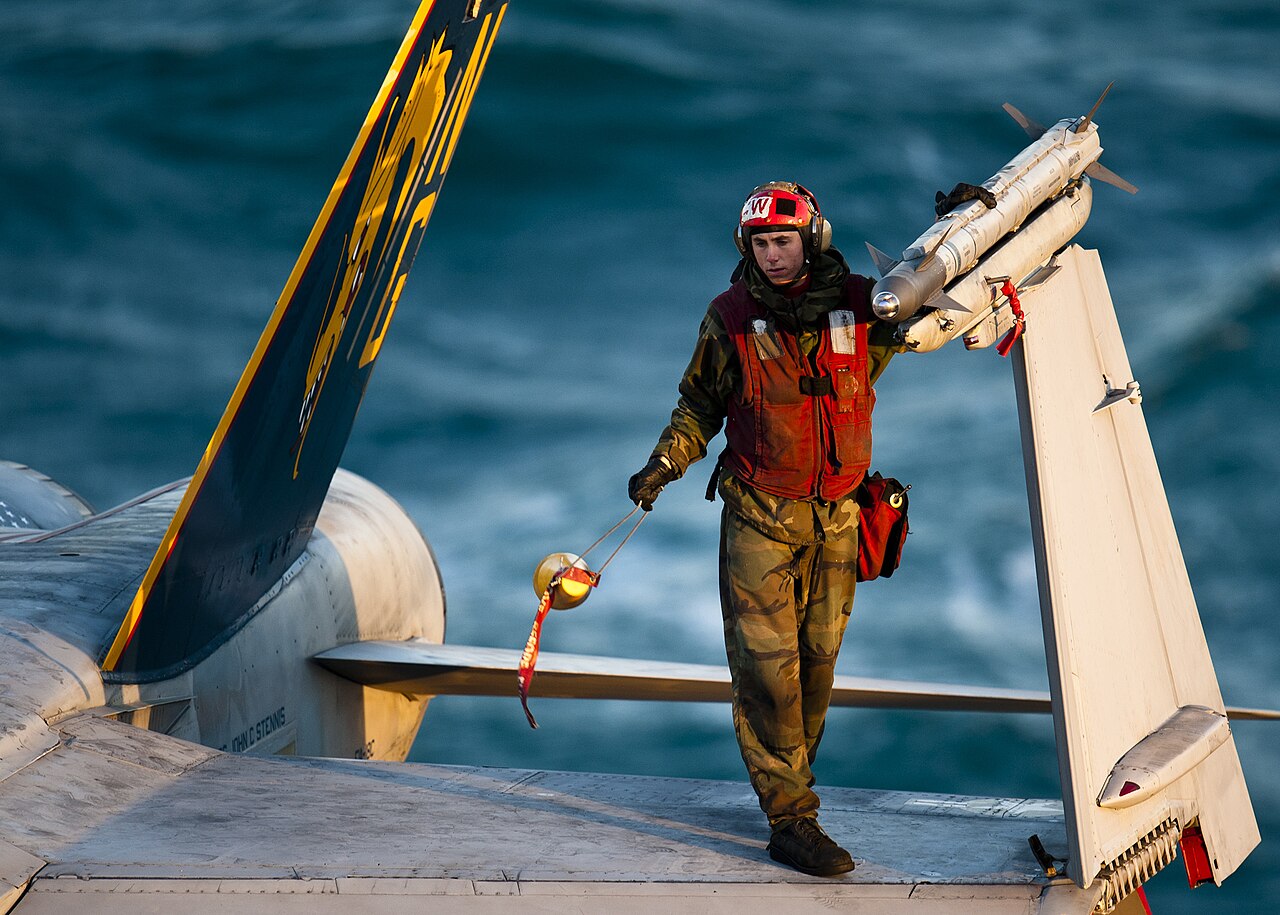

Drafted — not technically validated
Record revision 1 · The heat-seeking dogfight missile of the US Navy since 1956, copied by the Soviets and still in production as the AIM-9X.
Real-world weapon as described in public sources. Weights and dimensions change with the fins, fuzes and variant fitted; the data plate names the variants its figures describe, and differences are noted beside the number they affect. The record describes the weapon; it is not a guide to employing it.
AIM-9 Sidewinder short-range air-to-air missile · AIM-9
- Origin
- United States; a product of the Naval Weapons Center at China Lake, California [1]
- In service
- US Navy since 1956 and US Air Force since 1964 [1]
- Weight
- 188 lb (85 kg) [1]
- Dimensions
- Length 9 ft 11 in (3.02 m); diameter 5 in (127 mm); wingspan 11 in [1]
- Warhead or payload
- Annular blast-fragmentation warhead, the WDU-17/B in the AIM-9L, of about 20.8 lb (9.4 kg) [1] [3]
- Guidance
- Passive infrared homingHoming GlossaryNavigation: Flying to a station by keeping the bearing pointer at the top of the instrument without correcting for wind. In a crosswind it flies a curved path.Weapons: The technique whereby a mobile station directs itself, or is directed, towards a source of primary or reflected energy, or to a specified point. with proportional navigation [2]; the AIM-9X uses an imaging infrared seeker, and the AIM-9C was a semi-active radar version [1]
- Motor
- Mk 36 single-grain solid rocket motor; the Mod 8 adds a safe-arm ignition assembly [3]
- Fuzing
- Target detector: a narrow-beam active-optical proximity fuzeProximity fuze GlossaryWeapons: A fuze that detonates before impact when any substantial object is detected at a predetermined distance from it. that fires the warhead through a safety and arming device [3]
- Delivery
- Rail launched from a LAU-7 launcher, whose cooling gas keeps the seeker electronics from overheating before launch [3]
- Range
- About 0.6 to 22 mi (1 to 35 km), a figure Wikipedia marks as not verified in its own text; the real reach depends on launch speed, altitude and target aspect [1]
- Carried by
- F-14 TomcatF-14 Tomcat AircraftThe Navy's swing-wing fleet defence fighter: two crew, AWG-9 radar and AIM-54 Phoenix. and F/A-18 HornetF/A-18 Hornet AircraftA carrier-capable fighter and attack aircraft that one pilot can switch between roles on the same sortie. in Navy service [2]
- F-86 SabreF-86 Sabre AircraftThe swept-wing day fighter that met the MiG-15 over Korea.: Taiwanese Sabres fired the first Sidewinders in combat in 1958 [1]
- F-4 Phantom IIF-4 Phantom II AircraftThe big two-seat Cold War fighter-bomber; the F-4E added an internal gun and slats after Vietnam., F-15 EagleF-15C Eagle AircraftA twin-engine air superiority fighter with more than 104 air-to-air victories and no losses. and F-16 Fighting FalconF-16 Fighting Falcon AircraftA single-engine multirole fighter: fly-by-wire, 9 g, and the US Air Force's main strike and SEAD aircraft. [1]
- Variants
- AIM-9B: the early uncooled, rear-aspect missile copied by the Soviet Union as the K-13K-13 (R-3) "Atoll" OrdnanceThe Soviet Union's reverse-engineered Sidewinder, so close a copy that parts of the two missiles interchange. [1]
- AIM-9L: the first all-aspect version, used in the 1982 Falklands War [1]
- AIM-9M and AIM-9X: high off-boresight versions; the AIM-9X has an imaging infrared seeker [1]
- ATM-9L-1: training round with a smoke-flash WDU-9A/B warhead in place of the tactical one [2] [3]
The heat-seeker everyone copied
The Sidewinder came out of the Navy’s weapons laboratory at China Lake in the Mojave Desert, and it was built to be small, light and cheap. It entered Navy service in 1956 and Air Force service in 1964, and more than 110,000 have been made for the United States and 27 other nations, which makes it the most widely used air-to-air missile in the West. [1] The Navy’s ordnance manual describes the AIM-9 series as supersonicSupersonic GlossaryFlight: The regime of flight from about Mach 1.20 to 5.00, with definite supersonic flow on all parts of the aircraft. Above Mach 5.00 is hypersonic. missiles with passive infrared target detection, proportional navigation guidance and torque-balance control, carried by the F-14F-14 Tomcat AircraftThe Navy's swing-wing fleet defence fighter: two crew, AWG-9 radar and AIM-54 Phoenix. and the F/A-18F/A-18 Hornet AircraftA carrier-capable fighter and attack aircraft that one pilot can switch between roles on the same sortie.. [2]
Passive is the important word: the missile sends nothing out. Its seeker homesHoming GlossaryNavigation: Flying to a station by keeping the bearing pointer at the top of the instrument without correcting for wind. In a crosswind it flies a curved path.Weapons: The technique whereby a mobile station directs itself, or is directed, towards a source of primary or reflected energy, or to a specified point. on heat, and the early versions could only see the hot exhaust of a jet engine, so they had to be fired from behind the target. Later seekers were cooled with liquid nitrogen from the launcher, which let them track the heat that air friction builds on a fast aircraft from any angle. [1] In brevity a Sidewinder shot is “FoxFOX GlossaryBrevity: Simulated or actual launch of air-to-air weapons. (ONE): Semi active radar-guided missile. (TWO): IR-guided missile. (THREE): Active radar-guided missile. Two”, the call for an infrared-guided missile.
Inside the missile
The guidance and control section holds the infrared seeker, an electronics assembly that turns what the seeker sees into steering commands, and a gas servo that moves the four control fins. Behind it the target detector, a narrow-beam active-optical proximity fuzeProximity fuze GlossaryWeapons: A fuze that detonates before impact when any substantial object is detected at a predetermined distance from it., senses an aircraft within the warhead’s burst range and sends the firing signal. The Mk 36 rocket motor drives it, and four wings at the tail each carry a rolleron to steady the missile in flight. [3]
From Taiwan to today
The first Sidewinders fired in combat were launched by Taiwanese F-86 SabresF-86 Sabre AircraftThe swept-wing day fighter that met the MiG-15 over Korea. over the Taiwan Strait on 24 September 1958, after a small US Marine Corps team modified the aircraft to carry them. [1] Over Vietnam the AIM-9E hit only about 8% of the time, which drove the all-aspect AIM-9L; that version proved itself in the 1982 Falklands War and over Lebanon the same year. [1] The latest AIM-9X, with an imaging infrared seeker, remains standard equipment in most Western-aligned air forces. [1]
Sources
- AIM-9 Sidewinder. Wikipedia (secondary source). https://en.wikipedia.org/wiki/AIM-9_Sidewinder (accessed 2026-10-27).
- Aviation Ordnanceman, NAVEDTRA 14313, p. 3-10. US Navy, Naval Education and Training Command; copy hosted by Integrated Publishing. https://navyaviation.tpub.com/14313/css/Sidewinder-Guided-Missile-84.htm (accessed 2026-10-27).
- Aviation Ordnanceman, NAVEDTRA 14313, p. 3-12. US Navy, Naval Education and Training Command; copy hosted by Integrated Publishing. https://navyaviation.tpub.com/14313/css/Sidewinder-Guided-Missile-86.htm (accessed 2026-10-27).
Wikipedia articles are secondary sources and can change; they are cited with the date they were read. NAVEDTRA training manuals and budget justification exhibits are official US publications, but each describes the weapons in service when it was written.