
Drafted — not technically validated
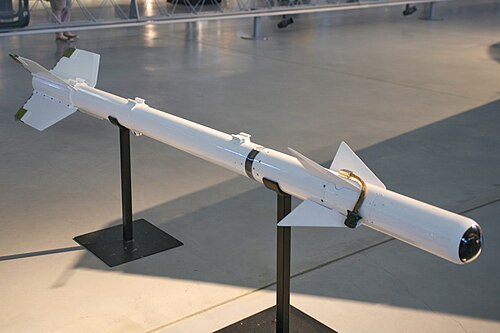
Record revision 1 · The Soviet Union's reverse-engineered Sidewinder, so close a copy that parts of the two missiles interchange.
Real-world weapon as described in public sources. Weights and dimensions change with the fins, fuzes and variant fitted; the data plate names the variants its figures describe, and differences are noted beside the number they affect. The record describes the weapon; it is not a guide to employing it.
Vympel K-13 (R-3) short-range air-to-air missile, NATO AA-2 "Atoll" · K-13 / R-3, AA-2 Atoll
- Type
- Short-range infrared-homing air-to-air missile [1]
- Origin
- Soviet Union; a reverse-engineered copy of the American AIM-9B Sidewinder [1]
- In service
- K-13 (R-3) in limited service from 1960; the improved R-3S from 1962 [1]
- Weight
- 90 kg (198 lb), R-13M [1]
- Dimensions
- Length 2.83 m (R-13M) or 3.48 m (radar-guided R-3R); diameter 127 mm, the same 5 in as the Sidewinder [1]
- Warhead or payload
- About 7.4 kg (16 lb) [1]
- Guidance
- Infrared homingHoming GlossaryNavigation: Flying to a station by keeping the bearing pointer at the top of the instrument without correcting for wind. In a crosswind it flies a curved path.Weapons: The technique whereby a mobile station directs itself, or is directed, towards a source of primary or reflected energy, or to a specified point.; the radar-guided R-3R is the exception [1]
- Motor
- Solid-fuel rocket [1]
- Range
- Minimum engagement range for the R-3S about 1 km; Wikipedia gives no maximum it can support [1]
- Carried by
A Sidewinder in Soviet service
The K-13 is a copy of the AIM-9 SidewinderAIM-9 Sidewinder OrdnanceThe heat-seeking dogfight missile of the US Navy since 1956, copied by the Soviets and still in production as the AIM-9X., and it looks like one. [1] The Sidewinder was quickly reverse-engineered, the copy entered limited service in 1960, and the improved R-3S followed in 1962. NATO saw it in 1961 and named it AA-2 “Atoll”. All versions share the Sidewinder’s 5 in body, and when NATO later examined captured missiles it found that parts from an AIM-9 could be swapped into an AA-2 and either combination would still work. [1] Its seeker has the early Sidewinder’s limits: the R-3S needed about 22 seconds for its seeker to settle, and its minimum range was about a kilometre. [1]
Wide use
The K-13 armed the MiG-21MiG-21 AircraftThe small delta-wing Mach 2 fighter: the most-produced supersonic jet in history. in many air forces. North Vietnamese MiG-21 pilots, few in number, would race in at high speed, fire their missiles in volleys at an American formation and leave at full speed before they could be engaged. [1] Israel captured some in the Six-Day War, and India used them on MiG-21s in 1971. [1]
Sources
- K-13 (missile). Wikipedia (secondary source). https://en.wikipedia.org/wiki/K-13_(missile) (accessed 2026-10-27).
Wikipedia articles are secondary sources and can change; they are cited with the date they were read. NAVEDTRA training manuals and budget justification exhibits are official US publications, but each describes the weapons in service when it was written.