
Drafted — not technically validated
Record revision 1 · One of the largest air-to-air missiles ever built, made for the MiG-25 to catch Mach 3 bombers.
Real-world weapon as described in public sources. Weights and dimensions change with the fins, fuzes and variant fitted; the data plate names the variants its figures describe, and differences are noted beside the number they affect. The record describes the weapon; it is not a guide to employing it.
Bisnovat (later Molniya, then Vympel) R-40 long-range air-to-air missile, NATO AA-6 "Acrid" · R-40, AA-6 Acrid
- Type
- Long-range air-to-air missile [1]
- Origin
- Soviet Union; Bisnovat design bureau, from 1962 [1]
- In service
- Since 1970 [1]
- Weight
- 475 kg (1,047 lb) [1]
- Dimensions
- Length 6.29 m (radar-guided) or 5.91 m (infrared); diameter 0.31 m; wingspan 1.45 m [1]
- Warhead or payload
- Blast-fragmentation, 38 to 100 kg [1]
- Guidance
- Semi-active radar homingHoming GlossaryNavigation: Flying to a station by keeping the bearing pointer at the top of the instrument without correcting for wind. In a crosswind it flies a curved path.Weapons: The technique whereby a mobile station directs itself, or is directed, towards a source of primary or reflected energy, or to a specified point. in the R-40R; infrared homing in the R-40T [1]
- Motor
- Solid-propellant rocket [1]
- Fuzing
- Radar and active laser proximity fuzesProximity fuze GlossaryWeapons: A fuze that detonates before impact when any substantial object is detected at a predetermined distance from it. [1]
- Range
- About 50 to 80 km, depending on version and launch conditions [1]
- Carried by
- MiG-25 and MiG-31 interceptors [1]
Built to catch the Valkyrie
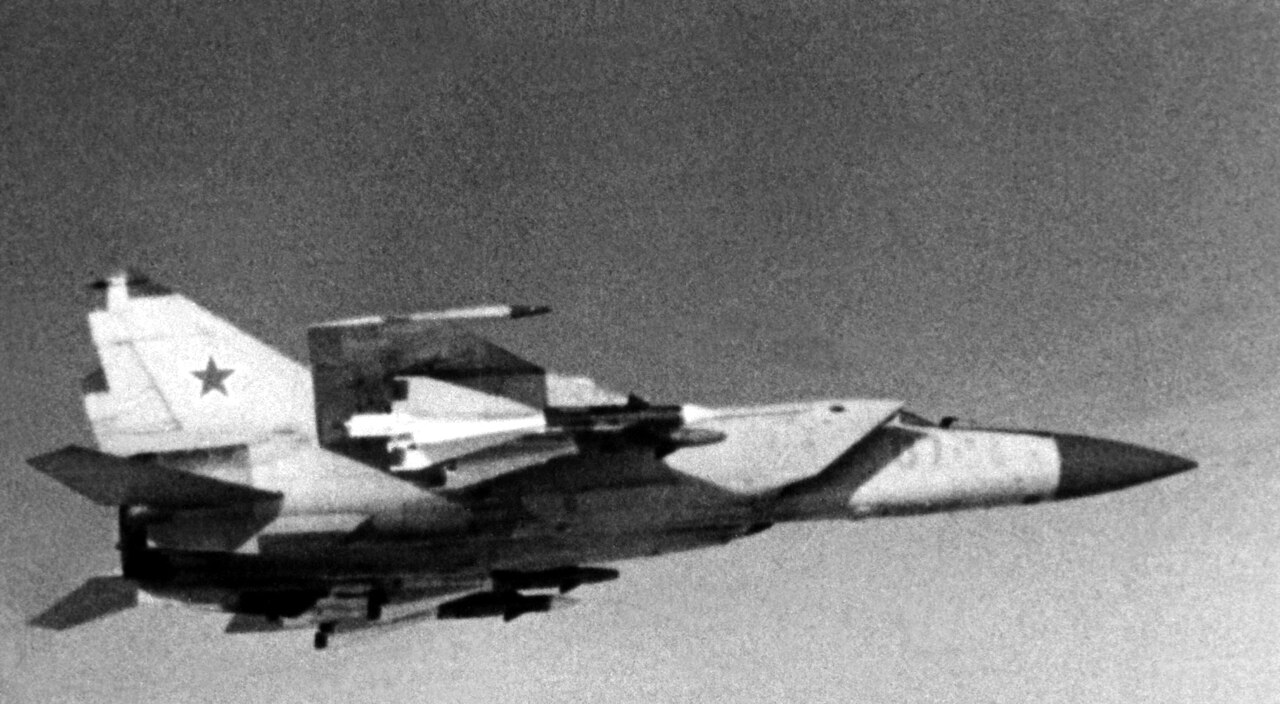
The R-40 exists because of the American XB-70 Valkyrie, a Mach 3 bomber that threatened to make the Soviet air defence force’s interceptors and missiles obsolete at a stroke. The answer was the MiG-25 and a new long-range missile for it, which the Bisnovat bureau began in 1962. [1] The result is one of the largest production air-to-air missiles ever made, at 475 kg and more than 6 m long. [1]
Firing doctrine and combat
Soviet procedure was to fire a pair: an infrared R-40T first, then a radar-guided R-40R, so that the heat-seeker would not lock on to the radar missile. [1] In Soviet hands the R-40 was never fired outside training and tests, but MiG-25s exported to the Middle East used it in combat. [1] On the first night of the 1991 Gulf War an Iraqi MiG-25 shot down a US Navy F/A-18 HornetF/A-18 Hornet AircraftA carrier-capable fighter and attack aircraft that one pilot can switch between roles on the same sortie. of VFA-81, flown by Scott Speicher, with an R-40. [1]
Sources
- R-40 (missile). Wikipedia (secondary source). https://en.wikipedia.org/wiki/R-40_(missile) (accessed 2026-10-27).
Wikipedia articles are secondary sources and can change; they are cited with the date they were read. NAVEDTRA training manuals and budget justification exhibits are official US publications, but each describes the weapons in service when it was written.