
Drafted — not technically validated
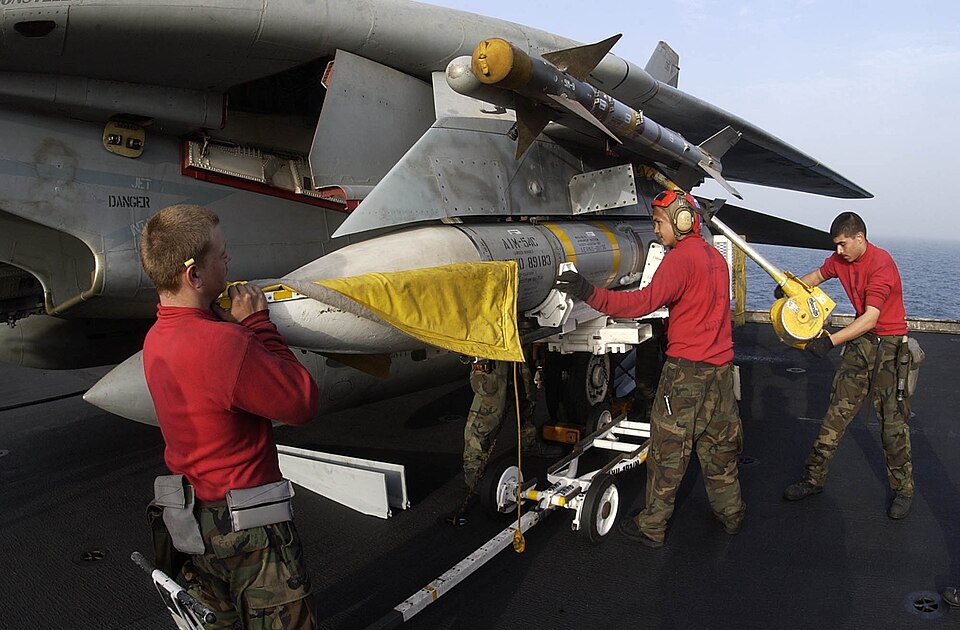
Record revision 1 · The F-14 Tomcat's long-range fleet-defence missile: up to six fired at once, each guided to a different target.
Real-world weapon as described in public sources. Weights and dimensions change with the fins, fuzes and variant fitted; the data plate names the variants its figures describe, and differences are noted beside the number they affect. The record describes the weapon; it is not a guide to employing it.
AIM-54 Phoenix long-range air-to-air missile · AIM-54
- Type
- Long-range air-intercept missile with active, semi-active and passive homing [2]
- Origin
- United States; designed by Hughes Aircraft from 1960 [1]
- Weight
- About 1,020 lb (463 kg), AIM-54C [2]
- Dimensions
- Length 13 ft (4 m); diameter 15 in (381 mm) [2]
- Warhead or payload
- Continuous-rod high-explosive warhead of about 133 lb (60 kg) [1]
- Guidance
- Semi-active radar mid-course guidance from the F-14's AWG-9 and active radar homingHoming GlossaryNavigation: Flying to a station by keeping the bearing pointer at the top of the instrument without correcting for wind. In a crosswind it flies a curved path.Weapons: The technique whereby a mobile station directs itself, or is directed, towards a source of primary or reflected energy, or to a specified point. at the end [1] [2]
- Motor
- Solid-propellant rocket motor [1]
- Fuzing
- Proximity fuzeProximity fuze GlossaryWeapons: A fuze that detonates before impact when any substantial object is detected at a predetermined distance from it. [1]
- Delivery
- Up to six from one F-14, guided at the same time against widely separated targets [2]
- Range
- About 72.9 nmi (135 km) for the AIM-54A/B and 99.4 nmi (184 km) for the AIM-54C, at the best launch conditions [1]
- Carried by
- F-14 TomcatF-14 Tomcat AircraftThe Navy's swing-wing fleet defence fighter: two crew, AWG-9 radar and AIM-54 Phoenix., its only operational launch aircraft [1] [2]
A missile for the fleet
The Phoenix was built for one job: stopping massed Soviet bombers and their cruise missilesGuided missile GlossaryWeapons: An unmanned vehicle moving above the surface of the Earth whose trajectory or flight path is capable of being altered by an external or internal mechanism. before they could reach a carrier group. [1] The Navy’s ordnance manual calls the AIM-54C a long-range air-intercept missile for the F-14F-14 Tomcat AircraftThe Navy's swing-wing fleet defence fighter: two crew, AWG-9 radar and AIM-54 Phoenix., used with its AWG-9 airborne missile control system. One aircraft can launch up to six, guided at the same time against widely separated targets, and the missile also has dogfight, anti-jamming and anti-cruise-missile capabilities. [2] It is big for an air-to-air missileGuided missile GlossaryWeapons: An unmanned vehicle moving above the surface of the Earth whose trajectory or flight path is capable of being altered by an external or internal mechanism.: 13 ft long, 15 in across and about 1,020 lb. Beyond that, the manual says, its description is classified. [2]
The pairing of the Phoenix with the AWG-9 made it the first air weapon system that could engage several targets at once. Because the missile turns on its own radar for the final run, firing it was called “FoxFOX GlossaryBrevity: Simulated or actual launch of air-to-air weapons. (ONE): Semi active radar-guided missile. (TWO): IR-guided missile. (THREE): Active radar-guided missile. Three”. [1]
A short American combat record
In US service the Phoenix was fired in combat only twice, both times at Iraqi fighters in 1999, and neither missile hit. It was retired on 30 September 2004, two years before the F-14 itself. [1] Iran, which bought Tomcats and Phoenixes before 1979, used them heavily in the Iran–Iraq War; historians Tom Cooper and Farzad Bishop credit the missile with 78 kills there. [1]
Sources
- AIM-54 Phoenix. Wikipedia (secondary source). https://en.wikipedia.org/wiki/AIM-54_Phoenix (accessed 2026-10-27).
- Aviation Ordnanceman, NAVEDTRA 14313, p. 3-14. US Navy, Naval Education and Training Command; copy hosted by Integrated Publishing. https://navyaviation.tpub.com/14313/css/Phoenix-Missile-88.htm (accessed 2026-10-27).
Wikipedia articles are secondary sources and can change; they are cited with the date they were read. NAVEDTRA training manuals and budget justification exhibits are official US publications, but each describes the weapons in service when it was written.