
Drafted — not technically validated
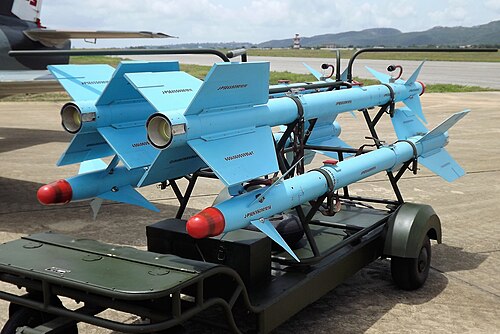
Record revision 1 · A Chinese infrared dogfight missile descended from the Sidewinder via the Soviet K-13, carried by the JF-17.
Real-world weapon as described in public sources. Weights and dimensions change with the fins, fuzes and variant fitted; the data plate names the variants its figures describe, and differences are noted beside the number they affect. The record describes the weapon; it is not a guide to employing it.
PL-5 short-range air-to-air missile · PL-5 (Pi Li-5)
- Type
- Short-range infrared-homing air-to-air missile [1]
- Origin
- China; Luoyang Electro-Optics Technology Development Centre [1]
- In service
- In production from 1982; PL-5C in the mid-1980s and PL-5E-II in the early 1990s [1]
- Weight
- 148 kg (PL-5B, PL-5C) or 83 kg (PL-5E) [1]
- Dimensions
- Length 3.128 m (PL-5B, C) or 2.893 m (PL-5E); diameter 0.127 m (PL-5E) [1]
- Warhead or payload
- 6 kg blast-fragmentation or expanding-rod warhead [1]
- Guidance
- Infrared homingHoming GlossaryNavigation: Flying to a station by keeping the bearing pointer at the top of the instrument without correcting for wind. In a crosswind it flies a curved path.Weapons: The technique whereby a mobile station directs itself, or is directed, towards a source of primary or reflected energy, or to a specified point.; the PL-5E-II has a dual-band, multi-element detector [1]
- Motor
- Solid-fuel rocket [1]
- Fuzing
- Active infrared or laser proximity fuzeProximity fuze GlossaryWeapons: A fuze that detonates before impact when any substantial object is detected at a predetermined distance from it. [1]
- Range
- 1.3 to 16 km (PL-5B, C), at best [1]
- Carried by
- JF-17 ThunderJF-17 Thunder AircraftA lightweight Pakistani–Chinese multirole fighter powered by the RD-93. [2]
- F-7 and other Chinese fighters, trainers and helicopters [1]
A long road into service
The PL-5 follows the PL-2, which was based on the Soviet K-13K-13 (R-3) "Atoll" OrdnanceThe Soviet Union's reverse-engineered Sidewinder, so close a copy that parts of the two missiles interchange. and so, at one remove, on the SidewinderAIM-9 Sidewinder OrdnanceThe heat-seeking dogfight missile of the US Navy since 1956, copied by the Soviets and still in production as the AIM-9X.. [1] Work began in 1966 but production started only in 1982. The designers first considered radar guidance, like the US Navy’s AIM-9C, before settling on a heat-seeker, the PL-5B. The PL-5C followed in the mid-1980s and the PL-5E-II in the early 1990s. [1]
China’s newest fighters now use the PL-8 and PL-10, but the PL-5 remains useful on lighter aircraft that cannot carry them. [1] The JF-17JF-17 Thunder AircraftA lightweight Pakistani–Chinese multirole fighter powered by the RD-93. carries the PL-5E alongside the radar-guided PL-12PL-12 OrdnanceChina's first active-radar beyond-visual-range missile, exported as the SD-10 and carried by the JF-17.. [2]
Sources
- PL-5. Wikipedia (secondary source). https://en.wikipedia.org/wiki/PL-5 (accessed 2026-10-27).
- CAC/PAC JF-17 Thunder. Wikipedia (secondary source). https://en.wikipedia.org/wiki/CAC/PAC_JF-17_Thunder (accessed 2026-10-27).
Wikipedia articles are secondary sources and can change; they are cited with the date they were read. NAVEDTRA training manuals and budget justification exhibits are official US publications, but each describes the weapons in service when it was written.