
Drafted — not technically validated
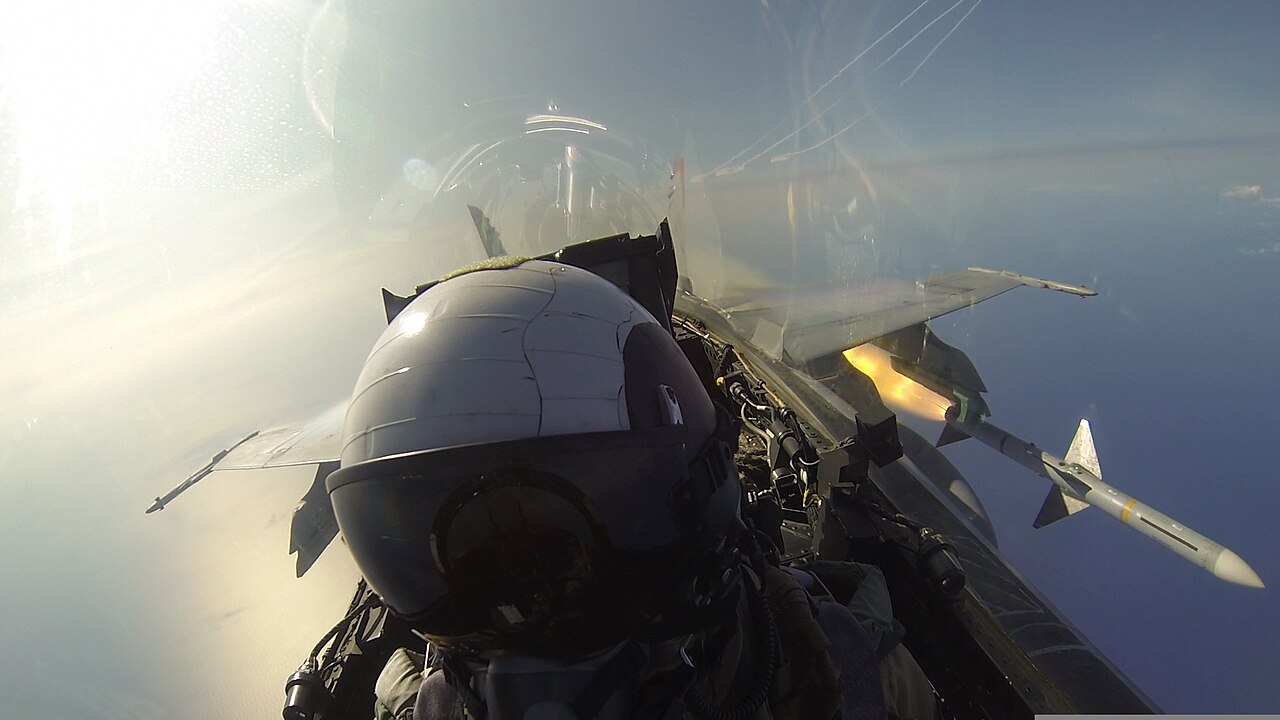
Record revision 1 · The West's main radar-guided missile from the late 1950s to the 1990s, which homes on radar energy the fighter reflects off its target.
Real-world weapon as described in public sources. Weights and dimensions change with the fins, fuzes and variant fitted; the data plate names the variants its figures describe, and differences are noted beside the number they affect. The record describes the weapon; it is not a guide to employing it.
AIM-7 Sparrow medium-range air-to-air missile · AIM-7
- Origin
- United States; a US Navy programme of the late 1940s [1]
- In service
- Since 1958 [1]; still in service, but being replaced by the AIM-120AIM-120 AMRAAM OrdnanceThe active-radar "fire and forget" missile that replaced the Sparrow, carried by US fighters of every service since 1991. [1]
- Weight
- About 510 lb (231 kg), AIM-7F/M [2]
- Dimensions
- Length about 142 in (3.6 m); diameter 8 in (203 mm) [2]
- Warhead or payload
- Continuous-rod warhead [1]: 65 lb (29 kg) in the AIM-7C/D/E and 88 lb (40 kg) in the AIM-7F/M [1]
- Guidance
- Semi-active radar homingHoming GlossaryNavigation: Flying to a station by keeping the bearing pointer at the top of the instrument without correcting for wind. In a crosswind it flies a curved path.Weapons: The technique whereby a mobile station directs itself, or is directed, towards a source of primary or reflected energy, or to a specified point.: the missile homes on radio-frequency energy radiated by the launching aircraft and reflected by the target [2]
- Motor
- Solid rocket; the AIM-7F introduced a dual-stage motor, and the F/M/P use the Hercules Mk 58 [1]
- Fuzing
- The AIM-7M has an active radar proximity fuzeProximity fuze GlossaryWeapons: A fuze that detonates before impact when any substantial object is detected at a predetermined distance from it. [1]
- Delivery
- Rail or ejection launched [2]
- Range
- AIM-7F/M/P about 70 km (38 nmi), and about 50 km for the AIM-7E [1]. These are best cases; head-on shots at altitude reach furthest
- Carried by
- F-14 TomcatF-14 Tomcat AircraftThe Navy's swing-wing fleet defence fighter: two crew, AWG-9 radar and AIM-54 Phoenix. and F/A-18 HornetF/A-18 Hornet AircraftA carrier-capable fighter and attack aircraft that one pilot can switch between roles on the same sortie. [2]
- F-4 Phantom IIF-4 Phantom II AircraftThe big two-seat Cold War fighter-bomber; the F-4E added an internal gun and slats after Vietnam., F-15 EagleF-15C Eagle AircraftA twin-engine air superiority fighter with more than 104 air-to-air victories and no losses., F-15E Strike EagleF-15E Strike Eagle AircraftThe two-seat, long-range, all-weather strike derivative of the Eagle. and F-16 Fighting FalconF-16 Fighting Falcon AircraftA single-engine multirole fighter: fly-by-wire, 9 g, and the US Air Force's main strike and SEAD aircraft. [1]
Riding the fighter’s radar
The Sparrow was the West’s main beyond-visual-range missile from the late 1950s until the 1990s, used by the US Air Force, Navy and Marine Corps and many other air arms. [1] The Navy’s ordnance manual describes the AIM-7F/M as a supersonicSupersonic GlossaryFlight: The regime of flight from about Mach 1.20 to 5.00, with definite supersonic flow on all parts of the aircraft. Above Mach 5.00 is hypersonic., all-weather, semi-active missile. It carries no radar transmitter of its own: its target seeker receives the radar energy that the launching aircraft beams at the target and that the target reflects. [2] The call for a semi-active radar shot is “FoxFOX GlossaryBrevity: Simulated or actual launch of air-to-air weapons. (ONE): Semi active radar-guided missile. (TWO): IR-guided missile. (THREE): Active radar-guided missile. One”.
That design ties the fighter to the fight. The launching aircraft’s radar has to stay pointed at the target until the missile arrives, so the pilot keeps flying toward the enemy, who may get close enough to fire a heat-seeker in the meantime. [1]
Vietnam to the Gulf
Over Vietnam the Sparrow’s record was disappointing. Wikipedia puts it down to unreliable missiles in a tropical climate, limited training in fighter-versus-fighter combat, and rules of engagement that mostly ruled out beyond-visual-range shots. [1] The AIM-7F of 1976 brought solid-state electronics, a dual-stage motor and a larger warhead, and the AIM-7M of 1982 a new inverse monopulse seeker. In the 1991 Gulf War, 30 of 44 Sparrows fired hit their targets, and 19 of the kills were beyond visual range. [1]
Related entries: AIM-120 AMRAAMAIM-120 AMRAAM OrdnanceThe active-radar "fire and forget" missile that replaced the Sparrow, carried by US fighters of every service since 1991. and R-27 AlamoR-27 "Alamo" OrdnanceThe Flanker and Fulcrum's medium-range missile, built in radar, infrared and anti-radiation versions on one airframe..
Sources
- AIM-7 Sparrow. Wikipedia (secondary source). https://en.wikipedia.org/wiki/AIM-7_Sparrow (accessed 2026-10-27).
- Aviation Ordnanceman, NAVEDTRA 14313, p. 3-8. US Navy, Naval Education and Training Command; copy hosted by Integrated Publishing. https://navyaviation.tpub.com/14313/css/Sparrow-Iii-Guided-Missile-82.htm (accessed 2026-10-27).
Wikipedia articles are secondary sources and can change; they are cited with the date they were read. NAVEDTRA training manuals and budget justification exhibits are official US publications, but each describes the weapons in service when it was written.