
Drafted — not technically validated
Record revision 1 · A twin-engine air superiority fighter with more than 104 air-to-air victories and no losses.
Real-world aircraft as described in public sources. Figures vary between variants, loads and sources; the data plate names the variant its figures describe, and differences are noted beside the number they affect.
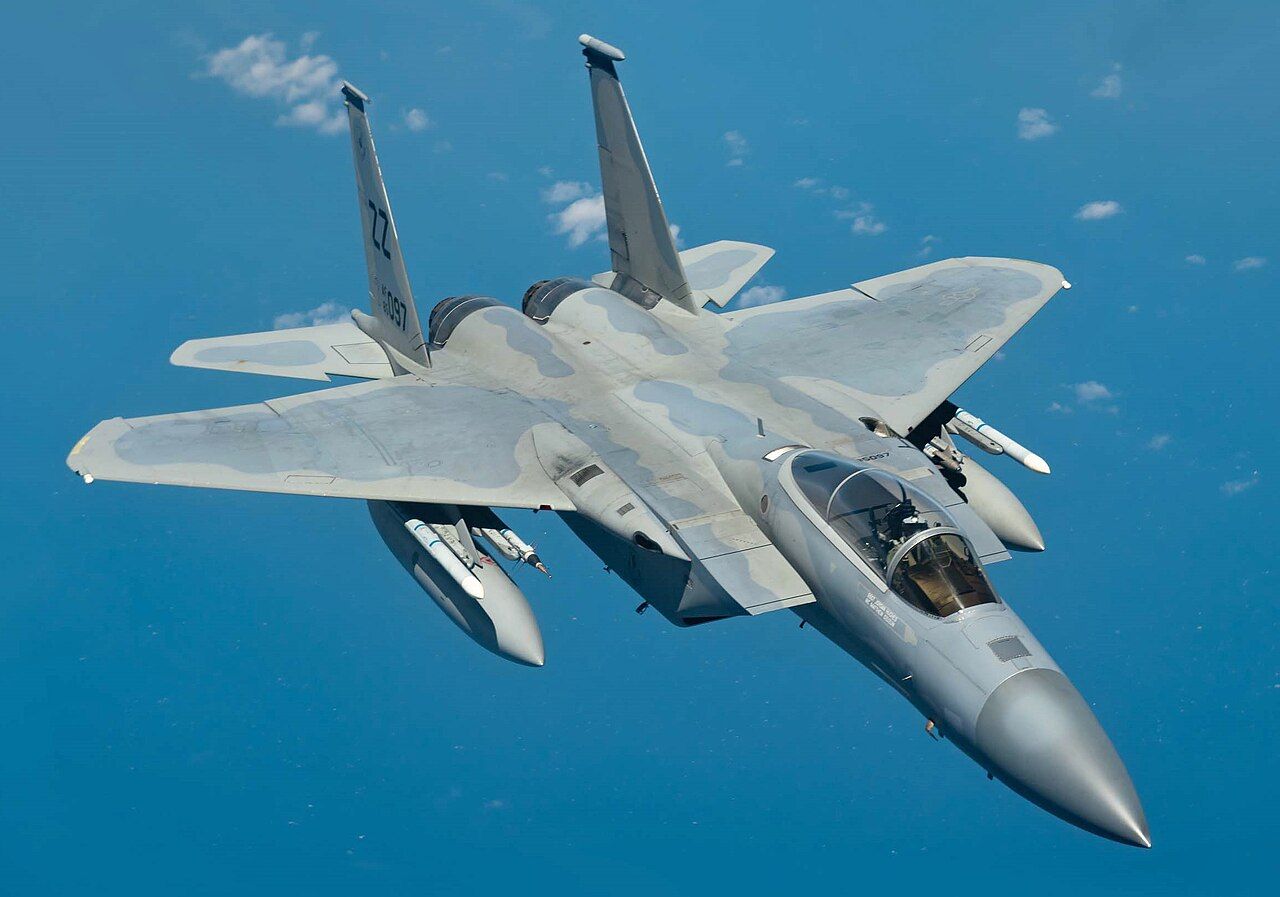
F-15C Eagle · McDonnell Douglas F-15C
- Origin
- United States
- Manufacturer
- McDonnell Douglas, now Boeing [1]
- Crew
- 1 (F-15D: 2) [1]
- First flight
- 27 July 1972 [1]
- Entered service
- 9 January 1976 [1]
- Status
- In service; 1,198 F-15A/B/C/D/J/DJ built. US Air Force F-15Cs are being retired, most of the rest by 2030 [1]
- Powerplant
- Two Pratt & Whitney F100 afterburningAfterburner GlossaryFlight: An additional combustion area aft of the turbine section of a turbojet, with fuel nozzles and flameholders, that burns fuel in the engine's large excess of air. It adds only 10 to 20 percent to the engine's weight but 40… turbofans: F100-PW-220, 23,770 lbf each with afterburnerAfterburner GlossaryFlight: An additional combustion area aft of the turbine section of a turbojet, with fuel nozzles and flameholders, that burns fuel in the engine's large excess of air. It adds only 10 to 20 percent to the engine's weight but 40… [1]; the FAS sheet gives 25,000 lb each for C/D models [2]
- Range
- Combat radius 586 NM on a counter-air mission with one external tank; ferry range 3,000 NM with conformal and three external tanks [1] [2]
- Armament
- Sensors and avionics
- AN/APG-63 or APG-70 pulse-Doppler radar, later APG-63(V)1, and the AESA APG-63(V)2 and (V)3 [1]
- Tactical Electronic WarfareEW GlossaryJoint terms: Electronic warfare. Military action involving the use of electromagnetic and directed energy to control the electromagnetic spectrum or to attack the enemy. System including the AN/ALR-56 radar warning receiver and ALQ-135 internal jammerElectromagnetic jamming GlossaryJoint terms: The deliberate radiation, reradiation, or reflection of electromagnetic energy for the purpose of preventing or reducing an enemy's effective use of the electromagnetic spectrum, and with the intent of degrading or… [1]
- Joint Helmet Mounted Cueing System [1]
- Purchase
- DCS WorldF-15C Flaming Cliffs by Eagle DynamicsDCS Store
- Microsoft Flight SimulatorF-15 C, D, E and I Eagle by DC DesignsJust Flight
Store pages checked 2026-10-28. Prices and availability change.
“Not a pound for air-to-ground”
In 1967 the Soviet Union showed off a new fighter at Domodedovo airfield near Moscow. The MiG-25 had a huge wing and was built for speeds above MachMach number GlossaryFlight: The ratio of the true airspeed to the speed of sound. All compressibility effects depend on it. 2.8, and to Western observers it looked as if the United States was about to be outclassed: it seemed faster, higher-flying and longer-legged than any American fighter, including the one still on the drawing board. The US Air Force’s answer was to sharpen its F-X project into a pure air superiorityAir superiority GlossaryJoint terms: That degree of dominance in the air battle by one force that permits the conduct of its operations at a given time and place without prohibitive interference from air and missile threats. fighter. [1] Its design team’s slogan said it all: “Not a pound for air-to-ground.” [2]
McDonnell Douglas won the contract in 1969. The Eagle first flew in July 1972 and entered service in 1976, replacing the F-4 Phantom IIF-4 Phantom II AircraftThe big two-seat Cold War fighter-bomber; the F-4E added an internal gun and slats after Vietnam.. [1] It was built to fly higher and faster than the PhantomF-4 Phantom II AircraftThe big two-seat Cold War fighter-bomber; the F-4E added an internal gun and slats after Vietnam., climb and accelerate far better, and give its pilot an all-round view and a radar that could look down and shoot down at low-flying targets. [2]
Power to spare
The Eagle’s secret is a big wing and a lot of thrust. Low wing loading lets it turn hard at up to 9 g without bleeding airspeed, it can climb to 30,000 ft in about a minute, and at some speeds its two F100 engines produce more thrust than the aircraft’s weight and drag, so it can accelerate going straight up. [1]
The Air Force proved it in 1975. An unpainted F-15A stripped of most of its avionics, the “Streak Eagle”, broke eight time-to-climb world records from Grand Forks, North Dakota, between 16 January and 1 February. It now stands in the National Museum of the US Air Force. [1] All that thrust came at a price in the early years: the F100-PW-100 engines were unreliable, not helped by pilots slamming the throttles about far more than in earlier fighters, until the improved F100-PW-220 arrived in 1986. [1]
The airframe is famously tough. In 1983 an Israeli F-15D collided with an A-4 Skyhawk over the Negev and lost most of its right wing. Using full afterburnerAfterburner GlossaryFlight: An additional combustion area aft of the turbine section of a turbojet, with fuel nozzles and flameholders, that burns fuel in the engine's large excess of air. It adds only 10 to 20 percent to the engine's weight but 40…, and landing at twice the normal speed, pilot Zivi Nedivi brought it home to Ramon Airbase. Wind-tunnel tests later showed that controlled flight on one wing was possible only within a very narrow band of speed and angle of attackAOA GlossaryJoint terms: Angle of attack. The angle at which relative wind meets an airfoil. It is the angle that is formed by the chord of the airfoil and the direction of the relative wind or between the chord line and the flight path.. [1]
Weapons and sensors
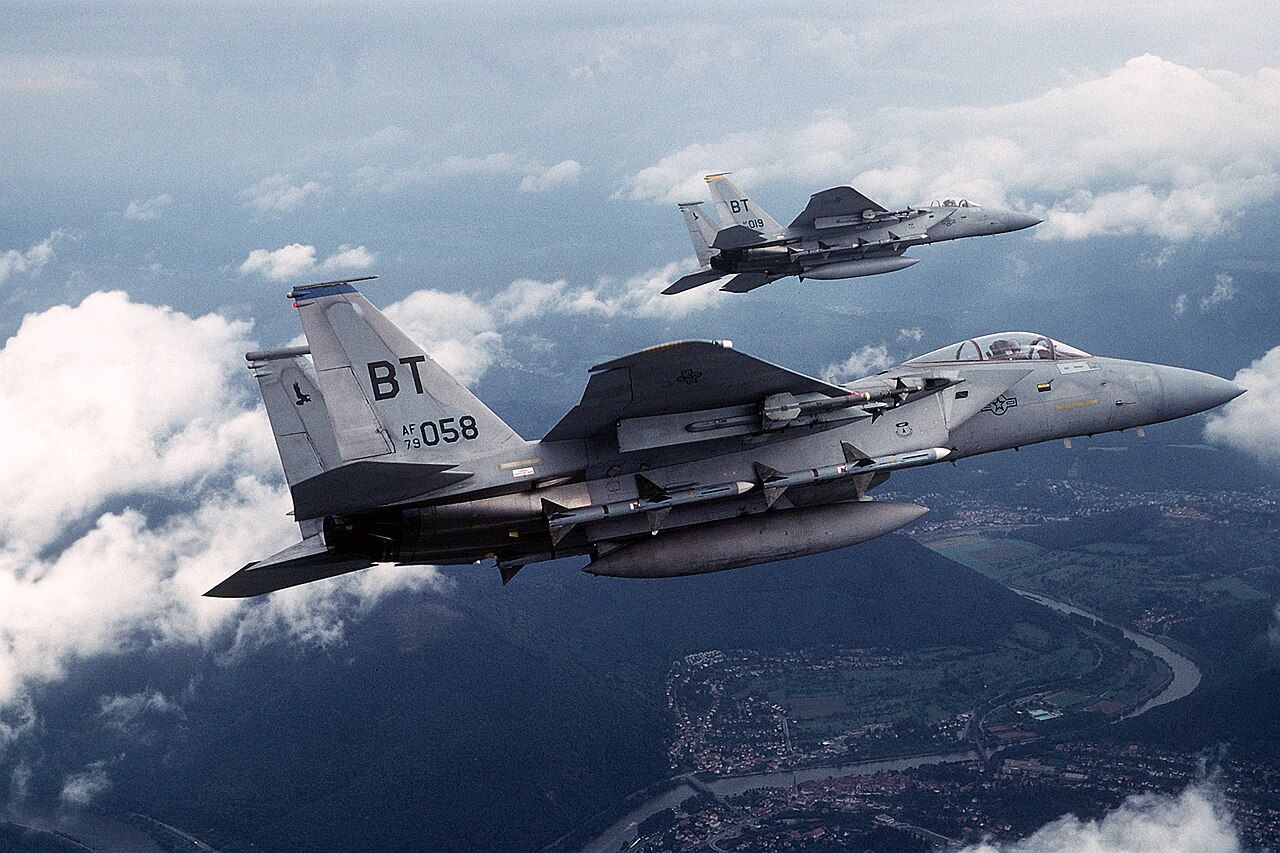
The F-15C carries up to eight air-to-air missiles: Sidewinders on the wing pylons and Sparrows or AMRAAMs on the fuselage stations, with an internal M61 gun and 940 rounds. [2] Everything is laid out so that one pilot can fight alone. [1] The original APG-63 radar was later replaced on some aircraft by active electronically scanned array (AESA) versions. [1]
104 to nothing
Israel flew the Eagle into combat first, and its pilot Moshe Melnik scored the first F-15 kill in 1979. In the 1982 Lebanon War Israeli F-15s were credited with 41 Syrian aircraft. [1]
In the 1991 Gulf War, F-15s accounted for 36 of the US Air Force’s 39 air-to-air victories over Iraq. The C and D fighters held the air while the F-15EF-15E Strike Eagle AircraftThe two-seat, long-range, all-weather strike derivative of the Eagle. Strike Eagles hunted Scud launchers at night. [1] Across all its users the F-15 has a combined record of 104 kills, and the air superiorityAir superiority GlossaryJoint terms: That degree of dominance in the air battle by one force that permits the conduct of its operations at a given time and place without prohibitive interference from air and missile threats. versions have never been lost to enemy action in air combat. More than half of those kills were scored by Israeli pilots. [1]
One of the strangest Eagle missions was flown in space. From 1984 to 1986 two F-15As served as the first stage of the ASM-135 anti-satellite missile. On the third test, Major Wilbert “Doug” Pearson’s missile destroyed a working solar observatory satellite in orbit, making him the only pilot ever to destroy a satellite. The programme ended in 1988. [1]
The F-22 began replacing the F-15C in the 2000s. Fewer F-22s were bought than planned, so the Eagle soldiered on, mostly with the Air National Guard, and the Air Force added the new F-15EX alongside it. The last active-duty F-15C flight was flown from Kadena in Japan on 24 January 2025. [1] The design’s untapped strike potential became the two-seat F-15E Strike Eagle. [2]

Sources
- McDonnell Douglas F-15 Eagle. Wikipedia (secondary source). https://en.wikipedia.org/wiki/McDonnell_Douglas_F-15_Eagle (accessed 2026-10-25).
- F-15 Eagle. Federation of American Scientists, Military Analysis Network. https://man.fas.org/dod-101/sys/ac/f-15.htm (accessed 2026-10-25).
Wikipedia articles are secondary sources and can change; they are cited with the date they were read. The Federation of American Scientists (FAS) Military Analysis Network pages largely reproduce US service fact sheets of the late 1990s and early 2000s, so later upgrades are not covered there.