
Drafted — not technically validated
Record revision 1 · The carrier-capable Hawk derivative in which Navy and Marine Corps strike pilots learn jets.
Real-world aircraft as described in public sources. Figures vary between variants, loads and sources; the data plate names the variant its figures describe, and differences are noted beside the number they affect.
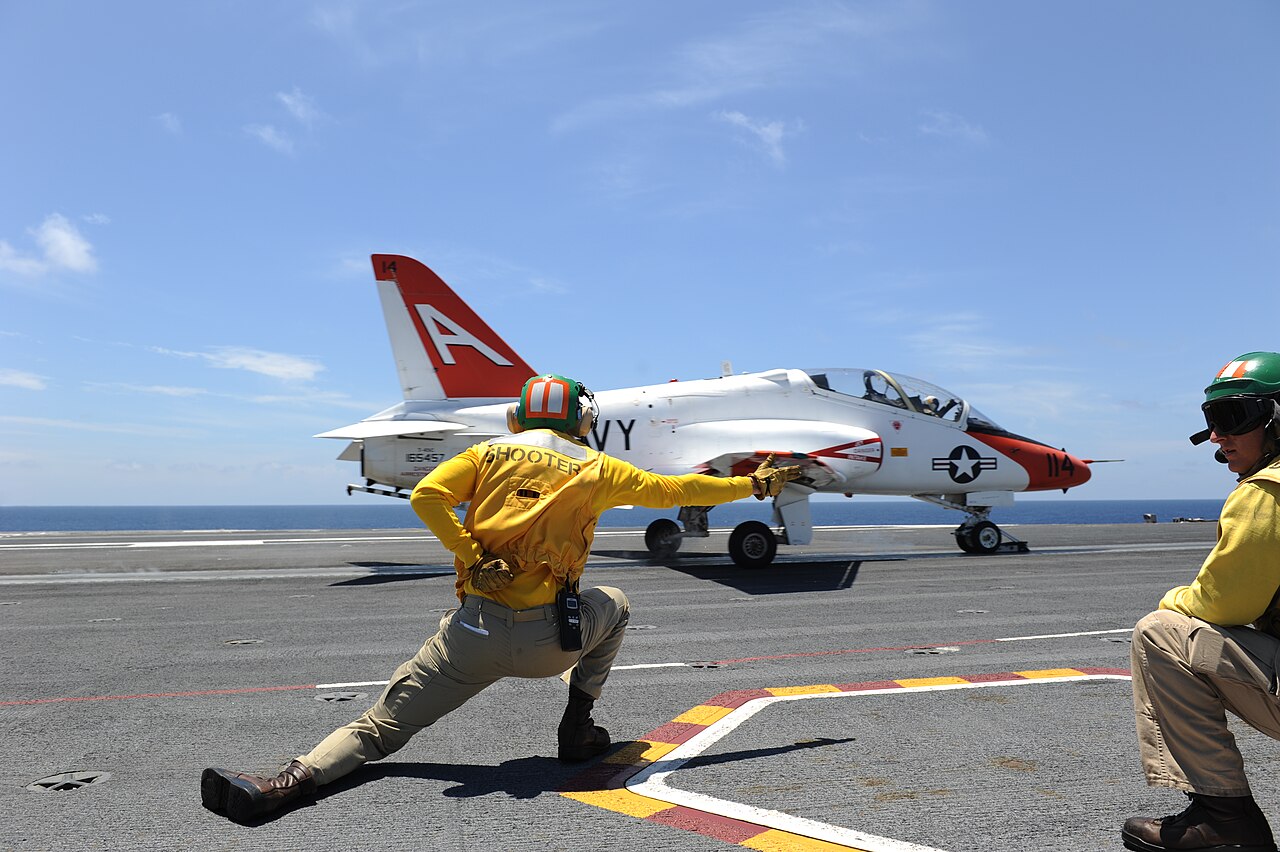
T-45 Goshawk · McDonnell Douglas/Boeing T-45C
- Variant described
- T-45A (analog cockpit) and T-45C (glass cockpit); all T-45As now upgraded to T-45C [1]
- Role
- Carrier-capable intermediate and advanced jet trainer for Navy and Marine Corps strike pilots [1] [2]
- Origin
- United States and United Kingdom
- Manufacturer
- McDonnell Douglas (now Boeing) with British Aerospace (now BAE Systems) [1]
- Crew
- 2 (student and instructor in tandem) [1]
- First flight
- 16 April 1988 [1]
- Entered service
- 1991 (US Navy) [1]
- Status
- In service; 221 built from 1988 to 2009; planned to serve until 2035 or later [1]
- Powerplant
- One Rolls-Royce Turbomeca F405-RR-401 Adour turbofan, 5,527 lbf (de-rated from 5,845 lbf) [1] [2]
- Maximum speed
- 543 kt at 8,000 ft [1]
- Service ceiling
- 42,500 ft [1]
- Range
- 700 NM [1]
- Armament
- Purchase
- Microsoft Flight SimulatorT-45 Goshawk by IndiaFoxtEchoOrbx
Store pages checked 2026-10-28. Prices and availability change.
A Hawk for the boat
By the mid-1970s the US Navy needed to replace two jet trainers at once: the T-2 Buckeye for intermediate training and the TA-4 Skyhawk for the advanced phase. [1] [2] Rather than design a new jet, it chose an existing one. In November 1981 the Navy picked the British Aerospace Hawk, a land-based trainer that had first flown in 1974, and McDonnell Douglas led the American programme with British Aerospace as partner. [1] [2] It bought more than an aeroplane: the T-45 came as an integrated training system with flight and instrument simulators, academics and a system to tie them together. [1] [2] The first Goshawk flew on 16 April 1988 and the type entered service in 1991. [1]
Rebuilt for catapults and arresting wires
Turning a land trainer into a carrier jet took real surgery. The Goshawk got a stronger airframe and landing gear to take catapult launches and landings at a sink rate of 14 ft per second, a new two-wheel nose gear with a catapult tow bar, an arresting hook, a wider tailplane, side-mounted airbrakes and small strakes on the rear fuselage to smooth the airflow over the tail with the brakes out. [1] Navy test pilots then found faults that needed further changes: a ventral fin ahead of the hook, a taller fin, squared-off wingtips and leading-edge slats. [1] Much of this was driven by the ship it was meant for, the Second World War-era USS Lexington, then the Navy’s training carrier, with its short catapults and arresting gear. [1]
Where strike pilots begin
The T-45 carries Navy and Marine Corps student naval aviators through the intermediate and advanced phases of strike pilot training, with Training Air Wing One at NAS Meridian, Mississippi, and Training Air Wing Two at NAS Kingsville, Texas. [1] From 2008 it also flew in the advanced strike track for student naval flight officers with Training Air Wing Six at Pensacola, Florida. [1] The jet is normally unarmed, but a hardpoint under each wing can take a practice bomb rack, a rocket pod or a fuel tank, and students learn to deliver weapons in it with small practice bombs such as the Mk 76Mk 76 and BDU-33 practice bombs OrdnanceThe 25 lb blue practice bombs that let Navy and Air Force crews practise bombing and see each hit by its smoke or flash.. [1] [3] The Navy’s flight training instruction for those weapons sorties, with its dive patterns, error tables and pop-up attacks, is the source behind the worked numbers in this site’s Weapons Delivery module. [3]
Glass cockpits and growing pains
The first T-45As had analog cockpits. From December 1997 the Navy took delivery of the T-45C with a digital glass cockpit, and every T-45A was later brought up to the same standard. [1] Production ended with the 221st aircraft in 2009. [1] In 2017 the fleet stopped flying for a three-day “safety pause” after more than 100 instructor pilots refused to fly it, citing hypoxia incidents they blamed on the onboard oxygen-generating system; flights resumed with altitude limits and returned to normal in August 2017. [1] In October 2022 the fleet was grounded again for two weeks after a compressor blade fault turned up in a preflight check. [1] The Navy plans to keep the Goshawk until 2035 or later. [1]
Sources
- McDonnell Douglas T-45 Goshawk. Wikipedia (secondary source). https://en.wikipedia.org/wiki/McDonnell_Douglas_T-45_Goshawk (accessed 2026-10-27).
- T-45 Goshawk. Federation of American Scientists, Military Analysis Network. https://man.fas.org/dod-101/sys/ac/t-45.htm (accessed 2026-10-27).
- CNATRA P-1219, Flight Training Instruction, Weapons, T-45 (4-03). Chief of Naval Air Training, US Navy (Integrated Publishing mirror). https://navyflightmanuals.tpub.com/P-1219/ (accessed 2026-10-27).
Wikipedia articles are secondary sources and can change; they are cited with the date they were read. The Federation of American Scientists (FAS) Military Analysis Network pages largely reproduce US service fact sheets of the late 1990s and early 2000s, so later upgrades are not covered there.