
Drafted — not technically validated
Record revision 1 · A vectored-thrust jump jet: vertical or short take-off, flown by the US Marines for close air support.
Real-world aircraft as described in public sources. Figures vary between variants, loads and sources; the data plate names the variant its figures describe, and differences are noted beside the number they affect.
AV-8B Harrier II Night Attack · McDonnell Douglas AV-8B(NA)
- Role
- V/STOL ground-attack aircraft [1]
- Origin
- United States and United Kingdom
- Manufacturer
- McDonnell Douglas and British Aerospace, later Boeing and BAE Systems [1]
- First flight
- YAV-8B: 9 November 1978; AV-8B: 5 November 1981 [1]
- Entered service
- January 1985 (US Marine Corps) [1]
- Status
- In limited service with the Spanish and Italian navies; the US Marine Corps retired its last on 3 June 2026 [1]
- Powerplant
- One Rolls-Royce Pegasus F402-RR-408 vectored-thrust turbofan, about 22,200 to 23,500 lbf [1] [2]
- Service ceiling
- Not given in the cited sources
- Range
- Combat radius 300 NM; ferry range 1,800 NM [1]; high-speed low-level combat radius greater than 142 NM [2]
- Armament
- One 25 mm GAU-12 Equalizer five-barrel rotary cannon in an underfuselage pod, 300 rounds [1] [2]
- Up to 9,000 lb on seven stations; standard loads six Mk 82Mark 82 general-purpose bomb OrdnanceThe 500 lb low-drag bomb that is one of the most common air-dropped weapons in the world, with conical, Snakeye or ballute tails. bombs or four AIM-9 Sidewinders [2]
- AGM-65 Maverick, laser- and GPS-guided bombs and rockets [1]
- Sensors and avionics
- Purchase
- DCS WorldDCS: AV-8B Night Attack V/STOL by RAZBAMNot on sale: the DCS Store lists this RAZBAM module as not available
- Microsoft Flight SimulatorAV-8B Harrier II by DC DesignsJust Flight
Store pages checked 2026-10-28. Prices and availability change.
The jump jet grows up
The first Harriers proved that a combat jet could take off and land like a helicopter, but they paid for it. In a short take-offSTOL GlossaryJoint terms: Short takeoff and landing. The ability of an aircraft to clear a 50-foot (15 meters) obstacle within 1,500 feet (450 meters) of commencing takeoff or in landing, to stop within 1,500 feet (450 meters) after passing over… the US Marine Corps’ AV-8A carried less than half the bomb load of the smaller A-4 Skyhawk, and over a shorter radius. [1] In 1973 Hawker Siddeley and McDonnell Douglas set out to double the Harrier’s payload and range, starting with a bigger Pegasus engine. Britain left the project for budget reasons in 1975, so McDonnell Douglas carried on alone and rebuilt the design as the AV-8B: a larger composite wing with an extra weapons station on each side, a raised cockpit, a new fuselage and an improved Pegasus. [1] Britain rejoined in 1981, and the AV-8B first flew in November 1981. The Marines declared it ready for operations with VMA-331 in January 1985. [1]
How a Harrier flies
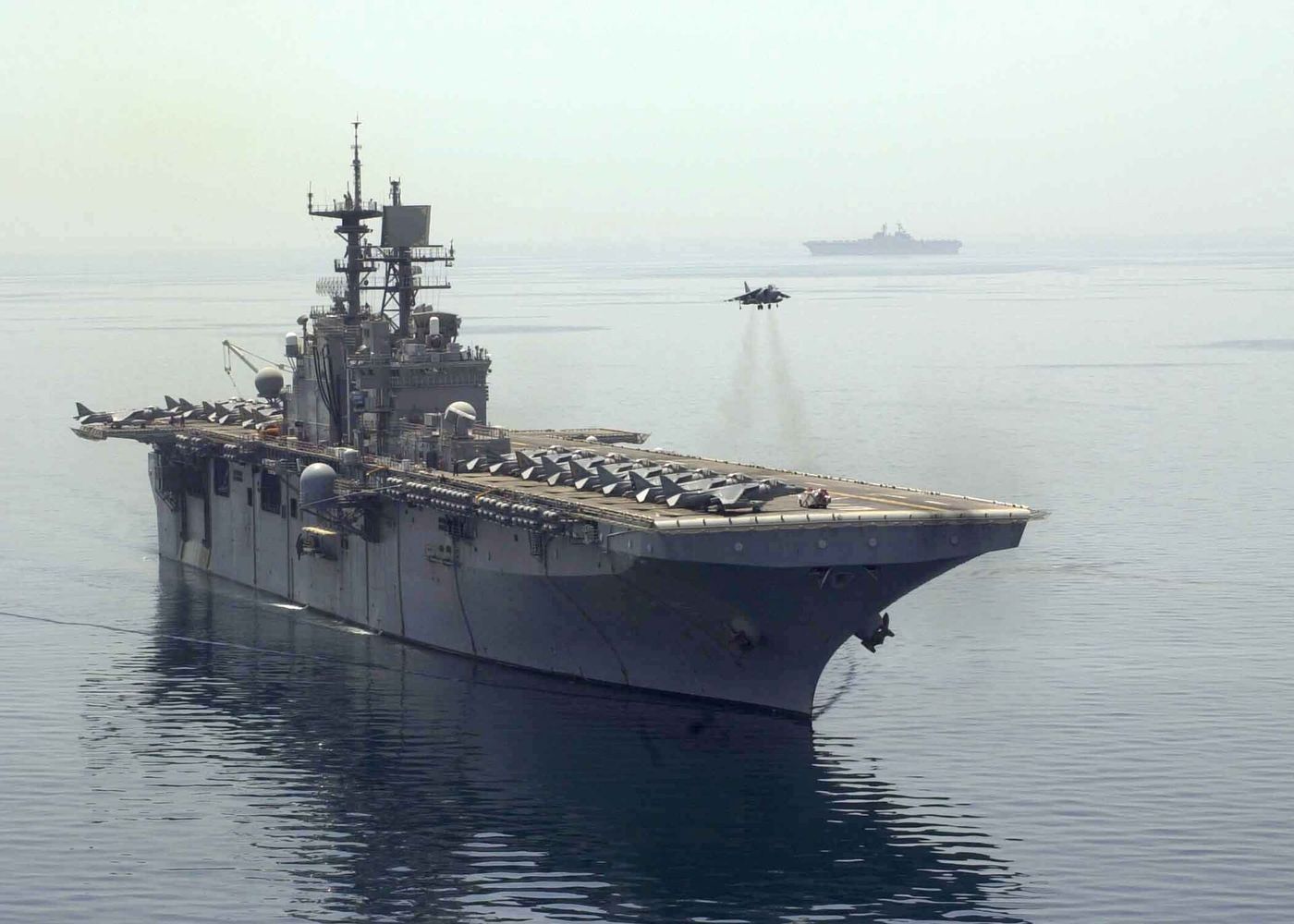
Everything depends on one engine. The Pegasus turbofan exhausts through four nozzles, two each side, that the pilot can rotate. Pointed down, they lift the aircraft straight up; pointed aft, they push it forward like any other jet; set in between, they give a short rolling take-off, which lets the aircraft lift far more weight than it could vertically. [1] That freedom let the Marines base their own jets on amphibious assault ships and on rough forward sites ashore, close to the troops they supported. [1]
The price was a demanding aircraft. Take-off and landing are the most dangerous moments of any flight, and Harriers spend more time in them than most. In Marine service the AV-8B’s accident rate was about three times that of the Corps’ F/A-18sF/A-18 Hornet AircraftA carrier-capable fighter and attack aircraft that one pilot can switch between roles on the same sortie., and some in the military called it a “widow maker”. Later analysis blamed much of that record on cuts to senior maintenance staff, pilot error and senior officers who did not understand the aircraft. [1]
Night Attack and radar
Upgrades gave it night-attack equipment, as the AV-8B(NA), and then an APG-65 radar in the Harrier II Plus. [1] The Night Attack aircraft fly with the uprated Pegasus F402-RR-408 of about 22,200 lb thrust. [2] The gun is a 25 mm GAU-12GAU-12 Equalizer OrdnanceThe Marine Corps Harrier's five-barrel 25 mm gun, carried in a belly pod; the F-35's GAU-22 is its four-barrel cousin. split between two pods under the fuselage, one holding the gun and the other its ammunition. [1]
Into action
The AV-8B’s war began on the morning of 17 January 1991, when an OV-10 forward air controllerFAC GlossaryJoint terms: Forward air controller. An officer (aviator/pilot) member of the tactical air control party who, from a forward ground or airborne position, controls aircraft in close air support of ground troops. called for help against Iraqi artillery shelling the Saudi town of Khafji. During the Gulf War 86 Harriers flew 3,380 sortiesSortie GlossaryJoint terms: In air operations, an operational flight by one aircraft. with an availability rate above 90 per cent; five were lost to surface-to-air missiles. General Norman Schwarzkopf later named the AV-8B among seven weapons that played a crucial role in the war, alongside the F-117 and the AH-64 ApacheAH-64D Apache Longbow AircraftThe US Army's twin-engine attack helicopter, flown from Panama and Desert Storm to Afghanistan; the Longbow adds a mast-mounted radar.. [1]
Marine Harriers went on to fly over Kosovo, Afghanistan and Iraq, where the street fighting around Fallujah demanded extreme precision, and over Libya in 2011. [1] Their worst single day came on 14 September 2012, when a Taliban raid on Camp Bastion in Afghanistan destroyed six AV-8Bs of VMFA-211 on the ground and badly damaged two more, described as the worst loss of US airpower in a single incident since the Vietnam War. [1] Near the end, in the Red Sea in 2024, a Harrier modified for air defenceAir defense GlossaryJoint terms: Defensive measures designed to destroy attacking enemy aircraft or missiles in the atmosphere, or to nullify or reduce the effectiveness of such attack. was reported to have shot down seven Houthi attack drones. [1]
The Marine Corps retired its Harriers in June 2026, replacing them with the F-35B. Spain and Italy fly their own AV-8Bs from their carriers. [1]

Sources
- McDonnell Douglas AV-8B Harrier II. Wikipedia (secondary source). https://en.wikipedia.org/wiki/McDonnell_Douglas_AV-8B_Harrier_II (accessed 2026-10-25).
- AV-8B Harrier. Federation of American Scientists, Military Analysis Network. https://man.fas.org/dod-101/sys/ac/av-8.htm (accessed 2026-10-25).
Wikipedia articles are secondary sources and can change; they are cited with the date they were read. The Federation of American Scientists (FAS) Military Analysis Network pages largely reproduce US service fact sheets of the late 1990s and early 2000s, so later upgrades are not covered there.