
Drafted — not technically validated
Record revision 1 · The 500 lb low-drag bomb that is one of the most common air-dropped weapons in the world, with conical, Snakeye or ballute tails.
Real-world weapon as described in public sources. Weights and dimensions change with the fins, fuzes and variant fitted; the data plate names the variants its figures describe, and differences are noted beside the number they affect. The record describes the weapon; it is not a guide to employing it.
Mark 82 general-purpose bomb · Mk 82
- Origin
- United States; also built in Australia and Turkey, and under licence in France [1]
- Weight
- 510–570 lb (231–259 kg), depending on fuzes, fins and retarder [1]
- Dimensions
- Length 2.21 m (87 in); diameter 273 mm (10.75 in) [1]
- Warhead or payload
- 192 lb (87 kg) of tritonal in a streamlined steel case; Composition H-6 and PBXN-109 fills are also used [1]
- Guidance
- None as a free-fall bomb; the same body is the warhead of the GBU-12GBU-12 Paveway II laser-guided bomb OrdnanceThe 500 lb laser-guided bomb that was the F-111F's tank buster in Desert Storm and is now one of the most used guided weapons. laser-guided bomb and the GBU-38 JDAMJoint Direct Attack Munition OrdnanceThe GPS/INS tail kit that made ordinary bombs accurate in any weather, and its laser-seeker version for moving targets. [1] [6]
- Fuzing
- Nose and tail fuzesFuze GlossaryWeapons: A device that causes the detonation of an explosive charge at the proper time after certain conditions are met. A bomb fuze is mechanical or electrical, and is classed by what sets it off (impact, mechanical time…, mechanical or electric [2]; the Air Force BLU-111 version takes ground-burst, delay or air-burst fuzing [6]
- Delivery
- Low drag with a conical fin; high drag with the Mk 15 Snakeye or BSU-86/B fin, or an air-inflatable ballute retarder [2] [4] [5] [7] [9]
- Carried by
- Most US fixed-wing strike aircraft; in the 1991 Gulf War, Mk 80 bombs were dropped by 'literally every fixed-wing aircraft' supporting the ground offensive [3]
- F/A-18 HornetF/A-18 Hornet AircraftA carrier-capable fighter and attack aircraft that one pilot can switch between roles on the same sortie. [8]
- F-111, with ballute-retarded Mk 82 AIR bombs [7]
The most common bomb in the world
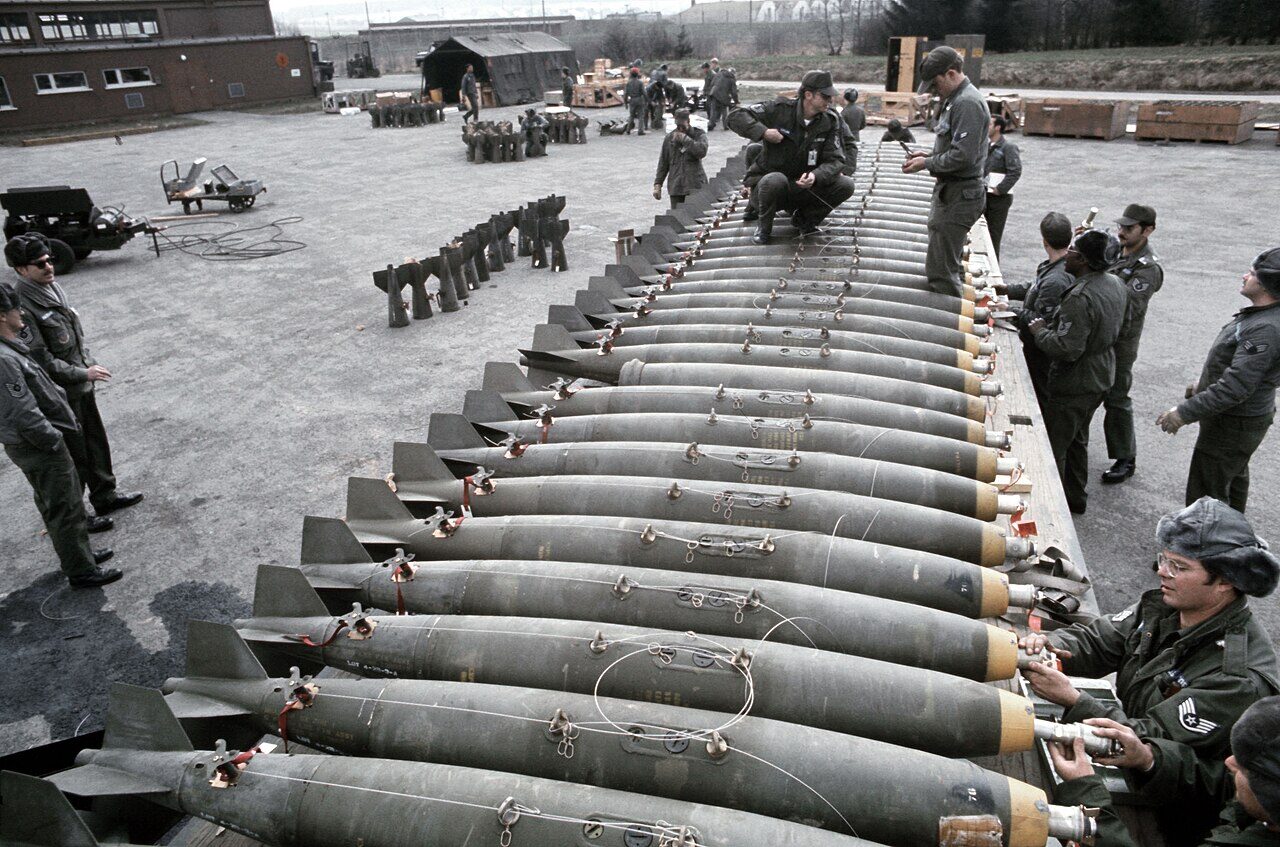
If one weapon stands for air-to-ground ordnance, it is the Mk 82. At a nominal 500 lb it is one of the smallest bombs in current service and one of the most common air-dropped weapons anywhere. [1] Its actual weight runs from about 510 to 570 lb depending on what is screwed into it, and the body itself is simple: a streamlined steel case holding 192 lb of tritonal. [1]
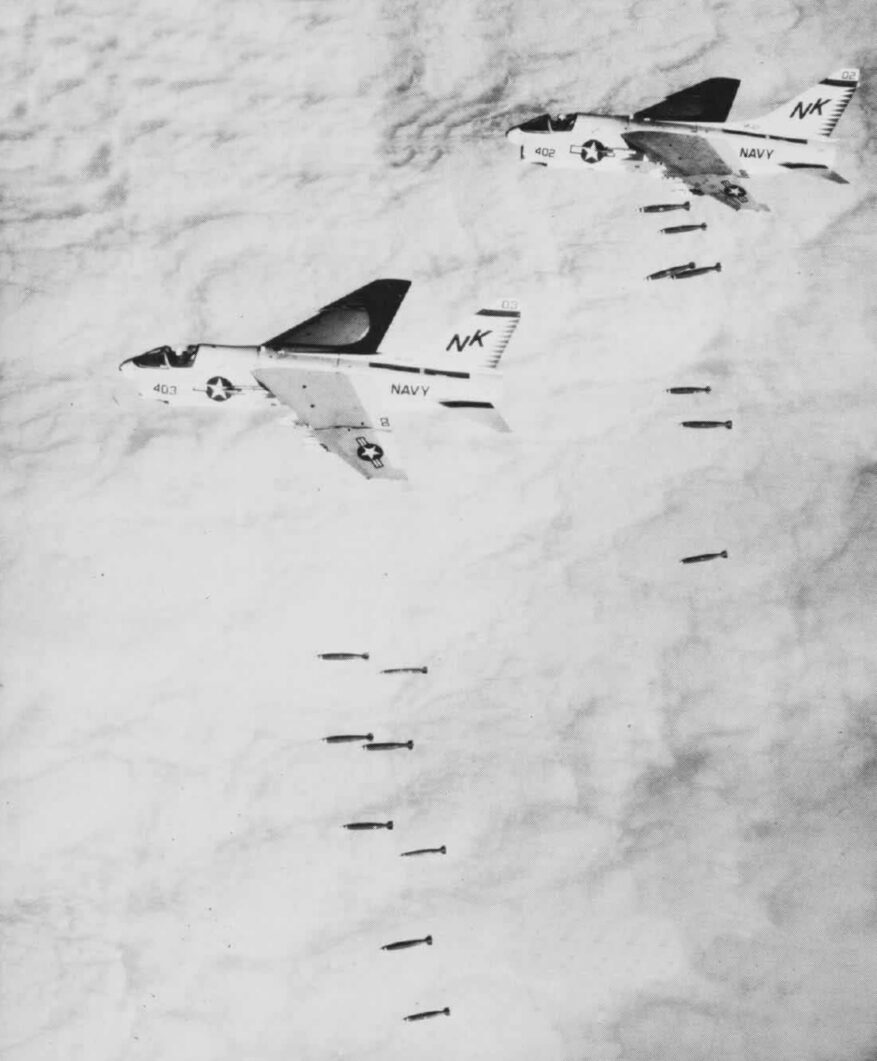
The shape goes back to 1946, when Ed Heinemann of Douglas Aircraft studied how to carry bombs on fast aircraft with as little drag as possible. The result, the Aero 1A shape, is about eight times as long as it is wide, and every Mk 80 bomb uses it. [8] The FAS describes the series as developed in the 1950s for exactly that reason: earlier bombs produced too much drag. [3] The Mk 80 bombs did not see combat until Vietnam, but they have since replaced most earlier American general-purpose bombs. [8]
One body, many tails
What makes the Mk 82 so adaptable is that the bomb body stays the same while the fins, fuzesFuze GlossaryWeapons: A device that causes the detonation of an explosive charge at the proper time after certain conditions are met. A bomb fuze is mechanical or electrical, and is classed by what sets it off (impact, mechanical time… and kits change. Navy ordnance training lists a conical fin for ordinary free-fall delivery and the Mk 15 Snakeye, a retarding fin made for the 500 lb bomb. [2] [9] The Snakeye’s four spring-loaded blades can stay shut, so the bomb falls as a low-drag weapon, or spring open at release, so it slows sharply. The manual explains why: in a low-level attack the aircraft and an unretarded bomb arrive over the target at the same moment, and the aircraft could be damaged. Retarding the bomb lets the aircraft clear the area first, so the retarded modeRetarded delivery GlossaryWeapons: A bomb delivery in which a retarding fin, such as the Snakeye, opens to give a high-drag configuration, used in low-level bombing. Unretarded, the same bomb falls free in a low-drag configuration; with the in-flight… is used for low-level bombing. The pilot can choose between the two in flight. [4] The later BSU-86/B fin gives the same choice of high or low drag. [5] A third way to slow the bomb is the ballute, an inflatable cross between a balloon and a parachute; F-111s dropped Mk 82 AIR bombs fitted with them. [7]
Add a guidance kit and the Mk 82 becomes something else entirely. It is the warhead of the GBU-12GBU-12 Paveway II laser-guided bomb OrdnanceThe 500 lb laser-guided bomb that was the F-111F's tank buster in Desert Storm and is now one of the most used guided weapons. laser-guidedLGW GlossaryWeapons: Laser-guided weapon. A weapon that uses a seeker to detect laser energy reflected from a laser marked/designated target and through signal processing provides guidance commands to a control system, which guides the… bomb and the GBU-38 JDAMJoint Direct Attack Munition OrdnanceThe GPS/INS tail kit that made ordinary bombs accurate in any weather, and its laser-seeker version for moving targets., and the Air Force’s 2021 budget describes its BLU-111 version as delivered in high- and low-drag modes with ground-burst, delay or air-burst fuzing. [1] [6]
Built for carrier decks
A fire on a carrier deck is the nightmare that shaped the Navy’s bombs. A safety board set up after the 1967 fire aboard USS Forrestal found that a Mk 82 caught in a fire would cook off in about two and a half minutes. [1] The Navy’s BLU-111A/B adds a thermal-protective coating to resist fuel fires, and the textured insulation shows clearly on bombs loaded aboard ship. [1] [8] Later variants trade blast for precision: the BLU-126/B carries a smaller charge with inert ballast so that it flies like a standard bomb, and the BLU-129/B’s composite case breaks up instead of fragmenting, to limit damage around the target. [1]

Sources
- Mark 82 bomb. Wikipedia (secondary source). https://en.wikipedia.org/wiki/Mark_82_bomb (accessed 2026-10-26).
- Aviation Ordnanceman, NAVEDTRA 14313, p. 1-17. US Navy, Naval Education and Training Command; copy hosted by Integrated Publishing. https://navyaviation.tpub.com/14313/css/Aircraft-Bomb-Ammunition-And-Associated-Components-27.htm (accessed 2026-10-26).
- MK84. Federation of American Scientists, Military Analysis Network; copy hosted on the DoD GulfLINK site, 23 April 2000. https://gulflink.fhpr.osd.mil/al_muth/al_muth_refs/n58en036/mk84.htm (accessed 2026-10-26). Describes the whole Mk 80 series as well as the Mk 84.
- Aviation Ordnanceman, NAVEDTRA 14313, p. 1-26. US Navy, Naval Education and Training Command; copy hosted by Integrated Publishing. https://navyaviation.tpub.com/14313/css/Bsu-85-B-Air-Inflatable-Retarder-36.htm (accessed 2026-10-26).
- Aviation Ordnanceman, NAVEDTRA 14313, p. 1-29. US Navy, Naval Education and Training Command; copy hosted by Integrated Publishing. https://navyaviation.tpub.com/14313/css/Bsu-86-B-Bomb-Fin-39.htm (accessed 2026-10-26).
- LI 353020 General Purpose Bombs, Exhibit P-40, page 1. US Air Force, FY2021 budget estimates, Procurement of Ammunition; copy hosted by Stratvocate, February 2020. https://www.stratvocate.com/files/2021/FY21_Air_Force_Ammunition_P_1-p51/FY21_Air_Force_Ammunition_P_1.html (accessed 2026-10-26).
- Ballute. Wikipedia (secondary source). https://en.wikipedia.org/wiki/Ballute (accessed 2026-10-26).
- General-purpose bomb. Wikipedia (secondary source). https://en.wikipedia.org/wiki/General-purpose_bomb (accessed 2026-10-26).
- Aviation Ordnanceman, NAVEDTRA 14313, p. 1-24. US Navy, Naval Education and Training Command; copy hosted by Integrated Publishing. https://navyaviation.tpub.com/14313/css/Mk-15-And-Mods-Snakeye-Fin-Assembly-34.htm (accessed 2026-10-26).
Wikipedia articles are secondary sources and can change; they are cited with the date they were read. NAVEDTRA training manuals and budget justification exhibits are official US publications, but each describes the weapons in service when it was written.