
Drafted — not technically validated
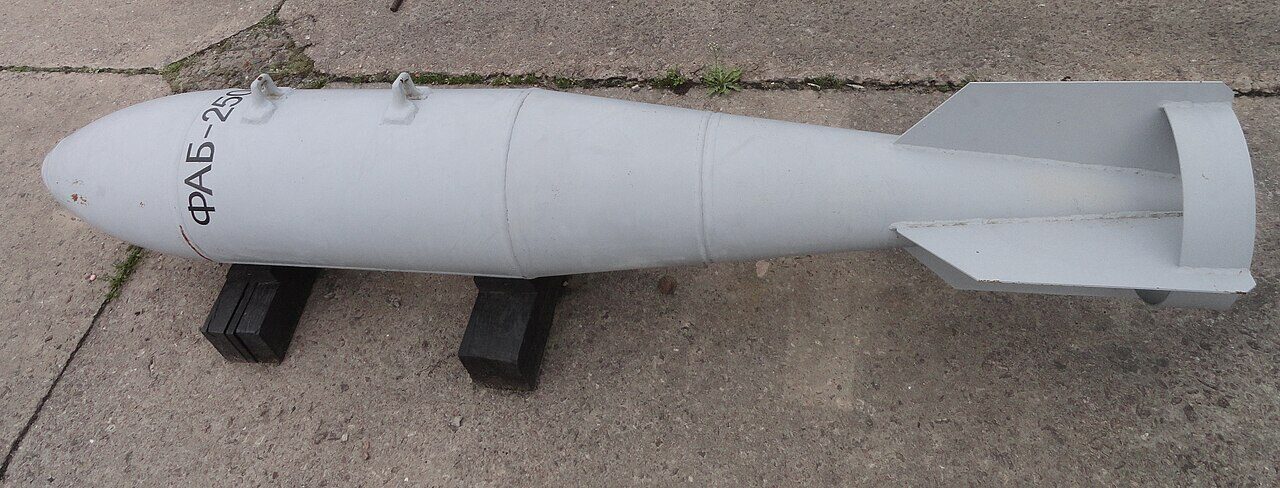
Record revision 1 · The Soviet 250 kg high-explosive bomb, from the 1946 bomber model to the low-drag M-62 for fighter-bombers.
Real-world weapon as described in public sources. Weights and dimensions change with the fins, fuzes and variant fitted; the data plate names the variants its figures describe, and differences are noted beside the number they affect. The record describes the weapon; it is not a guide to employing it.
FAB-250 high-explosive bomb · FAB-250 M-62
- Origin
- Soviet Union
- In service
- M-46 from 1946, M-54 from 1954, low-drag M-62 from 1962 [1]
- Weight
- 227 kg (500 lb) for the FAB-250 M-62; 268 kg for the M-54 [2]
- Dimensions
- M-62: length 1,924 mm (75.7 in), diameter 300 mm (11.8 in) [2]
- Warhead or payload
- 100 kg (220 lb) of explosive in the M-62; about half of a FAB's weight is explosive [2]
- Guidance
- None; since 2022, Russia has fitted UMPK glide and guidance kits [1]
- Fuzing
- A single nose fuzeFuze GlossaryWeapons: A device that causes the detonation of an explosive charge at the proper time after certain conditions are met. A bomb fuze is mechanical or electrical, and is classed by what sets it off (impact, mechanical time… [1]
- Delivery
- Level or dive; the M-46 and M-54 were shaped for internal carriage in heavy bombers, the M-62 for external carriage on fighter-bombers [1]
- Carried by
Reading the name
Soviet bomb names are a small code. FAB marks a high-explosive aerial bomb; the number is the calibre in kilograms; and the suffix is the model year, so the FAB-250 M-62 is the 250 kg bomb of 1962. [2] A second number, as in OFAB-250-270OFAB-250-270 fragmentation bomb OrdnanceA short, heavy Soviet high-explosive fragmentation bomb, with a case made to break into fragments., gives the real weight when it differs much from the calibre. [2] High-explosive FABs are built for blast: roughly half their weight is explosive, in a case strong enough to dig into the ground or an obstacle before it bursts. [2]
Three shapes for two kinds of aircraft
The FAB-250 has gone through three main shapes. The original M-46 of 1946 and the strengthened M-54 of 1954 were blunt bombs designed to pack efficiently into the bomb bays of heavy bombers. The M-62 of 1962 was something different: a long, low-drag bomb for the external pylons of fighter-bombers. [1] The difference shows in the numbers. The M-54 is 325 mm across and weighs 268 kg; the M-62 is 300 mm across, almost two metres long, and weighs 227 kg with 100 kg of explosive. [2] Its American counterpart is the Mk 82Mark 82 general-purpose bomb OrdnanceThe 500 lb low-drag bomb that is one of the most common air-dropped weapons in the world, with conical, Snakeye or ballute tails.. [1]
The smaller FAB-100 belongs to the same family: a 100 kg bomb carrying 70 kg of explosive, 267 mm across and less than a metre long. [2] Soviet practice treats general-purpose FABs as weighing 250 kg or more, and the FAB-100, FAB-250, FAB-500FAB-500 high-explosive bomb OrdnanceThe Soviet and Russian 500 kg high-explosive bomb, in service in one form or another since 1931. and FAB-1500 became the most common sizes. [2]
Half a century of wars
The FAB-250 is unguided, has a single nose fuzeFuze GlossaryWeapons: A device that causes the detonation of an explosive charge at the proper time after certain conditions are met. A bomb fuze is mechanical or electrical, and is classed by what sets it off (impact, mechanical time… and fits most Soviet aircraft, which helps explain how far it has spread. It is common across Asia and Africa, was used heavily by Soviet and Afghan forces in Afghanistan in the 1980s, and was dropped by Russian and Syrian aircraft over Syria. [1] Since 2022, Russia has fitted the M-62 with UMPK planning and correction kits, wings and inertial navigation that turn it into a glide bomb; because the FAB-250 is lighter and more streamlined than the FAB-500FAB-500 high-explosive bomb OrdnanceThe Soviet and Russian 500 kg high-explosive bomb, in service in one form or another since 1931., it glides further, a reported 80 km, so the launching aircraft can stay further from air defencesAir defense GlossaryJoint terms: Defensive measures designed to destroy attacking enemy aircraft or missiles in the atmosphere, or to nullify or reduce the effectiveness of such attack.. [1]
Sources
- FAB-250. Wikipedia (secondary source). https://en.wikipedia.org/wiki/FAB-250 (accessed 2026-10-26).
- Soviet and Russian aerial bombs. Wikipedia (secondary source). https://en.wikipedia.org/wiki/Soviet_and_Russian_aerial_bombs (accessed 2026-10-26). Tables of bomb dimensions, weights and explosive content.
Wikipedia articles are secondary sources and can change; they are cited with the date they were read. NAVEDTRA training manuals and budget justification exhibits are official US publications, but each describes the weapons in service when it was written.