
Drafted — not technically validated
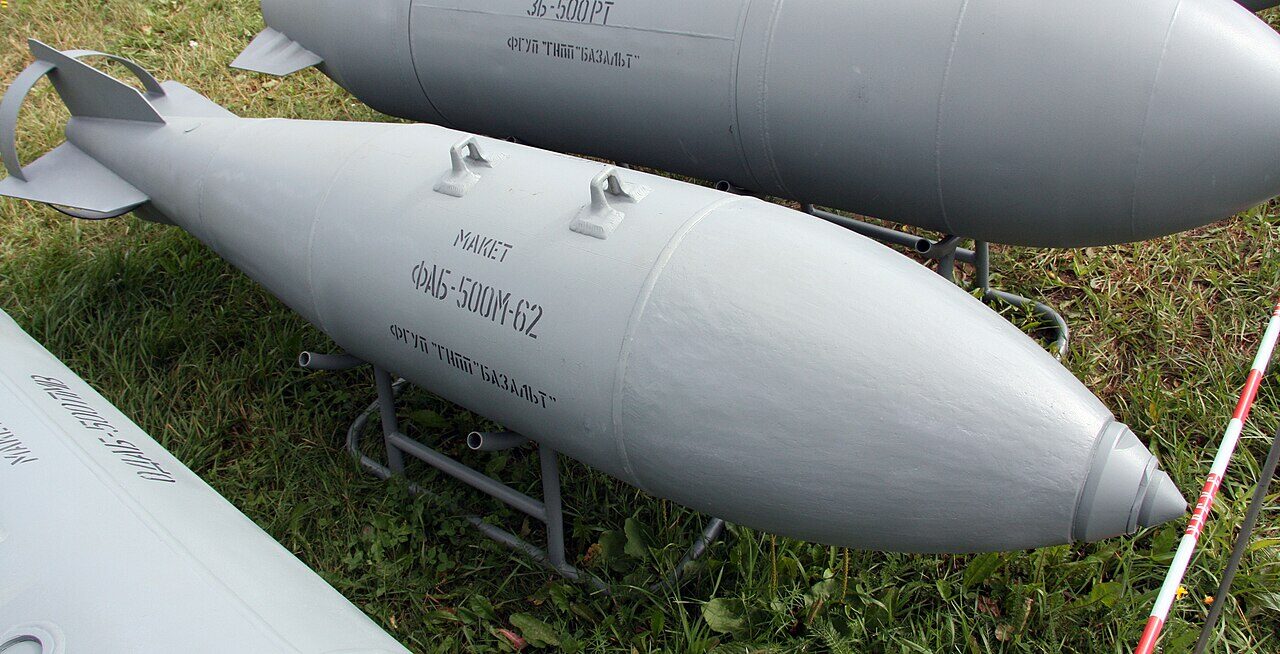
Record revision 1 · The Soviet and Russian 500 kg high-explosive bomb, in service in one form or another since 1931.
Real-world weapon as described in public sources. Weights and dimensions change with the fins, fuzes and variant fitted; the data plate names the variants its figures describe, and differences are noted beside the number they affect. The record describes the weapon; it is not a guide to employing it.
FAB-500 high-explosive bomb · FAB-500 M-62
- Origin
- Soviet Union
- In service
- FAB-500sv from 1931; M-54 from 1954; low-drag M-62 from 1962 [1]
- Weight
- 500 kg (1,100 lb) for the FAB-500 M-62 [2]
- Dimensions
- M-62: length 2,425 mm (95.5 in), diameter 400 mm (15.7 in) [2]
- Warhead or payload
- 200 kg (440 lb) of explosive in the M-62 [2]
- Guidance
- None; since 2023, M-62s have been seen fitted with UMPK glide kits [1]
- Fuzing
- Early models: a single nose fuzeFuze GlossaryWeapons: A device that causes the detonation of an explosive charge at the proper time after certain conditions are met. A bomb fuze is mechanical or electrical, and is classed by what sets it off (impact, mechanical time… [1]
- Delivery
- M-62 release altitude 570–12,000 m (1,870–39,400 ft) at 500–1,900 km/h (270–1,030 kt) [1]
- Carried by
Ninety years of the half-tonne bomb
The FAB-500 is the Soviet and Russian 500 kg high-explosive bomb, and its line is older than the Second World War. Work on the first model, the FAB-500sv, began in 1929 alongside a smaller 250 kg bomb; it passed its trials in 1931 and went straight into series production. [1] Through the 1930s it was refined year by year, with stronger lifting lugs and joints and a little weight saved, and before the war it was exported to the Spanish Republic, where it was known as the R-500. [1]
Wartime development brought the long welded M-43 and the short, stubby M-44, followed after the war by the M-46. [1]
Bombers and fighter-bombers
Like the FAB-250FAB-250 high-explosive bomb OrdnanceThe Soviet 250 kg high-explosive bomb, from the 1946 bomber model to the low-drag M-62 for fighter-bombers., the FAB-500 split into two lines in the jet age. The M-54 of 1954 was shaped to fit inside heavy bombers. The M-62 of 1962 was a low-drag bomb for the external pylons of fighter-bombers. [1] The M-62 is 400 mm across and nearly two and a half metres long, and carries 200 kg of explosive in its 500 kg. [2] Its export description gives a release envelope from 570 m to 12,000 m and from 500 to 1,900 km/h; the top of that speed range is well past the speed of sound. [1]
Still in use
The FAB-500 was used widely by Soviet and Afghan forces in Afghanistan in the 1980s and by Russian and Syrian aircraft in Syria’s civil war. [1] The M-62 has been used in Russia’s invasion of Ukraine, and in March 2023 wreckage showed that Su-35s had dropped M-62s fitted with UMPK kits, pop-out wings that turn a free-fall bomb into a glide bomb released from further away. [1]
Sources
- FAB-500. Wikipedia (secondary source). https://en.wikipedia.org/wiki/FAB-500 (accessed 2026-10-26). Its release limits for the M-62 are taken from the Rosoboronexport export catalogue.
- Soviet and Russian aerial bombs. Wikipedia (secondary source). https://en.wikipedia.org/wiki/Soviet_and_Russian_aerial_bombs (accessed 2026-10-26). Tables of bomb dimensions, weights and explosive content.
Wikipedia articles are secondary sources and can change; they are cited with the date they were read. NAVEDTRA training manuals and budget justification exhibits are official US publications, but each describes the weapons in service when it was written.