
Drafted — not technically validated
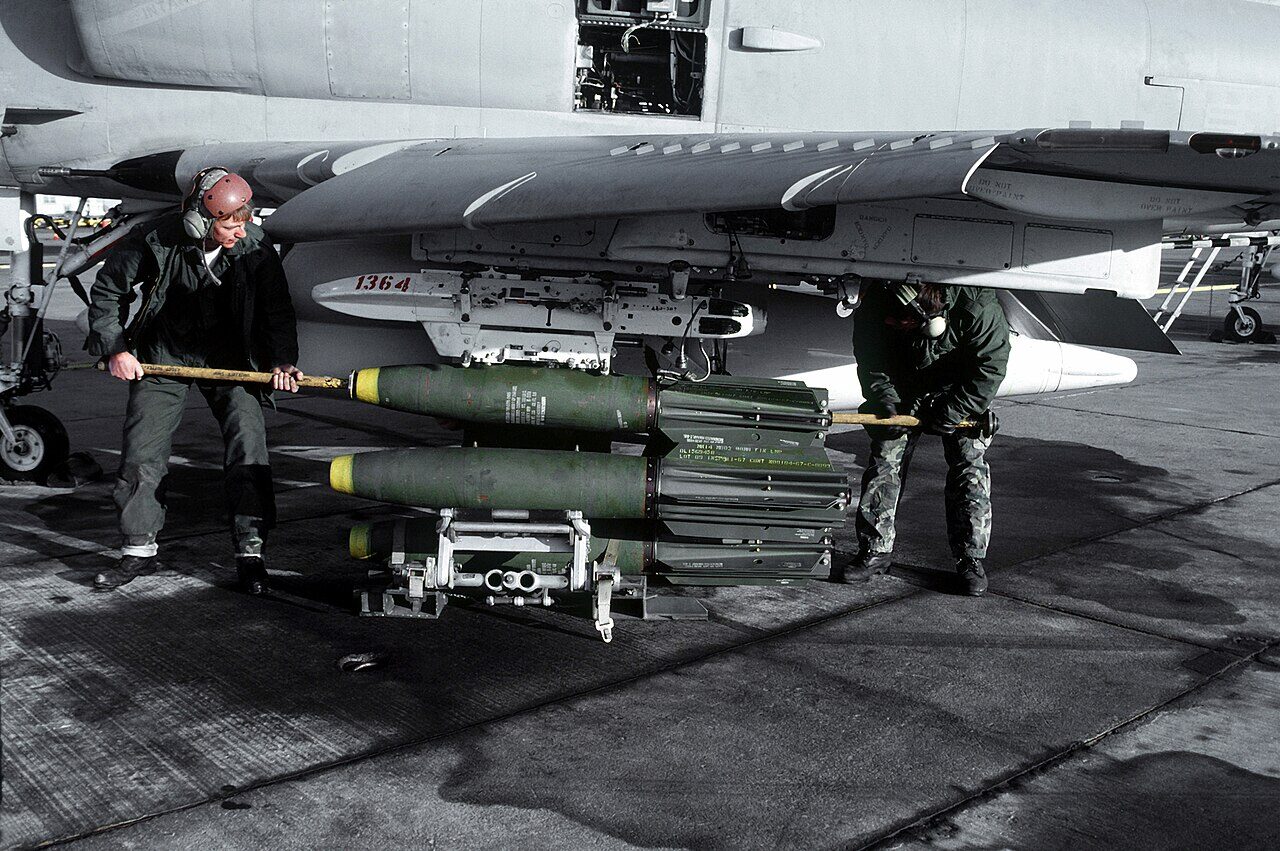
Record revision 1 · The smallest Mark 80 bomb: a 250 lb low-drag bomb remembered for Vietnam's 'snake and nape' close air support.
Real-world weapon as described in public sources. Weights and dimensions change with the fins, fuzes and variant fitted; the data plate names the variants its figures describe, and differences are noted beside the number they affect. The record describes the weapon; it is not a guide to employing it.
Mark 81 general-purpose bomb · Mk 81
- Origin
- United States
- Weight
- 262 lb (119 kg) [1]
- Dimensions
- Length 74 in (1.88 m); diameter 9 in (229 mm) [1]
- Warhead or payload
- 96 lb (44 kg) of tritonal, minol or Composition H-6 in a forged steel case [1]
- Guidance
- None: a free-fall bomb aimed by the aircraft's bombing system
- Fuzing
- Nose and tail fuzesFuze GlossaryWeapons: A device that causes the detonation of an explosive charge at the proper time after certain conditions are met. A bomb fuze is mechanical or electrical, and is classed by what sets it off (impact, mechanical time…, mechanical or electric, as on all Mk 80 bombs [3] [4]
- Delivery
- Level or dive with a conical fin; low-level retarded delivery with the Mk 14 Snakeye tail [1] [4]
- Carried by
- Variants
- Mk 81 Snakeye: Mk 81 with the Mk 14 tail retarding device [1]
- GBU-29 JDAMJoint Direct Attack Munition OrdnanceThe GPS/INS tail kit that made ordinary bombs accurate in any weather, and its laser-seeker version for moving targets.: a guided version, cancelled in favour of the Small Diameter BombGBU-39 Small Diameter Bomb OrdnanceA 250 lb class GPS glide bomb carried four to a rack in place of one 2,000 lb bomb. [1]
The smallest of the family
The Mark 80 series is the family of streamlined bombs that has armed American strike aircraft since Vietnam, and the Mk 81 is its smallest member: a 250 lb class bomb that actually weighs about 262 lb, nicknamed “Firecracker”. [1] It was developed in the 1950s, when the services wanted bombs that produced less drag when carried under fast jets, and like its larger siblings it is a thin steel case of which a large share of the weight is explosive. [1] [3] Navy ordnance training describes the Mk 80 bombs as low-drag general-purposeLDGP GlossaryWeapons: Low-drag, general-purpose bomb. The bomb used in most bombing operations, with an aerodynamically shaped, relatively light case of which about 45 percent of the weight is explosive. It may take nose and tail fuzes and a… bombs, about 45 per cent explosive by weight, used in most bombing operations. [4]
Snake and nape
The Mk 81 earned its place in the Vietnam War’s close air supportCAS GlossaryJoint terms: Close air support. Air action by fixed- and rotary-wing aircraft against hostile targets that are in close proximity to friendly forces and that require detailed integration of each air mission with the fire and movement…. Fitted with the Mk 14 tail retarding device, which springs open after release to slow the bomb, it became the Mk 81 Snakeye. The extra time of fall, and the forgiving drop envelope that came with it, allowed bombing runs at very low level and slower speed. [1] A typical support load of the period was known as “snake and nape”: 250 lb Snakeyes and napalm canisters. [1]
Too small for most jobs
US forces judged the Mk 81’s blast too small for most of their targets, and it was soon dropped from wide use, although licence-built copies remain in service in other countries. [1] It never disappeared entirely: the Air Force’s 2021 ammunition budget still describes the Mk-81 as a 250 lb class bomb “designed for soft, fragment sensitive targets, such as troops, POL, and radars”. [2] A guided version, the GBU-29 JDAMJoint Direct Attack Munition OrdnanceThe GPS/INS tail kit that made ordinary bombs accurate in any weather, and its laser-seeker version for moving targets., was started because a small bomb causes less collateral damage, but it was cancelled in favour of the purpose-built Small Diameter BombGBU-39 Small Diameter Bomb OrdnanceA 250 lb class GPS glide bomb carried four to a rack in place of one 2,000 lb bomb.. [1]
Sources
- Mark 81 bomb. Wikipedia (secondary source). https://en.wikipedia.org/wiki/Mark_81_bomb (accessed 2026-10-26).
- LI 353020 General Purpose Bombs, Exhibit P-40, page 1. US Air Force, FY2021 budget estimates, Procurement of Ammunition; copy hosted by Stratvocate, February 2020. https://www.stratvocate.com/files/2021/FY21_Air_Force_Ammunition_P_1-p51/FY21_Air_Force_Ammunition_P_1.html (accessed 2026-10-26).
- MK84. Federation of American Scientists, Military Analysis Network; copy hosted on the DoD GulfLINK site, 23 April 2000. https://gulflink.fhpr.osd.mil/al_muth/al_muth_refs/n58en036/mk84.htm (accessed 2026-10-26). Describes the whole Mk 80 series as well as the Mk 84.
- Aviation Ordnanceman, NAVEDTRA 14313, p. 1-17. US Navy, Naval Education and Training Command; copy hosted by Integrated Publishing. https://navyaviation.tpub.com/14313/css/Aircraft-Bomb-Ammunition-And-Associated-Components-27.htm (accessed 2026-10-26).
Wikipedia articles are secondary sources and can change; they are cited with the date they were read. NAVEDTRA training manuals and budget justification exhibits are official US publications, but each describes the weapons in service when it was written.