
Drafted — not technically validated
Record revision 1 · A short, heavy Soviet high-explosive fragmentation bomb, with a case made to break into fragments.
Real-world weapon as described in public sources. Weights and dimensions change with the fins, fuzes and variant fitted; the data plate names the variants its figures describe, and differences are noted beside the number they affect. The record describes the weapon; it is not a guide to employing it.
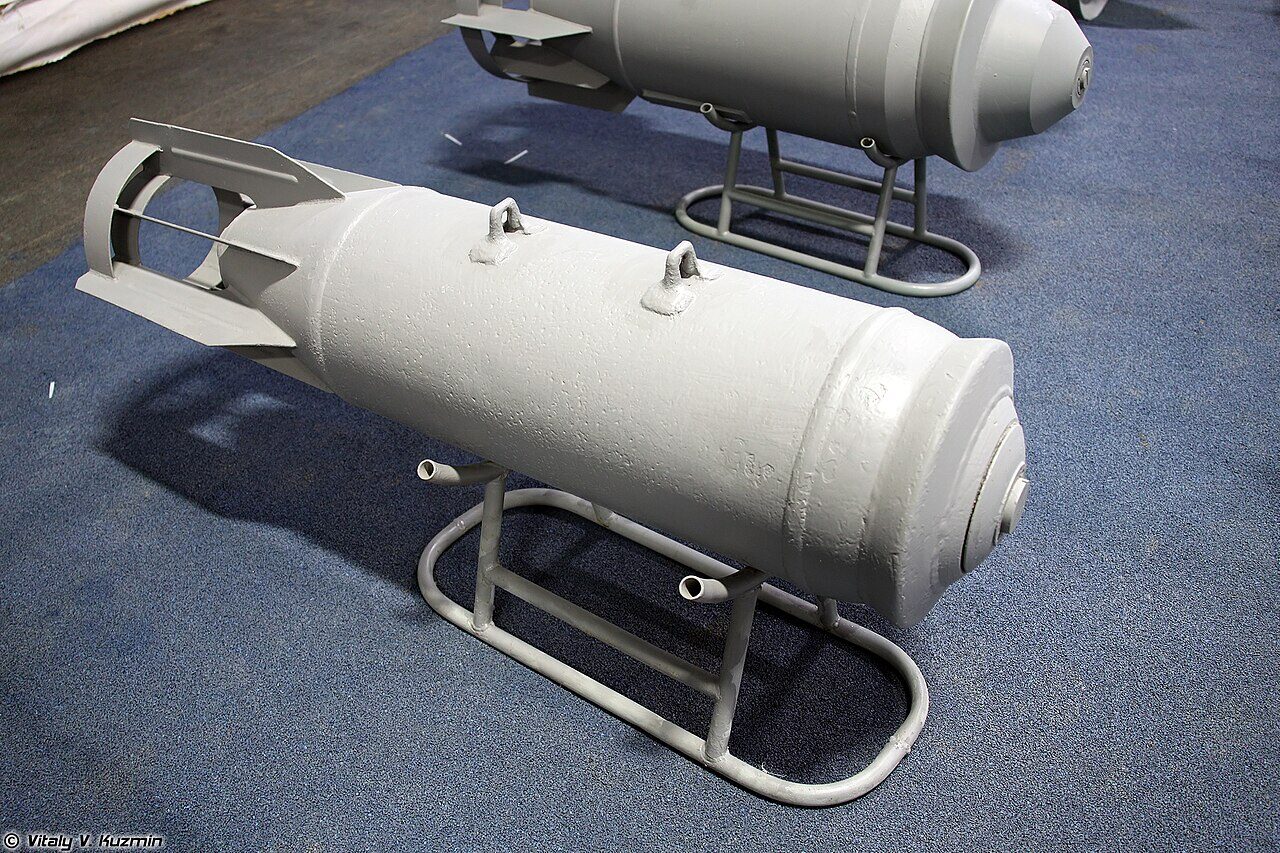
OFAB-250-270 high-explosive fragmentation bomb · OFAB-250-270
- Type
- High-explosive fragmentation bomb, 250 kg calibre, 270 kg class [1]
- Origin
- Soviet Union
- In service
- Not given in the cited source
- Weight
- 266 kg (586 lb) [1]
- Dimensions
- Length 1,456 mm (57.3 in); diameter 325 mm (12.8 in) [1]
- Warhead or payload
- 97 kg (214 lb) of explosive; OFAB bombs are about 30–35 per cent explosive, with a case made to break into fragments [1]
- Guidance
- None
- Fuzing
- Not given in the cited source
- Delivery
- Not given in the cited source; specialised OFAB-250 models exist for low-altitude and assault use [1]
- Carried by
- Soviet and Russian strike aircraft; the cited source does not list them
Blast or fragments
Soviet bomb designers drew a clear line between two kinds of explosive bomb. A FAB is built for blast: about half its weight is explosive. An OFAB, a high-explosive fragmentation bomb, trades some of that explosive, down to about 30 to 35 per cent, for a case designed to burst into fragments in a controlled way, with a sawtooth inner surface or a grid of grooves cut into the body. [1] Its intended targets are military facilities, troops and combat vehicles. [1]
A short, heavy bomb
The name follows the Soviet code: OFAB for the type, 250 for the calibre in kilograms, and 270 for the class of its real weight, which is 266 kg. [1] It is a short, thick bomb, 325 mm across but less than a metre and a half long, and it carries 97 kg of explosive. [1] Its smaller relative, the OFAB-100-120, weighs 133 kg and carries 42 kg of explosive. [1]
The OFAB family also shows how one calibre was adapted for different tactics. Alongside the OFAB-250-270 there were a heat-resistant OFAB-250T and two longer “assault” models, the OFAB-250ShL and OFAB-250ShN, the second of them marked for low-altitude delivery. [1]
Sources
- Soviet and Russian aerial bombs. Wikipedia (secondary source). https://en.wikipedia.org/wiki/Soviet_and_Russian_aerial_bombs (accessed 2026-10-26). Tables of bomb dimensions, weights and explosive content.
Wikipedia articles are secondary sources and can change; they are cited with the date they were read. NAVEDTRA training manuals and budget justification exhibits are official US publications, but each describes the weapons in service when it was written.