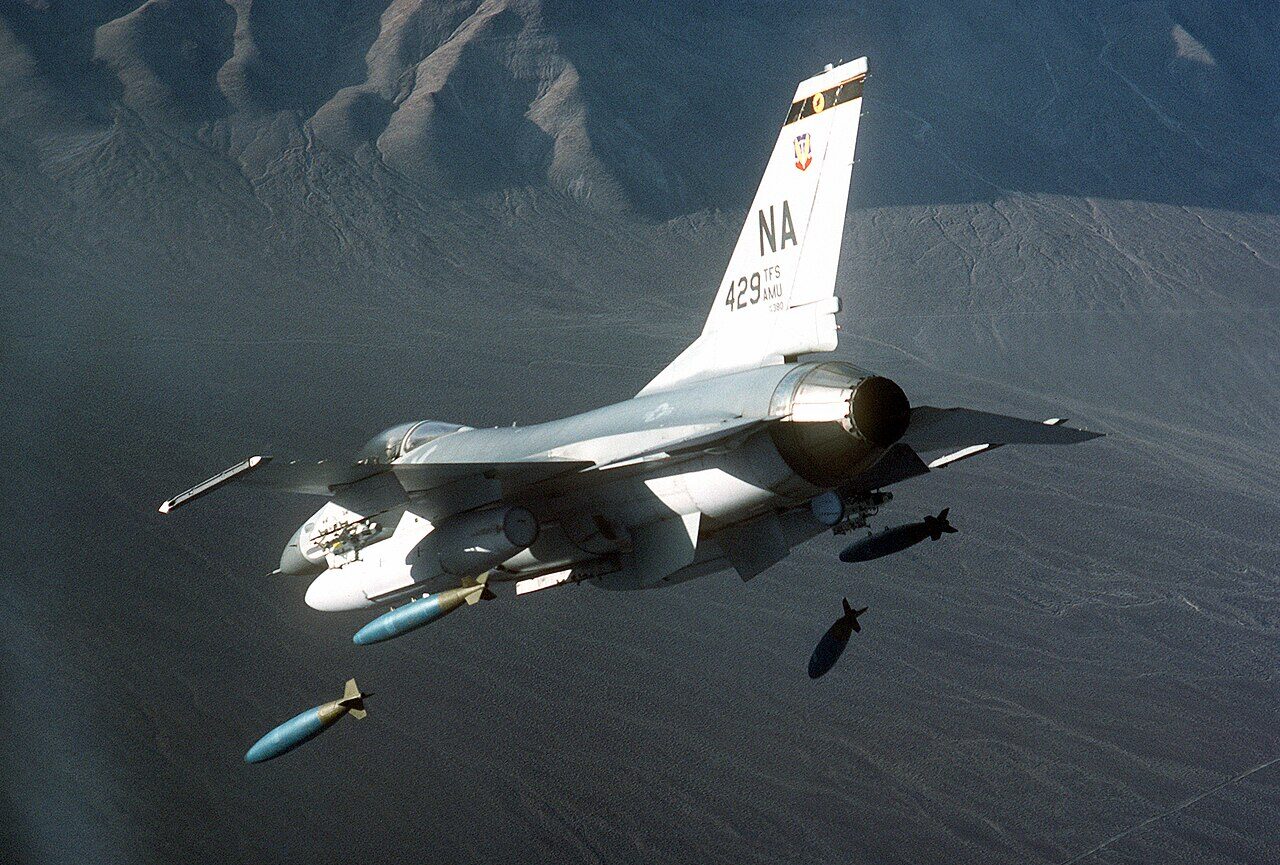

Drafted — not technically validated
Record revision 1 · The 2,000 lb heavyweight of the Mark 80 series, dropped by the thousand in Desert Storm and the warhead of the GBU-10 and GBU-31.
Real-world weapon as described in public sources. Weights and dimensions change with the fins, fuzes and variant fitted; the data plate names the variants its figures describe, and differences are noted beside the number they affect. The record describes the weapon; it is not a guide to employing it.
Mark 84 general-purpose bomb · Mk 84 / BLU-117
- Origin
- United States
- In service
- Entered service during the Vietnam War [1]
- Weight
- 1,972–2,083 lb (894–945 kg), depending on fins, fuzes and retarder [1]; 2,039 lb in the FAS specification [2]
- Dimensions
- Length 129 in (3.28 m); diameter 18 in (457 mm) [2]
- Guidance
- None as a free-fall bomb; the warhead of the GBU-10GBU-10 Paveway II laser-guided bomb OrdnanceA Mk 84 with a Paveway II laser kit: Desert Storm's bridge and bunker buster, once even credited with an air-to-air kill. and GBU-24GBU-24 Paveway III laser-guided bomb OrdnanceThe low-level laser-guided bomb with proportional guidance, built to be released low and still find the spot. laser-guided bombs and the GBU-31 JDAMJoint Direct Attack Munition OrdnanceThe GPS/INS tail kit that made ordinary bombs accurate in any weather, and its laser-seeker version for moving targets. [1] [3]
- Fuzing
- Mechanical M904 nose and M905 tail fuzesFuze GlossaryWeapons: A device that causes the detonation of an explosive charge at the proper time after certain conditions are met. A bomb fuze is mechanical or electrical, and is classed by what sets it off (impact, mechanical time…, or electrical fuzesFuze GlossaryWeapons: A device that causes the detonation of an explosive charge at the proper time after certain conditions are met. A bomb fuze is mechanical or electrical, and is classed by what sets it off (impact, mechanical time… [2]; proximity, instantaneous or delay [3]
- Delivery
- High or low drag [3]: a conical fin for free fall, or the BSU-50/B ballute tail (Mk 84 AIR) for high-speed, low-altitude release [2]
- Carried by
- US Air Force: A-10AA-10 Thunderbolt II AircraftThe Warthog: a straight-wing, armoured close air support jet built around the 30 mm GAU-8 cannon., B-1B, B-52H, F-4GF-4 Phantom II AircraftThe big two-seat Cold War fighter-bomber; the F-4E added an internal gun and slats after Vietnam., F-15AF-15C Eagle AircraftA twin-engine air superiority fighter with more than 104 air-to-air victories and no losses.–E, F-16AF-16 Fighting Falcon AircraftA single-engine multirole fighter: fly-by-wire, 9 g, and the US Air Force's main strike and SEAD aircraft.–D, F-111D–F, F-117A [2]
- US Marine Corps tactical aircraft, which dropped fewer than 1,000 of the Gulf War total [2]
- Also used by Israel and Saudi Arabia [1]
The heavyweight
The Mk 84 is the biggest bomb of the Mark 80 series: nominally 2,000 lb, actually between 1,972 and 2,083 lb depending on how it is fitted, with 945 lb of explosive inside a streamlined steel case. [1] When it entered service during the Vietnam War it was the third-heaviest bomb in the American inventory. [1] A Mk 84 can dig a crater about 50 ft across and 36 ft deep and can throw lethal fragments out to about 400 ft. [1]
The FAS explains why the whole series looks the way it does. The Mk 80 bombs were developed in the 1950s in response to the need for bombs with less aerodynamic drag; they are cylindrical, about 45 per cent explosive by weight, carry conical fins or retarders for high-speed external carriage, and are fitted for both nose and tail fuzesFuze GlossaryWeapons: A device that causes the detonation of an explosive charge at the proper time after certain conditions are met. A bomb fuze is mechanical or electrical, and is classed by what sets it off (impact, mechanical time… to make sure they go off. [2]
Desert Storm
The Gulf War shows how widely the Mk 84 was carried. More than 12,000 were expended in Desert Storm, most of them dropped by Air Force F-15EsF-15E Strike Eagle AircraftThe two-seat, long-range, all-weather strike derivative of the Eagle., F-16sF-16 Fighting Falcon AircraftA single-engine multirole fighter: fly-by-wire, 9 g, and the US Air Force's main strike and SEAD aircraft. and F-111Fs, while Marine Corps tactical aircraft dropped fewer than 1,000. [2] Across the whole series the FAS notes that Mk 80 bombs were dropped from “literally every fixed-wing aircraft” that supported the ground offensive, against artillery, trucks, bunkers, Scud launchers, missile and gun sites, radars and supply points. [2]
A ballute for low level
A 2,000 lb bomb released at low level is dangerous to the aircraft that drops it, so the Mk 84 has its own retarder. The Mk 84 AIR is fitted with the BSU-50/B tail, a canister holding a “ballute”, a combination of balloon and parachute made of strong nylon. On release a lanyard opens the canister, the airflow pulls the bag out and ram air inflates it through four inlets, slowing the bomb so that the aircraft can escape the blast. The pilot can also keep the canister shut and drop the bomb in low-drag form. [2]
A warhead today
Most Mk 84s dropped now carry a guidance kit. The Air Force’s 2021 ammunition budget describes the BLU-117/Mk-84 as a 2,000 lb class bomb producing blast and fragmentation, used either unguided in high- or low-drag form or as the warhead of the GBU-10 PavewayGBU-10 Paveway II laser-guided bomb OrdnanceA Mk 84 with a Paveway II laser kit: Desert Storm's bridge and bunker buster, once even credited with an air-to-air kill. and the GBU-31 JDAMJoint Direct Attack Munition OrdnanceThe GPS/INS tail kit that made ordinary bombs accurate in any weather, and its laser-seeker version for moving targets.. [3] Practice versions match its flight exactly: the 2,000 lb BDU-56/B and the inert Mk 84 both simulate the drop trajectory of a live bomb for aircrew training. [4] The Navy also converts the Mk 84 into the Mk 41 Destructor mine, which is dropped with a conical fin only. [5]
Sources
- Mark 84 bomb. Wikipedia (secondary source). https://en.wikipedia.org/wiki/Mark_84_bomb (accessed 2026-10-26).
- MK84. Federation of American Scientists, Military Analysis Network; copy hosted on the DoD GulfLINK site, 23 April 2000. https://gulflink.fhpr.osd.mil/al_muth/al_muth_refs/n58en036/mk84.htm (accessed 2026-10-26).
- LI 353020 General Purpose Bombs, Exhibit P-40, pages 1–2. US Air Force, FY2021 budget estimates, Procurement of Ammunition; copy hosted by Stratvocate, February 2020. https://www.stratvocate.com/files/2021/FY21_Air_Force_Ammunition_P_1-p51/FY21_Air_Force_Ammunition_P_1.html (accessed 2026-10-26).
- LI 353010 Practice Bombs, Exhibit P-40. US Air Force, FY2021 budget estimates, Procurement of Ammunition; copy hosted by Stratvocate, February 2020. https://www.stratvocate.com/files/2021/FY21_Air_Force_Ammunition_P_1-p47/FY21_Air_Force_Ammunition_P_1.html (accessed 2026-10-26).
- Aviation Ordnanceman, NAVEDTRA 14313, p. 1-33. US Navy, Naval Education and Training Command; copy hosted by Integrated Publishing. https://navyaviation.tpub.com/14313/css/Antitank-Bomb-Cluster-Mk-20-Cbu-99-And-Cbu-100-43.htm (accessed 2026-10-26).
Wikipedia articles are secondary sources and can change; they are cited with the date they were read. NAVEDTRA training manuals and budget justification exhibits are official US publications, but each describes the weapons in service when it was written.