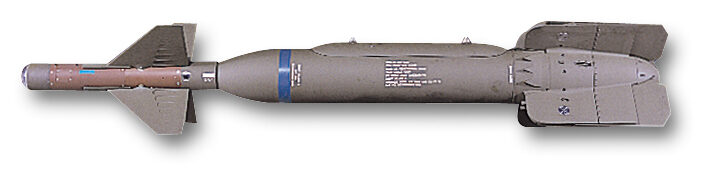

Drafted — not technically validated
Record revision 1 · The low-level laser-guided bomb with proportional guidance, built to be released low and still find the spot.
Real-world weapon as described in public sources. Weights and dimensions change with the fins, fuzes and variant fitted; the data plate names the variants its figures describe, and differences are noted beside the number they affect. The record describes the weapon; it is not a guide to employing it.
GBU-24 Paveway III laser-guided bomb · GBU-24
- Type
- 2,000 lb class low-level laser-guidedLGW GlossaryWeapons: Laser-guided weapon. A weapon that uses a seeker to detect laser energy reflected from a laser marked/designated target and through signal processing provides guidance commands to a control system, which guides the… bomb (LLLGB) [1] [2]
- Origin
- United States
- Weight
- 2,315 lb (1,050 kg) [1]
- Dimensions
- Length 14 ft 5 in (4.39 m); diameter 18 in (457 mm); wingspan 6 ft 6.75 in (2.0 m) [1]
- Warhead or payload
- Mk 84Mark 84 general-purpose bomb OrdnanceThe 2,000 lb heavyweight of the Mark 80 series, dropped by the thousand in Desert Storm and the warhead of the GBU-10 and GBU-31. general purpose or BLU-109 penetrator; also BLU-116 [1] [2]
- Guidance
- Semi-active laser with proportional guidance, a wider field of view and more sensitive seeker [1] [2]
- Fuzing
- Not given in the cited sources
- Delivery
- Built for low-altitude level, dive, glide and loft deliveries; holds level flight until it sees the laser spot [2]
- Carried by
- US Air Force: F-111F, F-15EF-15E Strike Eagle AircraftThe two-seat, long-range, all-weather strike derivative of the Eagle., F-16CF-16 Fighting Falcon AircraftA single-engine multirole fighter: fly-by-wire, 9 g, and the US Air Force's main strike and SEAD aircraft. [1] [2]
- US Navy: F-14F-14 Tomcat AircraftThe Navy's swing-wing fleet defence fighter: two crew, AWG-9 radar and AIM-54 Phoenix., F/A-18F/A-18 Hornet AircraftA carrier-capable fighter and attack aircraft that one pilot can switch between roles on the same sortie. [1]
- Tornado, Typhoon, Mirage 2000, Rafale [1]; Indian Mirage 2000s in the Kargil War [3]
Built for low level
The GBU-24 is a 2,000 lb Mk 84Mark 84 general-purpose bomb OrdnanceThe 2,000 lb heavyweight of the Mark 80 series, dropped by the thousand in Desert Storm and the warhead of the GBU-10 and GBU-31. or BLU-109 penetrator with a Paveway III low-level laser-guided bomb kit. The kit was developed in response to sophisticated air defences, poor visibility and low ceilings, which push an attacker down low. [2] It swaps the Paveway II’s bang-bang steering for proportional guidance, adds a more sensitive seeker with a larger field of regard, and has bigger wings for manoeuvrability. [2] The result glides farther than a Paveway II, but costs more, so it suits well-defended, high-value targets. [1]
Why the guidance matters
The FAS explains the problem it solves. One way to deliver a laser-guided bomb from low altitude is to loftLoft GlossaryWeapons: An attack in which the weapon is released by computer with the aircraft nose-up, so it is thrown at the target in a ballistic trajectory; it lets the attacker stay farther from the detonation and the target's defenses… it, but if an older bomb sees the laser spot too soon after release it pulls down below the trajectory it needs and lands well short. The GBU-24 is far less sensitive to how it was released and is not affected by early designation: after a low-altitude release it holds level flight while it looks for the spot, and if it never finds it, it flies on past the target to land long rather than short of friendly positions. [2] Its wide field of view also allows a “point shoot” delivery, in which the pilot points the aircraft at the target and releases without an accurate dive or tracking run. [2]
In service
The pulse-coded spot can come from the launch aircraft, from another aircraft (“buddy lasing”) or from a ground designator; if the laser is lost, the bomb stops guiding and falls on a roughly ballistic path. [1] In the Gulf War all 1,181 GBU-24s were released by F-111Fs. [2] Navy F-14sF-14 Tomcat AircraftThe Navy's swing-wing fleet defence fighter: two crew, AWG-9 radar and AIM-54 Phoenix. dropped twenty-three during the 2003 invasion of Iraq. [1]
Sources
- GBU-24 Paveway III. Wikipedia (secondary source). https://en.wikipedia.org/wiki/GBU-24_Paveway_III (accessed 2026-10-27).
- Guided Bomb Unit-24 (GBU-24) Paveway III. Federation of American Scientists, Military Analysis Network. https://man.fas.org/dod-101/sys/smart/gbu-24.htm (accessed 2026-10-27).
- Paveway. Wikipedia (secondary source). https://en.wikipedia.org/wiki/Paveway (accessed 2026-10-27).
Wikipedia articles are secondary sources and can change; they are cited with the date they were read. NAVEDTRA training manuals and budget justification exhibits are official US publications, but each describes the weapons in service when it was written.