
Drafted — not technically validated
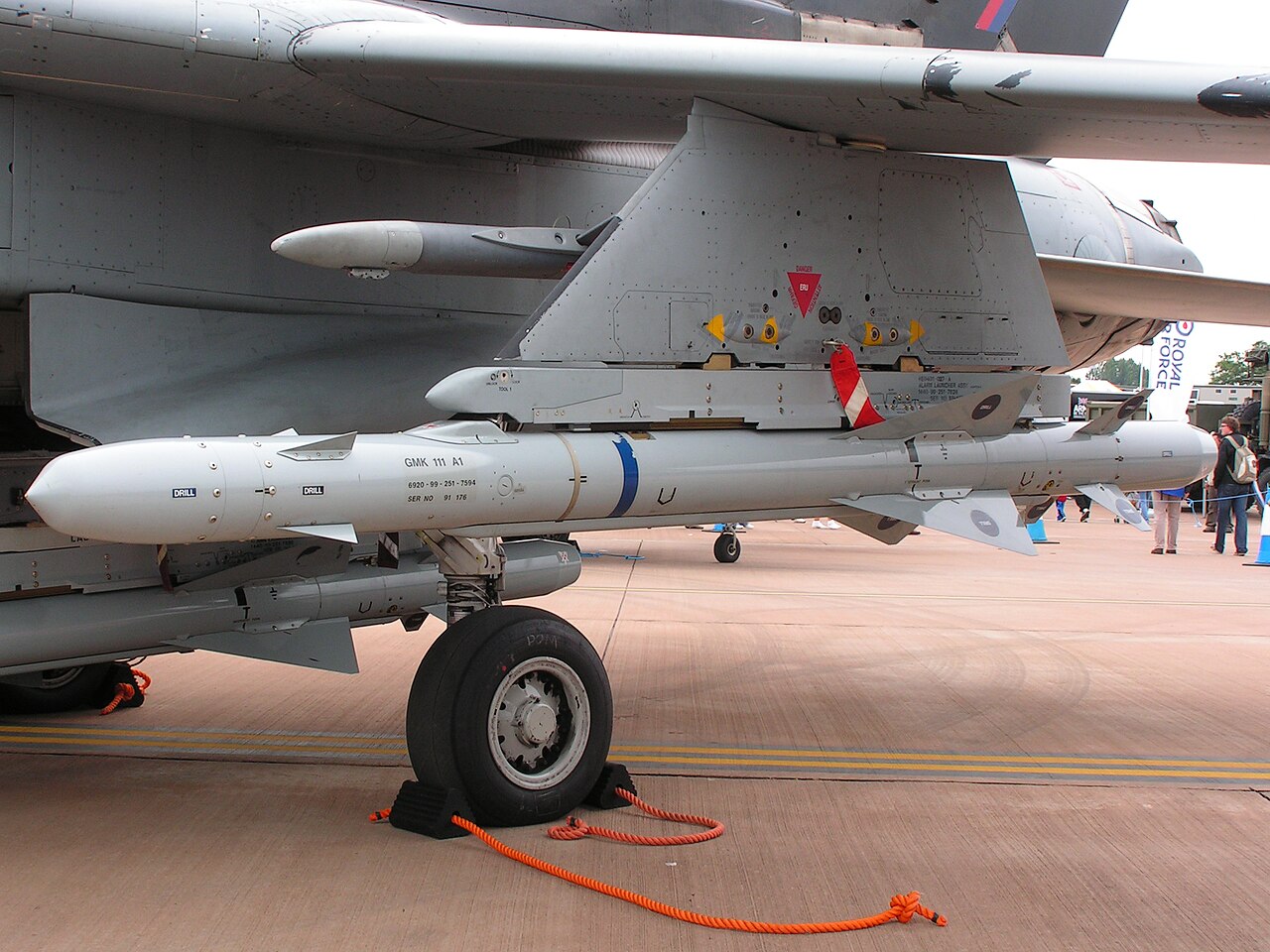
Record revision 1 · Britain's anti-radiation missile, which can loiter under a parachute until a silent radar switches back on.
Real-world weapon as described in public sources. Weights and dimensions change with the fins, fuzes and variant fitted; the data plate names the variants its figures describe, and differences are noted beside the number they affect. The record describes the weapon; it is not a guide to employing it.
ALARM · ALARM
- Type
- Air-launched anti-radiation missile for destroying enemy radars, with a loiter mode [1]
- Origin
- United Kingdom
- In service
- Royal Air Force 1990–2013; still used by the Royal Saudi Air Force [1]
- Weight
- 268 kg (591 lb) [1]
- Dimensions
- Length 4.24 m (13 ft 11 in); diameter 230 mm (9 in); wingspan 0.73 m (2 ft 5 in) [1]
- Warhead or payload
- High explosive, laser proximity fuzed [1]
- Guidance
- Preprogrammed, with a passive radar seeker [1]
- Fuzing
- Laser proximity [1]
- Delivery
- Direct attack, or a loiter mode: climb to about 13,000 m, and if the radar shuts down, descend under a parachute until it transmits again, then fire a second motor at it [1]
- Range
- About 93 km (50 NM) [1]
Britain’s anti-radiation missile
ALARM, the Air Launched Anti-Radiation Missile, was designed mainly to destroy enemy radars for the suppression of enemy air defences, SEADSEAD GlossaryJoint terms: Suppression of enemy air defenses. Activity that neutralizes, destroys, or temporarily degrades surface-based enemy air defenses by destructive and/or disruptive means.. [1] The Ministry of Defence chose it over the AGM-88 HARMAGM-88 HARM OrdnanceThe high-speed anti-radiation missile that hunts air defence radars, announced with the call Magnum. in 1983, a contested decision to keep the capability in British industry, and it entered service in 1990. [1]
Waiting for the radar
It is a fire-and-forget missile with an added loiter capability. In loiter mode it climbs to about 13,000 m after launch; if the target radar shuts down, it deploys a parachute and descends slowly until the radar transmits again, then fires a second motor to attack it. [1] That answers the oldest defence against an anti-radiation missileARM GlossaryJoint terms: Antiradiation missile. A missile which homes passively on a radiation source.: switching the radar off.
In service
The RAF fired 121 in the 1991 Gulf War, 6 over Kosovo in 1999 and 47 in the 2003 invasion of Iraq, and used it over Libya in 2011; Saudi Arabia used it in Yemen in 2015. The UK retired it at the end of 2013. [1]
Sources
- ALARM. Wikipedia (secondary source). https://en.wikipedia.org/wiki/ALARM (accessed 2026-11-03).
Wikipedia articles are secondary sources and can change; they are cited with the date they were read. NAVEDTRA training manuals and budget justification exhibits are official US publications, but each describes the weapons in service when it was written.