
Drafted — not technically validated
Record revision 1 · The Ka-50 and Su-25T's laser beam-riding missile for armour and air targets.
Real-world weapon as described in public sources. Weights and dimensions change with the fins, fuzes and variant fitted; the data plate names the variants its figures describe, and differences are noted beside the number they affect. The record describes the weapon; it is not a guide to employing it.
9K121 Vikhr (AT-16 Scallion) · 9K121 / AT-16
- Type
- Laser beam-riding anti-tank missile, also usable against air targets [1]
- Origin
- Soviet Union
- Weight
- 45 kg (99 lb) [1]
- Dimensions
- Length 2.8 m (9.2 ft); diameter 130 mm (5.1 in); wingspan 380 mm [1]
- Warhead or payload
- 8–12 kg tandem HEAT with a fragmentation sleeve; about 750 mm of armour penetration [1]
- Guidance
- Laser beam riding, from an automatic sight with TV and infrared channels and automatic target tracking [1]
- Fuzing
- Contact and proximity [1]
- Delivery
- Up to 8 km from a helicopter and 10 km from a fixed-wing aircraft by day, 5 km at night [1]
- Range
- About 10 km (5.4 NM) [1]
- Carried by
- Ka-50Ka-50 Black Shark AircraftA single-seat Russian attack helicopter with coaxial rotors and the first helicopter ejection seat in service. and Ka-52 helicopters [1]
- Su-25TSu-25 Frogfoot AircraftAn armoured Soviet close air support jet; the Su-25T adds Vikhr anti-tank missiles. aircraft; warships [1]
Riding the beam
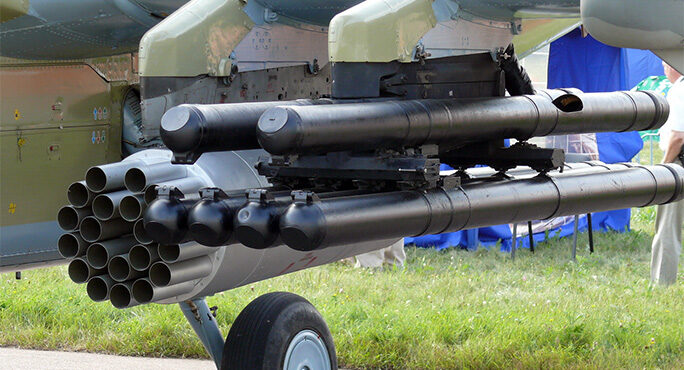
The Vikhr is a Soviet anti-tank missile that rides a laser beam to its target. It can be launched from the Ka-50Ka-50 Black Shark AircraftA single-seat Russian attack helicopter with coaxial rotors and the first helicopter ejection seat in service. and Ka-52 helicopters, the Su-25TSu-25 Frogfoot AircraftAn armoured Soviet close air support jet; the Su-25T adds Vikhr anti-tank missiles. and warships, and was first shown in public at the 1992 Farnborough Airshow. [1] The Vikhr-M system pairs the missile with an automatic sight that has TV and infrared channels, a laser channel to control the missile, a laser rangefinder and automatic target tracking, so it can find and track targets by day or night. [1] Because the receiver faces back toward the launcher, the guidance is hard to jam. [1]
One missile, three jobs
Its warhead combines a two-stage shaped charge with a fragmentation sleeve and both contact and proximity fuzes, so one missile can attack armour, including tanks with explosive reactive armour, aircraft and area targets. [1] Wikipedia notes this as an advantage over the 9M120 Ataka-V complex, which needs three different missiles for the same jobs. [1]
Sources
- 9K121 Vikhr. Wikipedia (secondary source). https://en.wikipedia.org/wiki/9K121_Vikhr (accessed 2026-10-27).
Wikipedia articles are secondary sources and can change; they are cited with the date they were read. NAVEDTRA training manuals and budget justification exhibits are official US publications, but each describes the weapons in service when it was written.