
Drafted — not technically validated
Record revision 1 · Soviet and Russian 500 kg guided bombs with laser, TV scene-matching or satellite guidance.
Real-world weapon as described in public sources. Weights and dimensions change with the fins, fuzes and variant fitted; the data plate names the variants its figures describe, and differences are noted beside the number they affect. The record describes the weapon; it is not a guide to employing it.
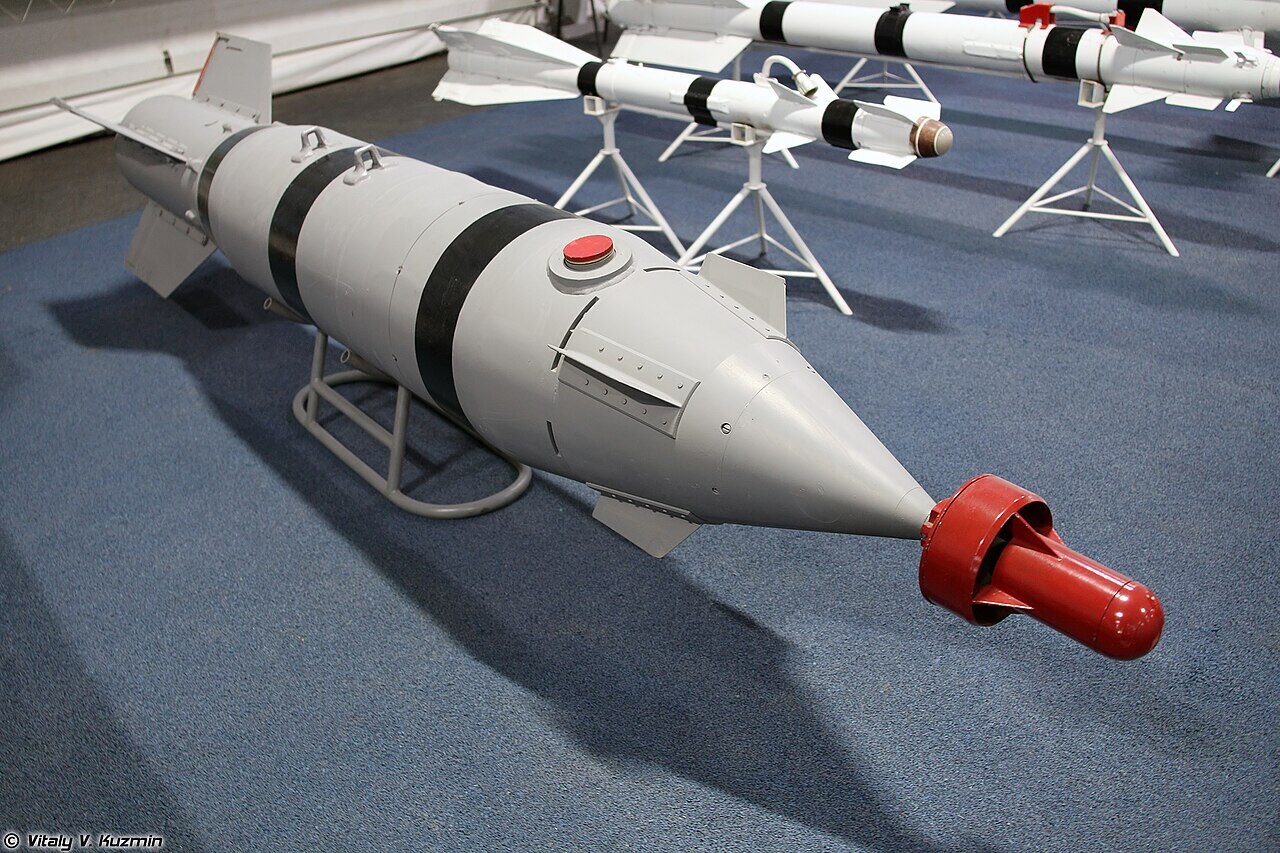
KAB-500 guided bomb family (KAB-500L, KAB-500Kr, KAB-500S-E) · KAB-500L / KAB-500Kr / KAB-500S-E
- Origin
- Soviet Union
- Warhead or payload
- KAB-500L: 450 kg (992 lb), about half of it blast explosive [1]; KAB-500Kr: 380 kg (838 lb) armour-piercing, through 1.5 m of reinforced concrete [2]; KAB-500-OD fuel-air explosive [2]
- Guidance
- Semi-active laser (L); TV scene-matching, fire and forget (Kr); GLONASS satellite (S-E) [1] [2]
- Fuzing
- Not given in the cited sources
Laser and TV
The KAB-500L is a Soviet laser-guidedLGW GlossaryWeapons: Laser-guided weapon. A weapon that uses a seeker to detect laser energy reflected from a laser marked/designated target and through signal processing provides guidance commands to a control system, which guides the… bomb that entered service in 1975 and remains in service with Russia and other former Soviet states. It weighs 525 kg, 450 kg of it warhead, and Russian sources credit it with a circular error probable of 7 m. [1] The KAB-500Kr, from the 1980s, is a TV-guided fire-and-forget bomb with a gimballed daylight camera under a glass dome. [2] Instead of locking on to contrast, as the AGM-65 MaverickAGM-65 Maverick OrdnanceThe West's most widely produced precision-guided missile: TV, infrared or laser seekers, launched and left. did, it matches the scene around the target, so it can attack low-contrast targets by using the contrast of nearby terrain and objects. [2]
Satellite guidance
The KAB-500S-E is guided by GLONASS, Russia’s satellite navigation system. It can be dropped from 500 to 5,000 m at 500–1,150 km/h, with a CEP of 7–12 m, and was first used in the Russian intervention in Syria in September 2015. [1] The same technology is used in bigger bombs, the KAB-1500L and KAB-1500Kr. [1] [2]
Sources
- KAB-500L. Wikipedia (secondary source). https://en.wikipedia.org/wiki/KAB-500L (accessed 2026-10-27).
- KAB-500KR. Wikipedia (secondary source). https://en.wikipedia.org/wiki/KAB-500KR (accessed 2026-10-27).
Wikipedia articles are secondary sources and can change; they are cited with the date they were read. NAVEDTRA training manuals and budget justification exhibits are official US publications, but each describes the weapons in service when it was written.