
Drafted — not technically validated
Record revision 1 · The Mi-24's radio-command anti-tank missile, first used in Afghanistan.
Real-world weapon as described in public sources. Weights and dimensions change with the fins, fuzes and variant fitted; the data plate names the variants its figures describe, and differences are noted beside the number they affect. The record describes the weapon; it is not a guide to employing it.
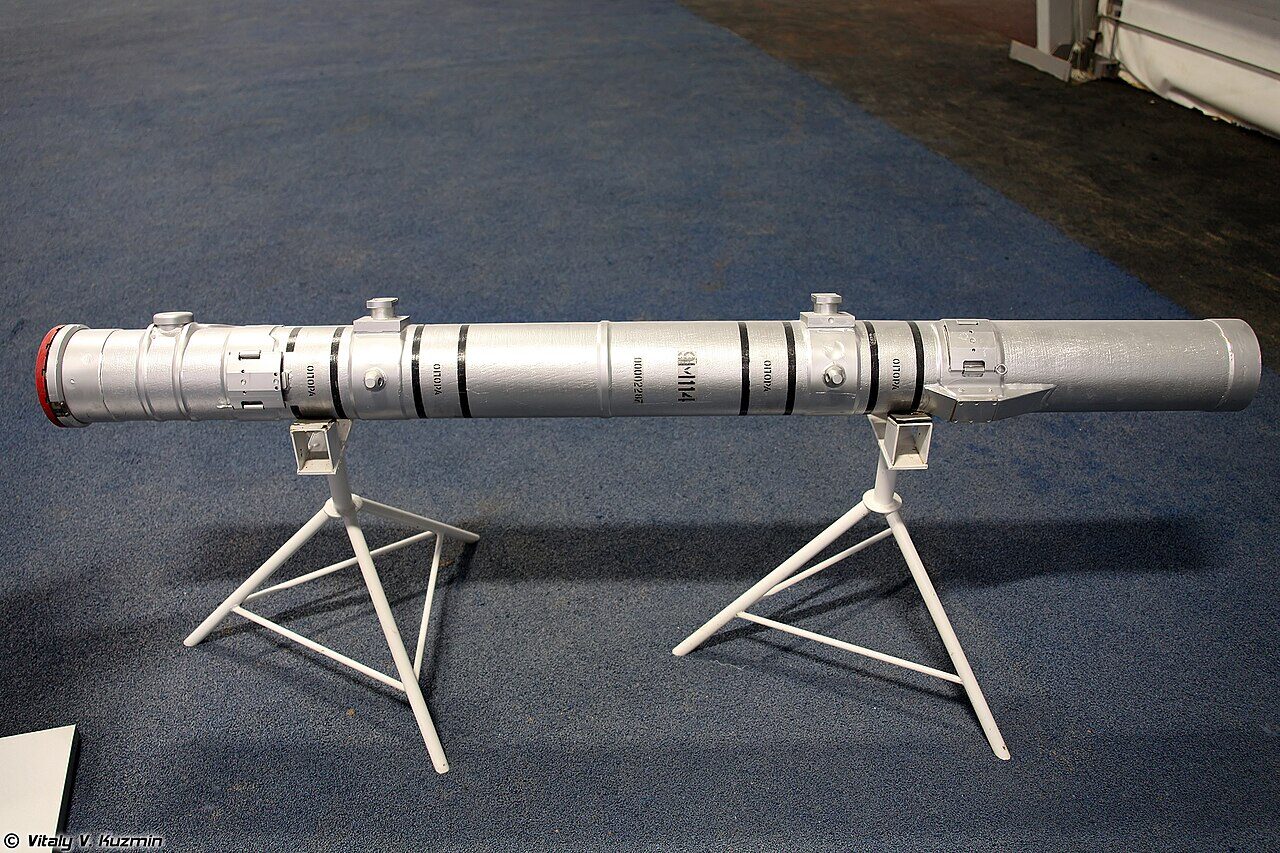
9K114 Shturm (AT-6 Spiral) · 9K114 / AT-6
- Type
- Radio-command anti-tank missile system, first built for the Mi-24 [1]
- Origin
- Soviet Union
- In service
- 1976 [1]
- Weight
- 31.4 kg (69 lb) at launch [1]
- Dimensions
- Not given in the cited source; launched from a glass-reinforced plastic tube [1]
- Warhead or payload
- 5.3 kg HEAT, 560–600 mm armour penetration; 7.4 kg on the 9M114M1 [1]
- Guidance
- SACLOS by VHF radio command: the gunner holds the sight's cross hairs on the target until impact [1]
- Fuzing
- Contact [1]
- Delivery
- Flies above the gunner's line of sight and descends onto the target just before impact, using the laser rangefinder's range [1]
- Range
- 400 m to 5 km (2.7 NM); 6 km on the 9M114M1 [1]
- Carried by
For the Mi-24
The 9M114 Kokon missile of the Shturm system was developed by the Kolomna bureau, starting in 1967 with the aim of arming the Mi-24Mi-24P Hind-F AircraftThe Soviet gunship that could also carry eight troops; the Mi-24P has a fixed twin-barrel 30 mm cannon.. Testing was completed in 1974 and it entered service in 1976. [1] In role it resembles the TOWBGM-71 TOW OrdnanceThe wire-guided anti-tank missile that first destroyed tanks from helicopters in Vietnam in 1972. and HOTHOT anti-tank missile OrdnanceThe Franco-German anti-tank missile of the Gazelle and Bo 105 helicopters., which entered service about the same time, but it is heavier, faster and longer-ranged. [1]
Radio, not wire
The Shturm is a SACLOS missile with a radio command link, which lets it fly much faster and farther than a wire-guided missile. The link uses five frequency bands and two codes to resist jammingElectromagnetic jamming GlossaryJoint terms: The deliberate radiation, reradiation, or reflection of electromagnetic energy for the purpose of preventing or reducing an enemy's effective use of the electromagnetic spectrum, and with the intent of degrading or…. [1] The gunner uses an 8× daylight sight with a built-in laser rangefinder and keeps the cross hairs on the target until impact. The missile flies above the line of sight to clear obstacles and drops onto the target just before it hits; it can even engage low, slow helicopters, though only a direct hit will do, since it has only a contact fuzeFuze GlossaryWeapons: A device that causes the detonation of an explosive charge at the proper time after certain conditions are met. A bomb fuze is mechanical or electrical, and is classed by what sets it off (impact, mechanical time…. [1]
Afghanistan
The Shturm was first used late in the Soviet–Afghan War, when better anti-aircraft weapons in the Mujahideen’s hands forced Mi-24 crews to use it from standoff range; sources report hit rates of 75–85 per cent. [1]
Sources
- 9K114 Shturm. Wikipedia (secondary source). https://en.wikipedia.org/wiki/9K114_Shturm (accessed 2026-10-27).
Wikipedia articles are secondary sources and can change; they are cited with the date they were read. NAVEDTRA training manuals and budget justification exhibits are official US publications, but each describes the weapons in service when it was written.