
Drafted — not technically validated
Record revision 1 · The wire-guided anti-tank missile that first destroyed tanks from helicopters in Vietnam in 1972.
Real-world weapon as described in public sources. Weights and dimensions change with the fins, fuzes and variant fitted; the data plate names the variants its figures describe, and differences are noted beside the number they affect. The record describes the weapon; it is not a guide to employing it.
BGM-71 TOW · BGM-71 TOW
- Type
- Tube-launched, optically tracked, wire-guided anti-tank missile, used from helicopters as well as the ground [1]
- Origin
- United States
- In service
- First produced in 1968; first combat use from helicopters in Vietnam, May 1972 [1]
- Weight
- Not given in the cited source
- Dimensions
- Diameter 152 mm (6 in); length 1.16–1.51 m (3.8–5.0 ft) depending on variant and probe [1]
- Warhead or payload
- 3.9–6.14 kg (8.6–13.5 lb) shaped charge, penetrating 430–900 mm of armour [1]
- Guidance
- SACLOS: the gunner keeps the sight on the target and the system steers the missile by wire (radio on RF variants) [1]
- Fuzing
- Not given in the cited source
- Delivery
- Fired from a tube; on helicopters the M65 sight on the AH-1 or the XM26 on the UH-1 [1]
- Range
- 3,000 m for the basic TOW, 3,750 m for most variants [1]
- Carried by
- Variants
- TOW-2 series [1]
Keep the cross hairs on the target
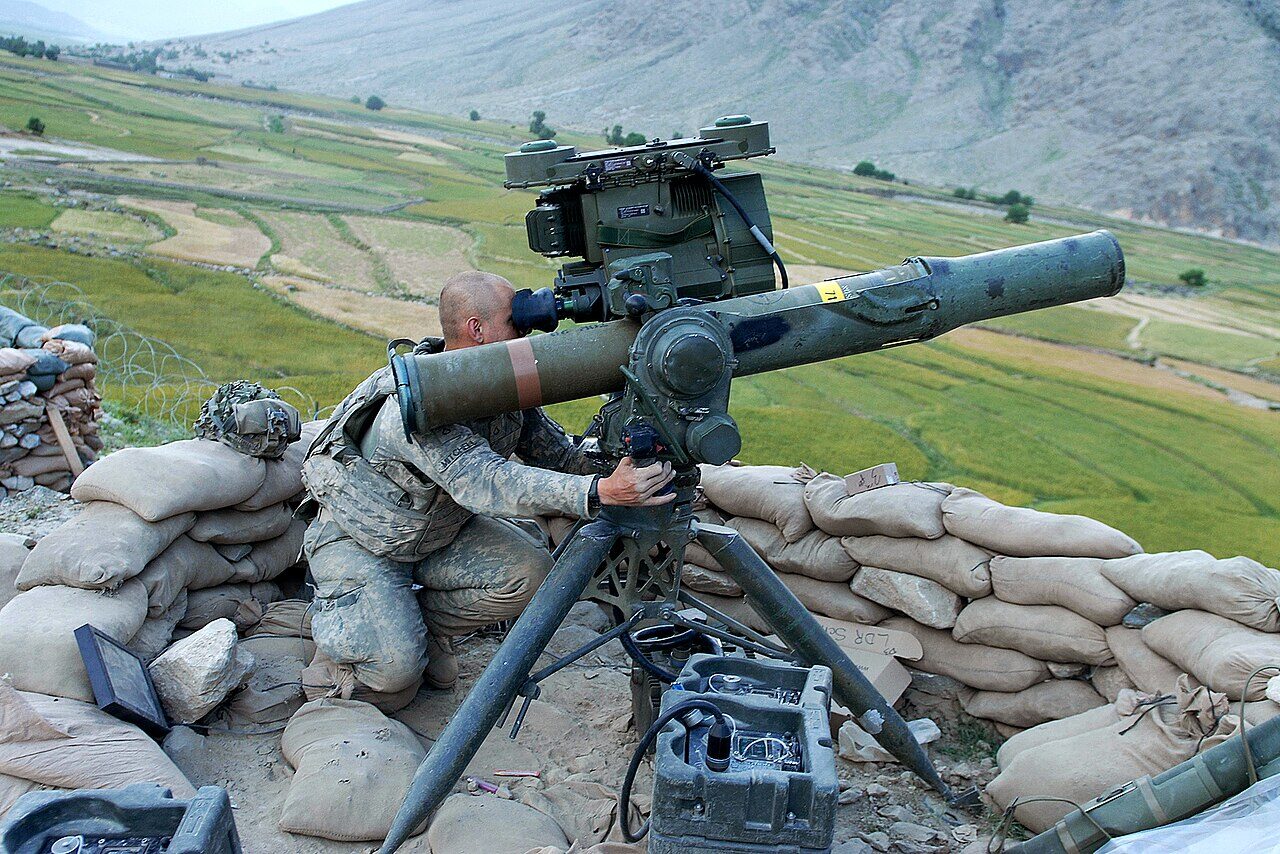
Earlier anti-tank missiles, such as the SS.10 and ENTAC, were flown with a small joystick, and operators tended to overcorrect and swing the missile back and forth across the target. [1] The TOW asked less of the gunner: keep the sight on the target, and the electronics, tracking an infrared lamp on the tail of the missile, work out the steering commands and send them down the wires. That is the concept now called SACLOS. [1] It is one of the most widely used anti-tank missiles in the world. [1]
From the helicopter
The tube launch made the TOW hard to fire from a helicopter, because the missile had to be gathered into the tracker’s view quickly after leaving the tube, and the requirement was dropped at first. [1] A stabilised sight solved it: the XM26 system was developed for the UH-1, and the M65 became the main system on the AH-1 Cobra series. [1] The British Army also fitted TOW to its Lynx helicopters, four missiles on each of two pylons. [1]
First blood
On 24 April 1972 the US 1st Combat Aerial TOW Team arrived in South Vietnam with two UH-1B helicopters, each carrying the XM26 system, to test the missile in combat. [1] On 2 May, UH-1sUH-1H Huey AircraftThe utility helicopter that defined the Vietnam War and served every US armed service; more than 16,000 built. firing TOWs destroyed North Vietnamese tanks near An Loc, the first time a US unit had destroyed enemy armour with American-designed guided missiles. [1] For helicopters, the laser-guidedLGW GlossaryWeapons: Laser-guided weapon. A weapon that uses a seeker to detect laser energy reflected from a laser marked/designated target and through signal processing provides guidance commands to a control system, which guides the… AGM-114 HellfireAGM-114 Hellfire OrdnanceThe helicopter tank buster with laser or radar seekers, now also the drone strike weapon. began to replace the TOW in the 1980s. [1]
Sources
- BGM-71 TOW. Wikipedia (secondary source). https://en.wikipedia.org/wiki/BGM-71_TOW (accessed 2026-10-27).
Wikipedia articles are secondary sources and can change; they are cited with the date they were read. NAVEDTRA training manuals and budget justification exhibits are official US publications, but each describes the weapons in service when it was written.