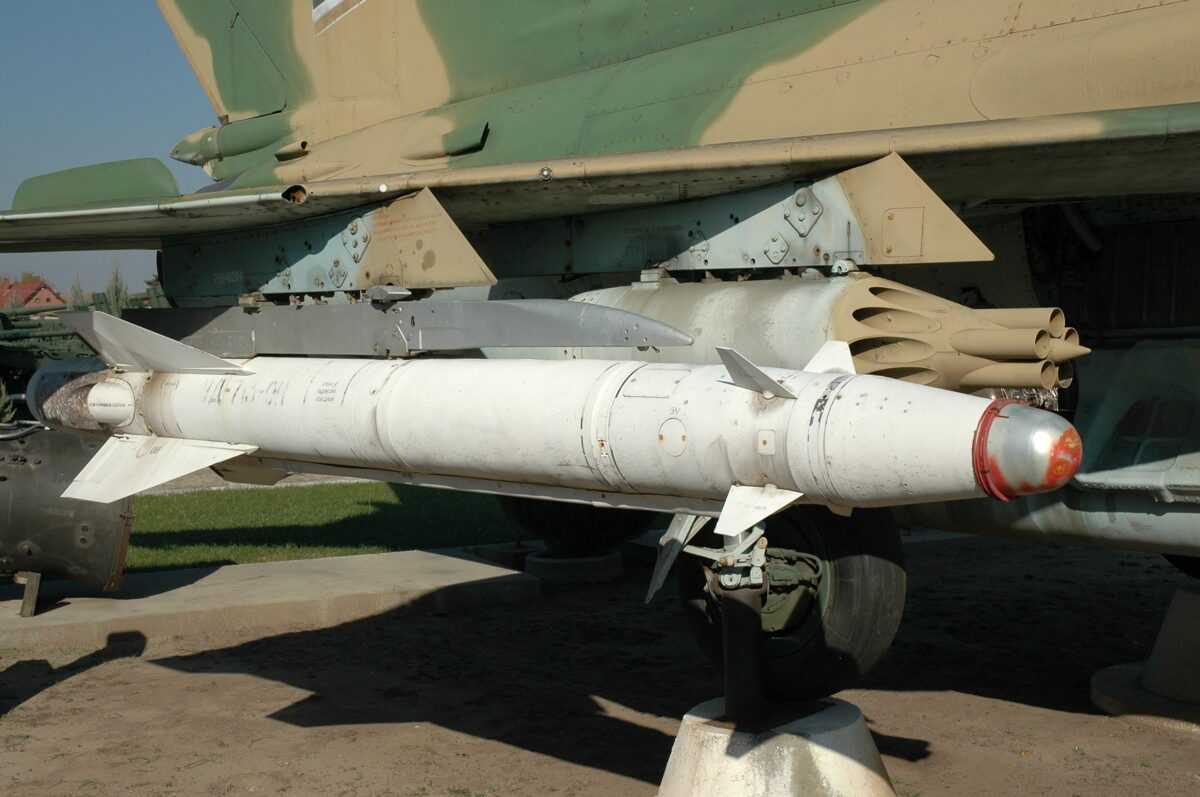

Drafted — not technically validated
Record revision 1 · A light Soviet tactical missile whose laser, radar-homing or radio seekers swap on one body.
Real-world weapon as described in public sources. Weights and dimensions change with the fins, fuzes and variant fitted; the data plate names the variants its figures describe, and differences are noted beside the number they affect. The record describes the weapon; it is not a guide to employing it.
Kh-25 (AS-10 Karen, AS-12 Kegler) · Kh-25 / AS-10 / AS-12
- Type
- Light modular tactical air-to-surface missile family; the Kh-25MP is anti-radiation [1]
- Origin
- Soviet Union
- In service
- 1975 (Kh-25); modular Kh-25M family completed by the end of 1978 [1]
- Weight
- 299 kg (659 lb) Kh-25ML; 315 kg (694 lb) Kh-25MP [1]
- Dimensions
- Length 3.71 m (12.2 ft) Kh-25ML, up to 4.36 m Kh-25MP; diameter 27.5 cm (10.8 in); span 75.5 cm [1]
- Warhead or payload
- High explosive, shell-forming; 90 kg (198 lb) on the Kh-25MP, 140 kg (309 lb) on the Kh-25MR [1]
- Guidance
- Interchangeable seekers: semi-active laser (Kh-25ML), passive radar (Kh-25MP), radio command (Kh-25MR); TV, infrared and satellite on later versions [1]
- Fuzing
- Not given in the cited source
- Delivery
- Seeker heads swap to suit the target, the missile body staying the same [1]
- Range
- About 10–11 km (6 NM) Kh-25ML; up to 40–60 km (22–32 NM) Kh-25MP [1]
- Carried by
- MiG-23/27, Su-17/22, Su-24 [1]
- MiG-21MiG-21 AircraftThe small delta-wing Mach 2 fighter: the most-produced supersonic jet in history., MiG-29MiG-29 Fulcrum AircraftA twin-engine Soviet fighter with a helmet sight and R-73 missiles, built to counter the F-15 and F-16., Su-25Su-25 Frogfoot AircraftAn armoured Soviet close air support jet; the Su-25T adds Vikhr anti-tank missiles., Su-27Su-27 Flanker AircraftA large, long-range Soviet air superiority fighter with ten missile stations. and Yak-130 [1]
One missile, many heads
The Kh-25 is a family of light Soviet air-to-ground missiles built round a modular choice of guidance systems. [1] It grew out of the laser-guidedLGW GlossaryWeapons: Laser-guided weapon. A weapon that uses a seeker to detect laser energy reflected from a laser marked/designated target and through signal processing provides guidance commands to a control system, which guides the… version of the Kh-23 Grom: work on a semi-active laser seeker began in 1971, and the Kh-25 entered production in 1975. [1] Its predecessor, the beam-riding Kh-66, had been hard to use because the launch aircraft had to dive at the target. [1]
The modular Kh-25M
From 1973 the design bureau combined the Kh-23M, Kh-25 and the Kh-27 anti-radar missile into one modular system, to cut costs and add tactical flexibility. Completed by the end of 1978, it produced the anti-radar Kh-25MP, the laser-guided Kh-25ML and the radio-guided Kh-25MR, which could be changed simply by changing the seeker head. [1] NATO kept calling them AS-12 and AS-10. [1]
In service
The original Kh-25 equipped the MiG-23, MiG-27 and Su-17M from the mid-1970s and has since been cleared for many more aircraft. [1] It remains in wide use, though a successor, the Kh-38, has been developed. [1]
Sources
- Kh-25. Wikipedia (secondary source). https://en.wikipedia.org/wiki/Kh-25 (accessed 2026-10-27).
Wikipedia articles are secondary sources and can change; they are cited with the date they were read. NAVEDTRA training manuals and budget justification exhibits are official US publications, but each describes the weapons in service when it was written.