
Drafted — not technically validated
Record revision 1 · The Viggen's supersonic missile, steered by the pilot with a joystick.
Real-world weapon as described in public sources. Weights and dimensions change with the fins, fuzes and variant fitted; the data plate names the variants its figures describe, and differences are noted beside the number they affect. The record describes the weapon; it is not a guide to employing it.
RB 05 air-to-surface missile · RB 05
- Type
- Short-range air-to-surface missile with limited air-to-air capability [1]
- Origin
- Sweden
- In service
- 1972–2005 [1]
- Weight
- 305 kg (672 lb) [1]
- Dimensions
- Length 3.6 m (11.8 ft); diameter 0.3 m (11.8 in); wingspan 0.8 m (31.5 in) [1]
- Warhead or payload
- 160 kg (353 lb) high explosive [1]
- Guidance
- Manual command to line of sight (MCLOS) by radio: the pilot steers it with a joystick, watching its flares [1]
- Fuzing
- Proximity [1]
- Delivery
- After a high-speed, very low run-in, the aircraft climbs to about 400 m to launch, then descends again while the pilot guides the missile [1]
- Range
- 9 km (4.9 NM) [1]
Flown by hand
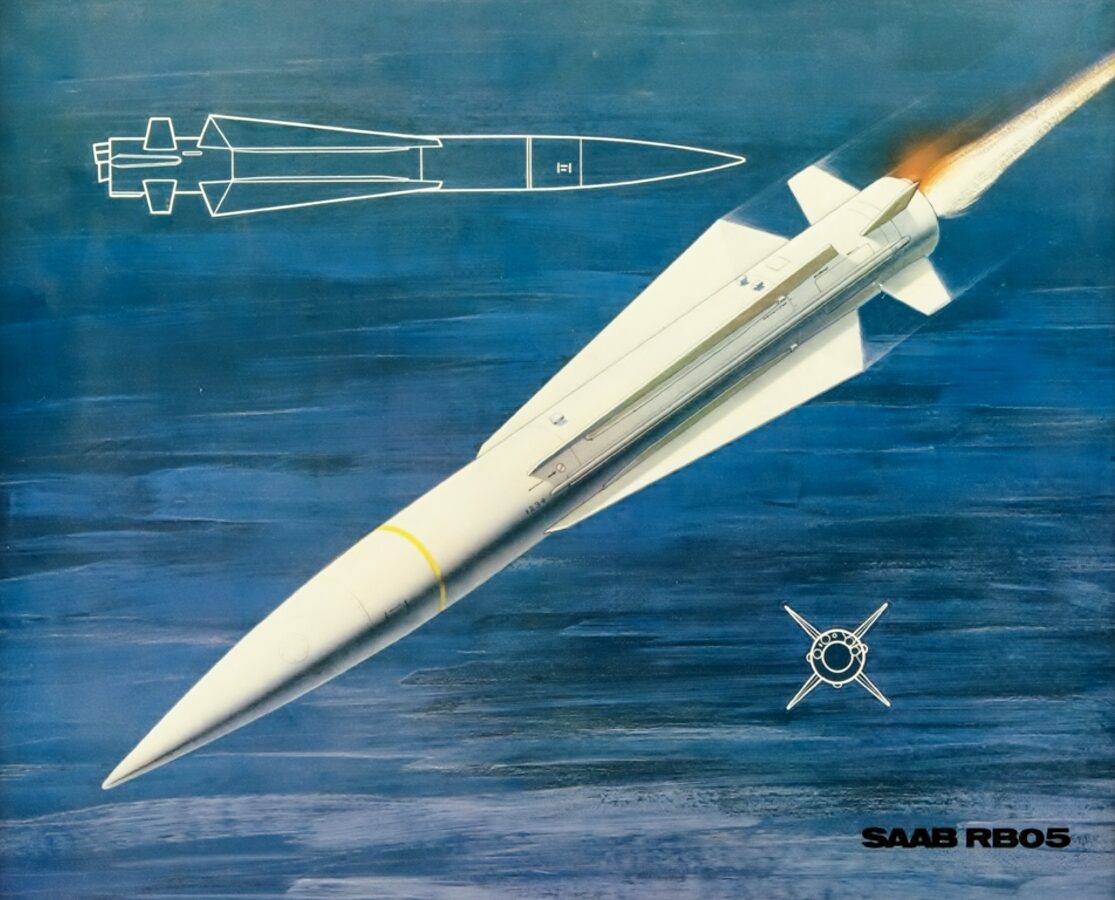
Saab developed the RB 05 in the 1960s as a ground-attack missile for the Saab 37 ViggenAJS 37 Viggen AircraftA Swedish canard-delta attack aircraft built to fly from road bases, with a thrust reverser and anti-ship missiles. and the Saab 105 trainer, and it entered service in 1972. [1] It was guided by manual command to line of sight: the pilot followed the flares on the missile and steered it to the target with a joystick, the commands going out over a jam-resistant radio link. [1] That meant aiming separately from flying, which needed either a second crew member, as in the Saab 105, or a computer to fly the aircraft during guidance, as in the Viggen. [1]
Supersonic and smokeless
The missile was usually launched after a high-speed run at very low altitude and a climb to 400 m. It flew at supersonic speed to cut the threat from surface-to-air missiles, and because it was roll-stabilised the aircraft did not need to point straight at the target and could descend again at once. [1] Its rocket engine was smokeless so as not to hide the target from the pilot. [1]
Sources
- Saab RB05. Wikipedia (secondary source). https://en.wikipedia.org/wiki/Saab_RB05 (accessed 2026-10-27).
Wikipedia articles are secondary sources and can change; they are cited with the date they were read. NAVEDTRA training manuals and budget justification exhibits are official US publications, but each describes the weapons in service when it was written.