
Drafted — not technically validated
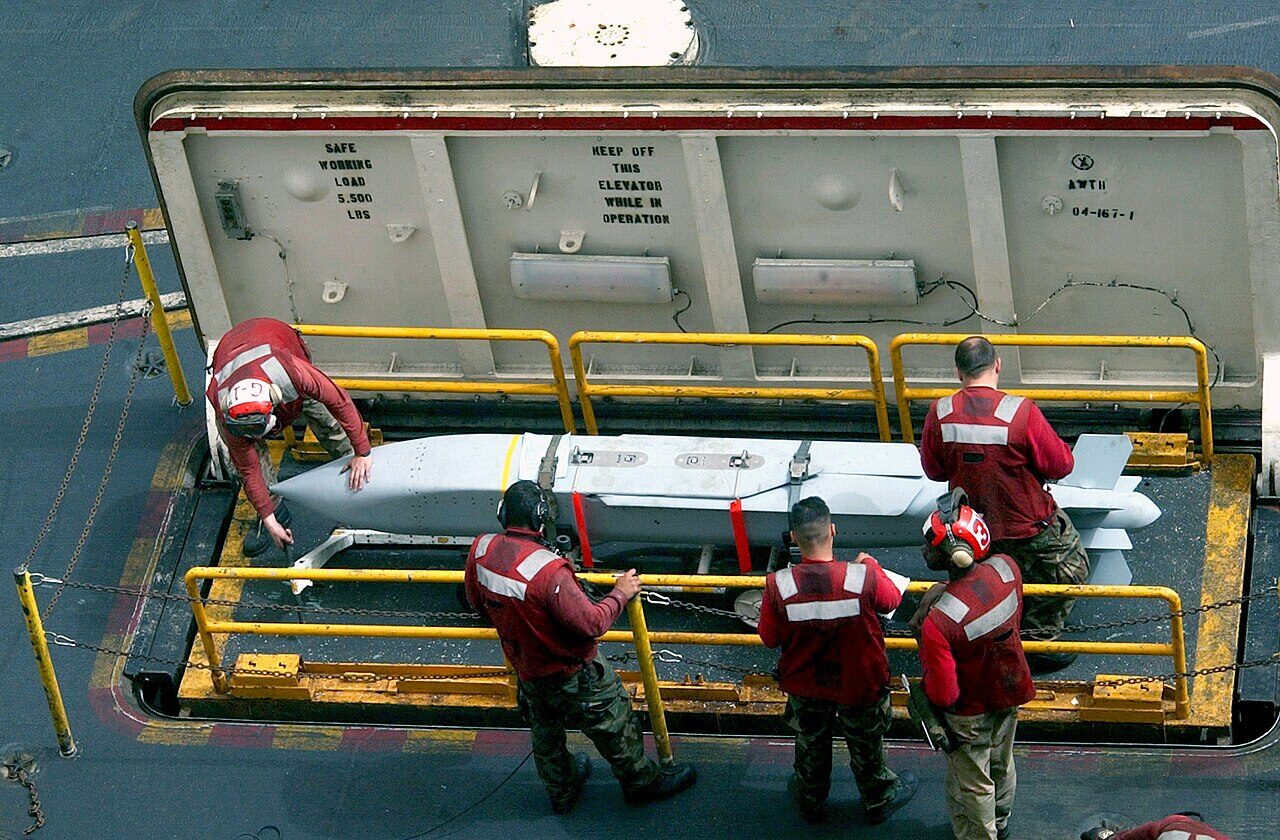
Record revision 1 · An unpowered GPS glide weapon that drops bomblets or a unitary warhead from outside the point defences.
Real-world weapon as described in public sources. Weights and dimensions change with the fins, fuzes and variant fitted; the data plate names the variants its figures describe, and differences are noted beside the number they affect. The record describes the weapon; it is not a guide to employing it.
AGM-154 Joint Standoff Weapon (JSOW) · AGM-154 JSOW
- Origin
- United States
- In service
- January 1999 (AGM-154A); February 2005 (AGM-154C) [1]
- Weight
- About 1,065–1,095 lb (483–497 kg) [1]
- Dimensions
- Length 160 in (4.1 m); diameter 13 in (330 mm); wingspan 106 in (2.7 m) [1]
- Warhead or payload
- AGM-154A: 145 BLU-97/B combined-effects bomblets; AGM-154C: BLU-111 500 lb unitary warhead [2], or the BROACH two-stage warhead [1]
- Guidance
- GPS/INS to the target; AGM-154C adds an imaging infrared seeker and two-way data link [1] [2]
- Fuzing
- AGM-154C: FMU-152 Joint Programmable FuzeFuze GlossaryWeapons: A device that causes the detonation of an explosive charge at the proper time after certain conditions are met. A bomb fuze is mechanical or electrical, and is classed by what sets it off (impact, mechanical time… [2]
- Delivery
- Launch and leave: given a waypoint or a point marked by a targeting pod, it glides on pop-out wings and dispenses its payload over the target [1] [2]
- Carried by
- US Navy F/A-18F/A-18 Hornet AircraftA carrier-capable fighter and attack aircraft that one pilot can switch between roles on the same sortie. family [1]
- US Air Force F-16F-16 Fighting Falcon AircraftA single-engine multirole fighter: fly-by-wire, 9 g, and the US Air Force's main strike and SEAD aircraft. (tested from 1996) [2]; export F-16s of Poland and Turkey [1]
Outside the point defences
The JSOW came from a joint Navy and Air Force programme for a standard, medium-range precision weapon that could attack defended targets from outside the reach of ordinary anti-aircraft defences, keeping the aircraft and crew safer. [1] It is a glide bomb, not a missile, despite its AGM designation. [1] The FAS gives a standoff of 15 NM from a low-altitude launch and 40 NM from high altitude [2]; Wikipedia gives 12 and 70 NM. [1]
How it is used
Before launch the weapon is given a destination, either a preplanned waypoint or a point marked with a targeting pod. It then glides on two pop-out wings and, in the baseline version, dispenses its submunitions in a short, roughly linear pattern over soft targets such as parked aircraft, trucks, armoured personnel carriers and SAM sites. [1] It is a fire-and-forget weapon guided by tightly coupled GPS and inertial navigation, usable day, night and in bad weather. [1] The AGM-154C adds an imaging infrared seeker and a two-way data link for point targets, with aimpoint refinement and man-in-the-loop guidance. [2]
Variants
All versions share one air vehicle, the “truck”, with different payloads. [1] The AGM-154A carries 145 BLU-97/B bomblets, each with a shaped charge against armour, a fragmenting case and a zirconium incendiary ring. [2] The anti-armour AGM-154B, carrying sensor-fuzed submunitions, was developed but never bought once the Air Force left the programme. [1]
Sources
- AGM-154 Joint Standoff Weapon. Wikipedia (secondary source). https://en.wikipedia.org/wiki/AGM-154_Joint_Standoff_Weapon (accessed 2026-10-27).
- AGM-154A Joint Standoff Weapon [JSOW]. Federation of American Scientists, Military Analysis Network. https://man.fas.org/dod-101/sys/smart/agm-154.htm (accessed 2026-10-27).
Wikipedia articles are secondary sources and can change; they are cited with the date they were read. NAVEDTRA training manuals and budget justification exhibits are official US publications, but each describes the weapons in service when it was written.