
Drafted — not technically validated
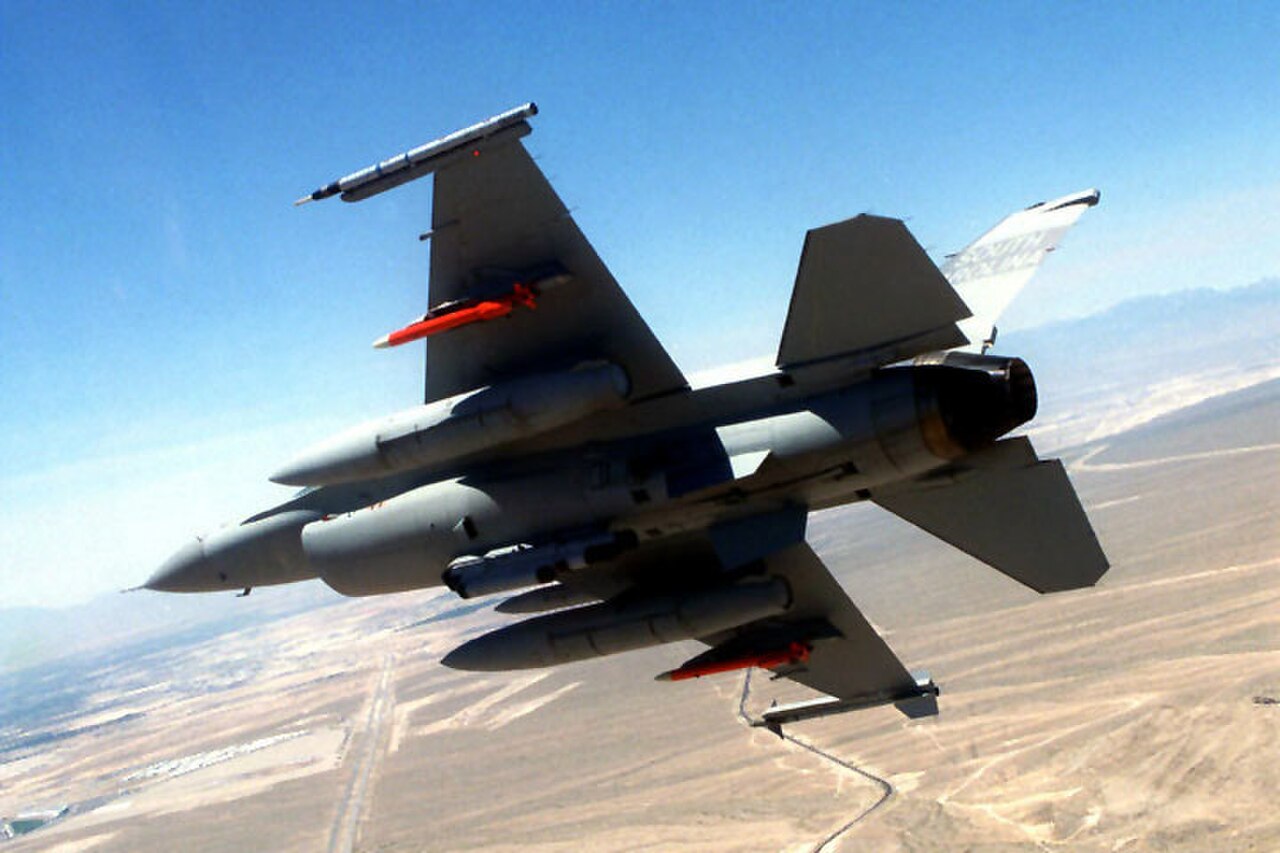
Record revision 1 · A small jet-powered decoy that imitates aircraft to air defence radars; the MALD-J version jams them too.
Real-world weapon as described in public sources. Weights and dimensions change with the fins, fuzes and variant fitted; the data plate names the variants its figures describe, and differences are noted beside the number they affect. The record describes the weapon; it is not a guide to employing it.
ADM-160 MALD · ADM-160
- Type
- Miniature air-launched decoy, powered, that imitates aircraft to air defence radars; the MALD-J also jams them [1]
- Origin
- United States
- In service
- ADM-160B first delivered in 2009, an operationally significant quantity in 2010; MALD-J from 2012 [1]
- Weight
- 279 lb (127 kg) MALD; about 286 lb (130 kg) MALD-J [1]
- Dimensions
- Length 9 ft 4.5 in (2.86 m); wingspan 5 ft 7 in (1.70 m) [1]
- Warhead or payload
- None [1]
- Guidance
- GPS-aided inertial navigation along a preprogrammed route, which the pilot can change before launch [1]
- Fuzing
- Not applicable
- Delivery
- Folded wings open after release and a turbojet flies it along up to 100 waypoints (256 in the ADM-160A) [1]
- Range
- About 500 NM (MALD) and 486 NM (MALD-J), at up to Mach 0.9 [1]
- Carried by
- US Air Force: F-16F-16 Fighting Falcon AircraftA single-engine multirole fighter: fly-by-wire, 9 g, and the US Air Force's main strike and SEAD aircraft., B-52 and A-10CA-10 Thunderbolt II AircraftThe Warthog: a straight-wing, armoured close air support jet built around the 30 mm GAU-8 cannon. [1]
- Ukrainian Air Force: Su-27Su-27 Flanker AircraftA large, long-range Soviet air superiority fighter with ten missile stations. and, probably, MiG-29MiG-29 Fulcrum AircraftA twin-engine Soviet fighter with a helmet sight and R-73 missiles, built to counter the F-15 and F-16. [1]
- Variants
- ADM-160A: the original DARPA decoy, cancelled by the Air Force in 2002 for lack of range and endurance [1]
- ADM-160B: the larger, longer-endurance Raytheon decoy in Air Force service [1]
- ADM-160C MALD-J: works as a decoy or as a stand-in jammer against early-warning and target acquisition radars, with a datalink [1]
- MALD-X and MALD-N: improved electronic warfare payload, low-level flight and networking; MALD-N for the US Navy [1]
A small, cheap aircraft for the radar
The Miniature Air-Launched Decoy began as a DARPA programme in 1995 to build a small, low-cost decoy for the suppression of enemy air defences, SEADSEAD GlossaryJoint terms: Suppression of enemy air defenses. Activity that neutralizes, destroys, or temporarily degrades surface-based enemy air defenses by destructive and/or disruptive means.. [1] Its signature augmentation system, a set of active radar enhancers covering a range of frequencies, lets it look like any aircraft from a B-52 to an F-117. A turbojet flies it along a preprogrammed route of waypoints, kept on course by GPS-aided inertial navigation. [1]
Decoy and jammer
The jamming MALD-J, delivered from 2012, can work as a decoy or jam early-warning and target acquisition radars as a stand-in jammer, and has a datalink so its mission can be adjusted in flight. [1]
In combat
Its first known combat use was by Ukraine in May 2023. Ukrainian pilots describe the decoys as built to “bear the brunt of the air defenses”, launched with Storm Shadow and SCALP cruise missile strikes and with AGM-88 HARMAGM-88 HARM OrdnanceThe high-speed anti-radiation missile that hunts air defence radars, announced with the call Magnum. anti-radiation missiles. [1]
Sources
- ADM-160 MALD. Wikipedia (secondary source). https://en.wikipedia.org/wiki/ADM-160_MALD (accessed 2026-11-03).
Wikipedia articles are secondary sources and can change; they are cited with the date they were read. NAVEDTRA training manuals and budget justification exhibits are official US publications, but each describes the weapons in service when it was written.