
Drafted — not technically validated
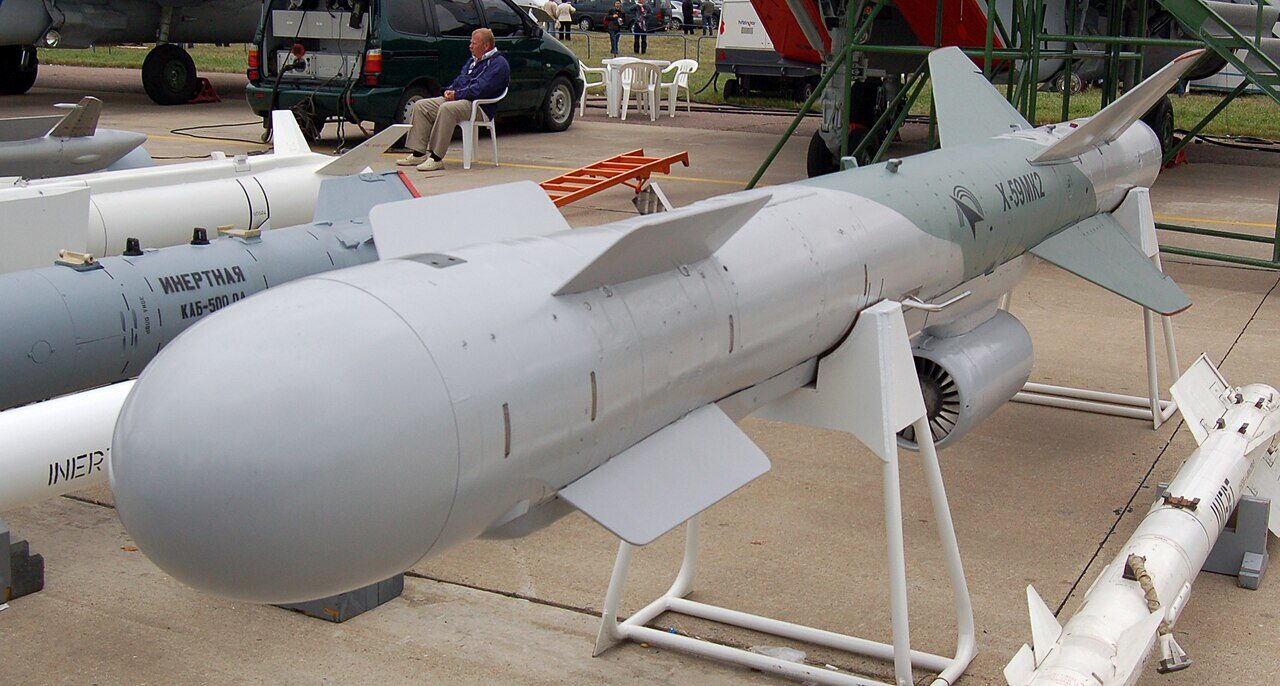
Record revision 1 · A Soviet standoff cruise missile flown inertially, then steered onto the target by TV.
Real-world weapon as described in public sources. Weights and dimensions change with the fins, fuzes and variant fitted; the data plate names the variants its figures describe, and differences are noted beside the number they affect. The record describes the weapon; it is not a guide to employing it.
Kh-59 Ovod (AS-13 Kingbolt, AS-18 Kazoo) · Kh-59 / AS-13 / AS-18
- Type
- Air-launched cruise missile for precision standoff attack [1]
- Origin
- Soviet Union
- In service
- 1980 [1]
- Weight
- 930 kg (2,050 lb) [1]
- Dimensions
- Length 5.7 m (18.7 ft); diameter 38 cm (15 in); wingspan 1.3 m (4.3 ft) [1]
- Warhead or payload
- 320 kg (705 lb) cluster or shaped-charge fragmentation [1]
- Guidance
- Inertial to the target area, then TV guidance with an operator in the launch aircraft; active radar on the anti-ship Kh-59MK [1]
- Fuzing
- Not given in the cited source
- Delivery
- Released at 600–1,000 km/h and 0.2–11 km altitude; cruises about 7 m over water or 100–1,000 m over land; TV guidance switches on 10 km from the target and the operator locks the missile on [1]
- Range
- 200 km (108 NM); 115 km for the Kh-59ME export version [1]
- Carried by
A longer reach
Raduga developed the Kh-59 in the 1970s as a longer-ranged relative of the Kh-25Kh-25 OrdnanceA light Soviet tactical missile whose laser, radar-homing or radio seekers swap on one body., a precision standoff weapon for the Su-24M and late MiG-27s. [1] After release a solid-fuel booster fires, the fins and wings unfold, and a sustainer motor drives it on, while a radar altimeter holds it about 7 m over water or 100–1,000 m over land. [1] The Kh-59M Ovod-M adds a bigger warhead and a turbofan engine. [1]
Man in the loop
The target’s coordinates are loaded before launch and the missile flies the first part of its flight on inertial guidance. About 10 km from the target its television guidance switches on; an operator in the aircraft identifies the target and locks the missile onto it. [1] Its electro-optical sensors came from the same Krasnogorsk design bureau as those of the Kh-29Kh-29 OrdnanceA heavy Soviet tactical missile with a 320 kg warhead and laser or TV guidance. and the KAB-500KrKAB-500 guided bombs OrdnanceSoviet and Russian 500 kg guided bombs with laser, TV scene-matching or satellite guidance. bomb. [1]
Sources
- Kh-59. Wikipedia (secondary source). https://en.wikipedia.org/wiki/Kh-59 (accessed 2026-10-27).
Wikipedia articles are secondary sources and can change; they are cited with the date they were read. NAVEDTRA training manuals and budget justification exhibits are official US publications, but each describes the weapons in service when it was written.