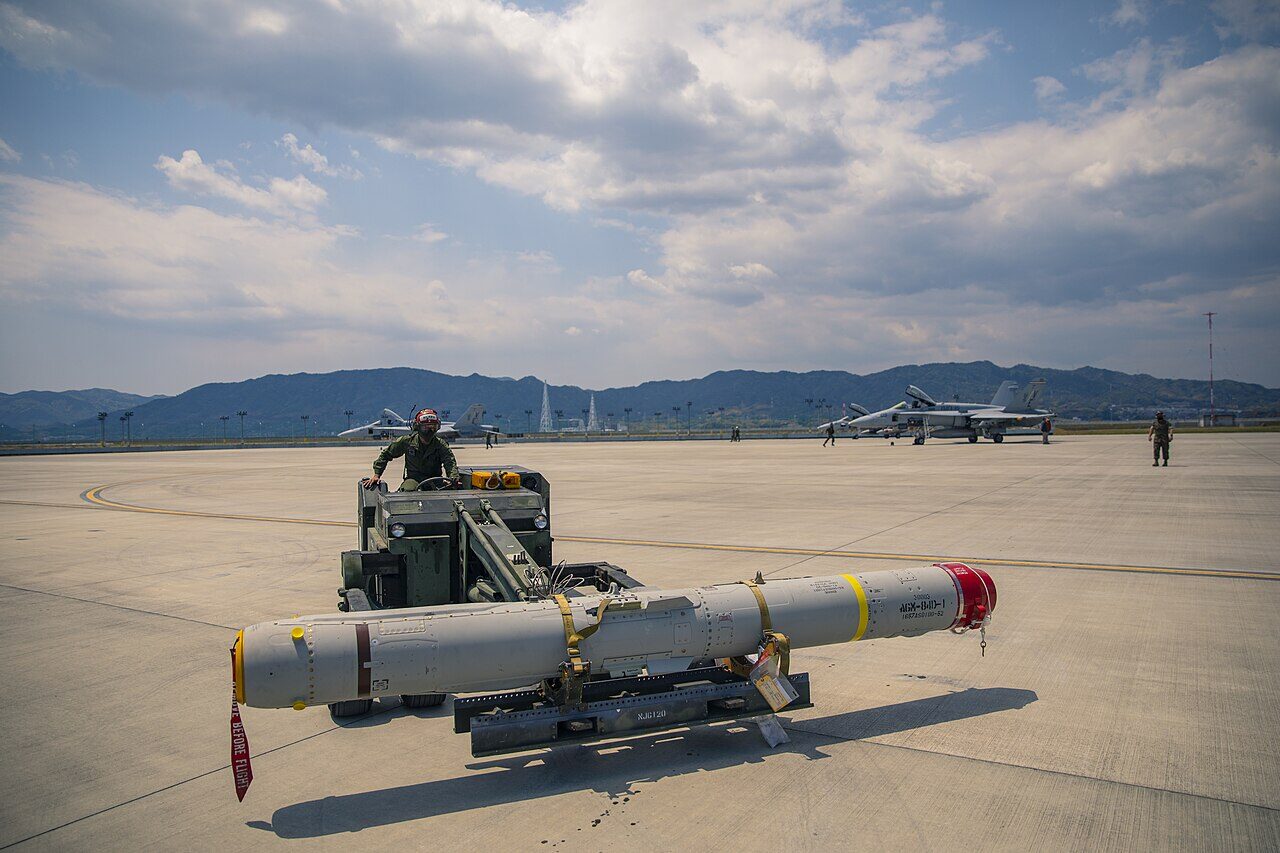

Drafted — not technically validated
Record revision 1 · The sea-skimming anti-ship missile and its SLAM land-attack derivative, first fired in combat in 1991.
Real-world weapon as described in public sources. Weights and dimensions change with the fins, fuzes and variant fitted; the data plate names the variants its figures describe, and differences are noted beside the number they affect. The record describes the weapon; it is not a guide to employing it.
AGM-84 Harpoon and SLAM · AGM-84
- Type
- All-weather, over-the-horizon anti-ship missile; the SLAM is its land-attack cruise missile derivative [1] [3]
- Origin
- United States
- Weight
- 1,523 lb (691 kg) with the booster used for ship and submarine launches; air launches need no booster [1] [2]; SLAM 627 kg (1,382 lb) [3]
- Dimensions
- Length 12.6 ft (3.84 m) air-launched; diameter 13.5 in (343 mm); wingspan 3 ft (0.91 m) [1]
- Guidance
- Mid-course guidance with a radar altimeter for sea-skimming cruise, then active radar terminal homing [1] [2]; SLAM: INS, GPS and infrared terminal seeker with a data link [3]
- Fuzing
- Impact [1]
- Delivery
- Fire and forget: once targeting data is passed and it is fired, it flies to the target area, turns on its seeker and strikes without further action [2]
- Carried by
- US Navy and Marine Corps: P-3 Orion, P-8 Poseidon, F/A-18F/A-18 Hornet AircraftA carrier-capable fighter and attack aircraft that one pilot can switch between roles on the same sortie., AV-8BAV-8B Harrier II AircraftA vectored-thrust jump jet: vertical or short take-off, flown by the US Marines for close air support. [1]
- US Air Force B-52H [1]
- SLAM: A-6E, F/A-18CF/A-18 Hornet AircraftA carrier-capable fighter and attack aircraft that one pilot can switch between roles on the same sortie., S-3B, P-3 [3]
Sea-skimmer
The Harpoon is an all-weather, over-the-horizon anti-ship missile that flies just above the water to evade defences and finds its ship with active radar. [1] The Navy accelerated it after a Soviet-built Styx sank the Israeli destroyer Eilat in 1967, and the first missiles were delivered in 1977. [1] The FAS describes the attack: once targeting information is sent to the missile and it is fired, it flies to the target location, turns on its seeker, finds the target and strikes it with no further action from the launcher, which is free to deal with other threats. [2] Air-launched Harpoons need no booster, and the engine usually starts only after the missile drops from the wing. [2]
SLAM
The AGM-84E Standoff Land Attack Missile took the Harpoon’s airframe and added a GPS receiver, the imaging infrared seeker of the AGM-65F MaverickAGM-65 Maverick OrdnanceThe West's most widely produced precision-guided missile: TV, infrared or laser seekers, launched and left. and a Walleye data link, for precision attacks on high-value land targets and ships in port. [3] An aircraft carrying a data-link pod could steer it to the aimpoint. [3] Its combat debut came on 18 January 1991: an A-6E fired two SLAMs, two minutes apart, at a hydroelectric plant in Iraq while an A-7E guided them by data link, the second missile flying through the hole the first had made. [3]
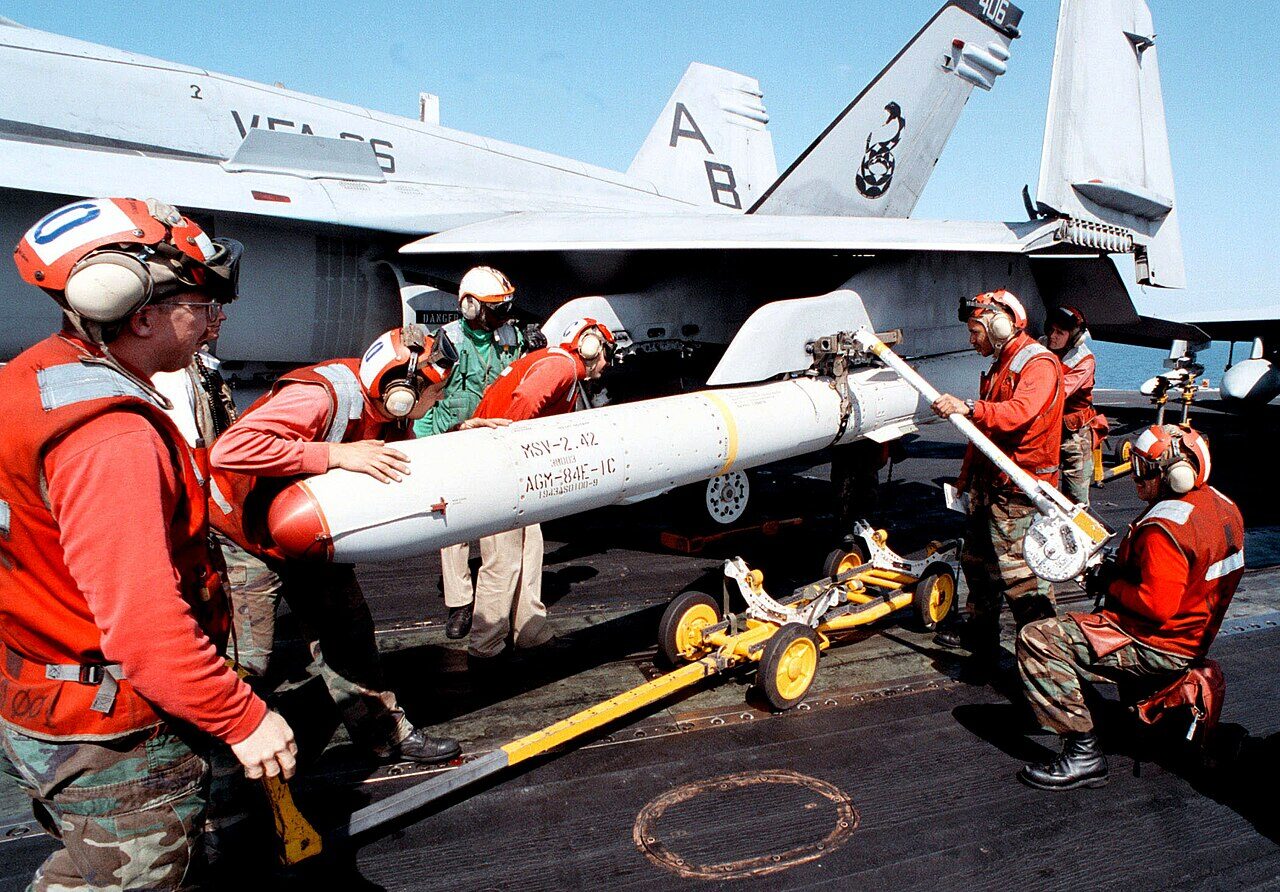

Sources
- Harpoon (missile). Wikipedia (secondary source). https://en.wikipedia.org/wiki/Harpoon_(missile) (accessed 2026-10-27).
- AGM-84 Harpoon. Federation of American Scientists, Military Analysis Network. https://man.fas.org/dod-101/sys/smart/agm-84.htm (accessed 2026-10-27).
- AGM-84E Standoff Land Attack Missile. Wikipedia (secondary source). https://en.wikipedia.org/wiki/AGM-84E_Standoff_Land_Attack_Missile (accessed 2026-10-27).
Wikipedia articles are secondary sources and can change; they are cited with the date they were read. NAVEDTRA training manuals and budget justification exhibits are official US publications, but each describes the weapons in service when it was written.