
Drafted — not technically validated
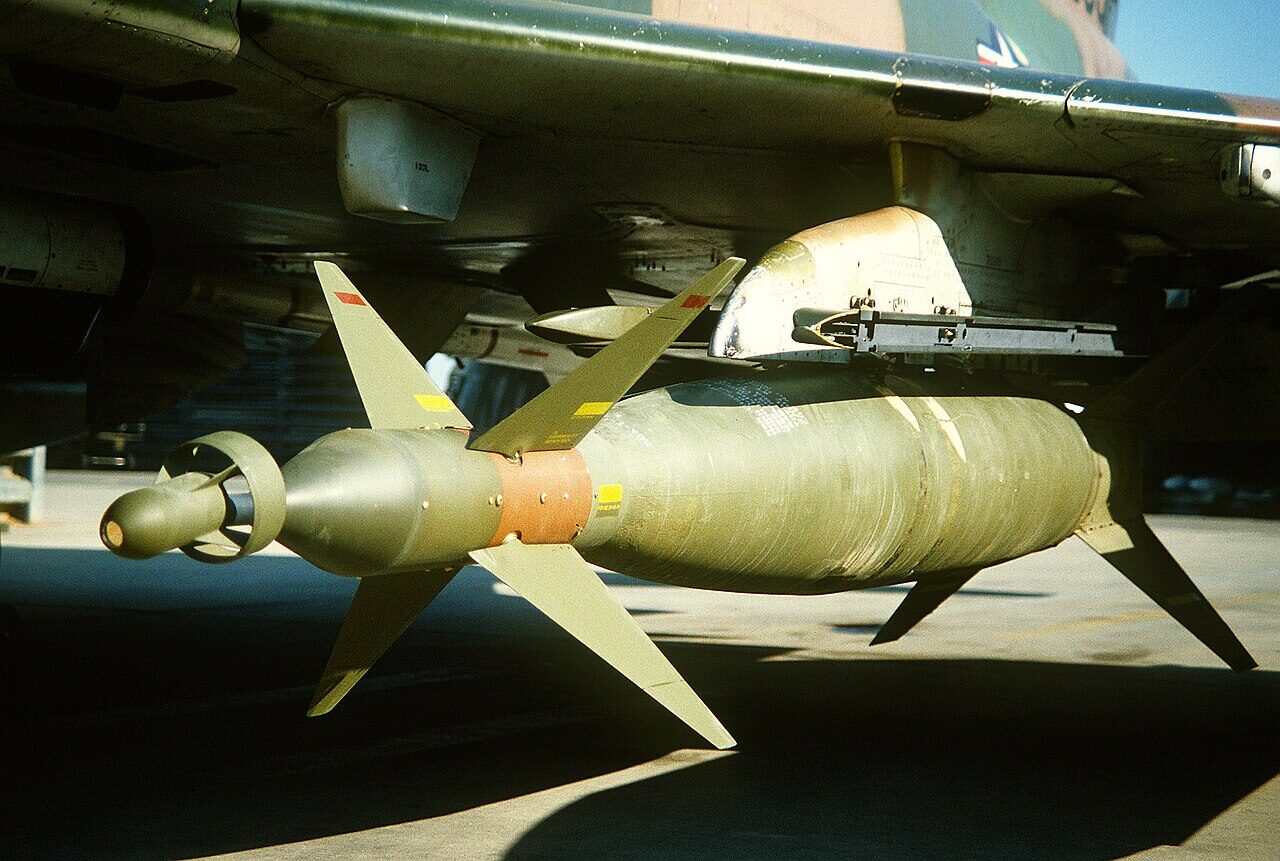
Record revision 1 · A Mk 84 with a Paveway II laser kit: Desert Storm's bridge and bunker buster, once even credited with an air-to-air kill.
Real-world weapon as described in public sources. Weights and dimensions change with the fins, fuzes and variant fitted; the data plate names the variants its figures describe, and differences are noted beside the number they affect. The record describes the weapon; it is not a guide to employing it.
GBU-10 Paveway II laser-guided bomb · GBU-10
- Type
- 2,000 lb class laser-guidedLGW GlossaryWeapons: Laser-guided weapon. A weapon that uses a seeker to detect laser energy reflected from a laser marked/designated target and through signal processing provides guidance commands to a control system, which guides the… bomb: a Mk 84 or BLU-109 bomb with a Paveway II guidance kit [1] [2]
- Origin
- United States
- In service
- First capability 1976 [2]
- Weight
- 2,562 lb (1,162 kg) in the FAS specification [2]
- Dimensions
- Length 172 in (4.37 m); diameter 18 in (457 mm) at the warhead, 28 in (711 mm) across the airfoil group [2]
- Warhead or payload
- Mk 84Mark 84 general-purpose bomb OrdnanceThe 2,000 lb heavyweight of the Mark 80 series, dropped by the thousand in Desert Storm and the warhead of the GBU-10 and GBU-31. blast/fragmentation with 945 lb of tritonal, or the BLU-109 penetrator with 535 lb (GBU-10I) [2]
- Guidance
- Semi-active laser: the bomb homes on laser energy reflected from the target; bang-bang control [1] [2]
- Fuzing
- FMU-81 nose or tail fuzeFuze GlossaryWeapons: A device that causes the detonation of an explosive charge at the proper time after certain conditions are met. A bomb fuze is mechanical or electrical, and is classed by what sets it off (impact, mechanical time… [2]
- Delivery
- Released toward a target lit by a laser designator on the launch aircraft, another aircraft or the ground [2] [3]
- Carried by
- US Air Force: A-10A-10 Thunderbolt II AircraftThe Warthog: a straight-wing, armoured close air support jet built around the 30 mm GAU-8 cannon., B-52, F-111, F-117, F-15EF-15E Strike Eagle AircraftThe two-seat, long-range, all-weather strike derivative of the Eagle., F-16F-16 Fighting Falcon AircraftA single-engine multirole fighter: fly-by-wire, 9 g, and the US Air Force's main strike and SEAD aircraft. [2]
- US Navy and Marine Corps: A-6, A-7, F-14F-14 Tomcat AircraftThe Navy's swing-wing fleet defence fighter: two crew, AWG-9 radar and AIM-54 Phoenix., F/A-18C/DF/A-18 Hornet AircraftA carrier-capable fighter and attack aircraft that one pilot can switch between roles on the same sortie. [2]
- Royal Australian Air Force and other NATO air forces [1]
A Mk 84 that steers
The GBU-10 is a 2,000 lb Mk 84Mark 84 general-purpose bomb OrdnanceThe 2,000 lb heavyweight of the Mark 80 series, dropped by the thousand in Desert Storm and the warhead of the GBU-10 and GBU-31. general-purpose bomb, or a BLU-109 penetrator, with a Paveway II laser guidance kit added: a seeker on the nose and wings for guidance. [1] [2] Someone lights the target with a laser designator and the bomb guides to the spot of laser energy reflected from it. [2] The FAS lists a range of 8 NM and a circular error probable of 9 m. [2]
Paveway I and II
Paveway kits are built by Texas Instruments’ successors, Raytheon, and by Lockheed Martin. The early, fixed-wing Paveway I kit gave way in the early 1970s to the Paveway II, with a simpler, more reliable seeker and pop-out rear wings. [3] The FAS lists what the Paveway II improved: lighter injection-moulded seeker optics, a more sensitive detector with a field of view 30 per cent wider, a shorter battery delay after release, more canard deflection, laser coding and folding wings. [2] Both generations steer with “bang-bang” control, deflecting the canards fully rather than in proportion, which makes the bomb wobble along its path and bleeds energy, limiting range. [3]
In combat
The Air Force says the GBU-10 hit 78 per cent of its targets in Desert Storm. Of the 2,637 dropped, over a third came from F-111Fs and the rest from F-117s, F-15EsF-15E Strike Eagle AircraftThe two-seat, long-range, all-weather strike derivative of the Eagle. and Navy and Marine Corps aircraft, mainly against bridges, Scud launchers, command nodes and bunkers. [2] On 14 February 1991 an F-15E crew even scored an air-to-air kill with one, destroying an Iraqi Mi-24 helicopter. [1] Later Enhanced Paveway versions added GPS/INS guidance; the Royal Air Force has used Raytheon’s over Afghanistan and Iraq. [1]
Sources
- GBU-10 Paveway II. Wikipedia (secondary source). https://en.wikipedia.org/wiki/GBU-10_Paveway_II (accessed 2026-10-27).
- Guided Bomb Unit-10 (GBU-10) Paveway II. Federation of American Scientists, Military Analysis Network, 19 February 1998. https://man.fas.org/dod-101/sys/smart/gbu-10.htm (accessed 2026-10-27).
- Paveway. Wikipedia (secondary source). https://en.wikipedia.org/wiki/Paveway (accessed 2026-10-27).
Wikipedia articles are secondary sources and can change; they are cited with the date they were read. NAVEDTRA training manuals and budget justification exhibits are official US publications, but each describes the weapons in service when it was written.