
Drafted — not technically validated
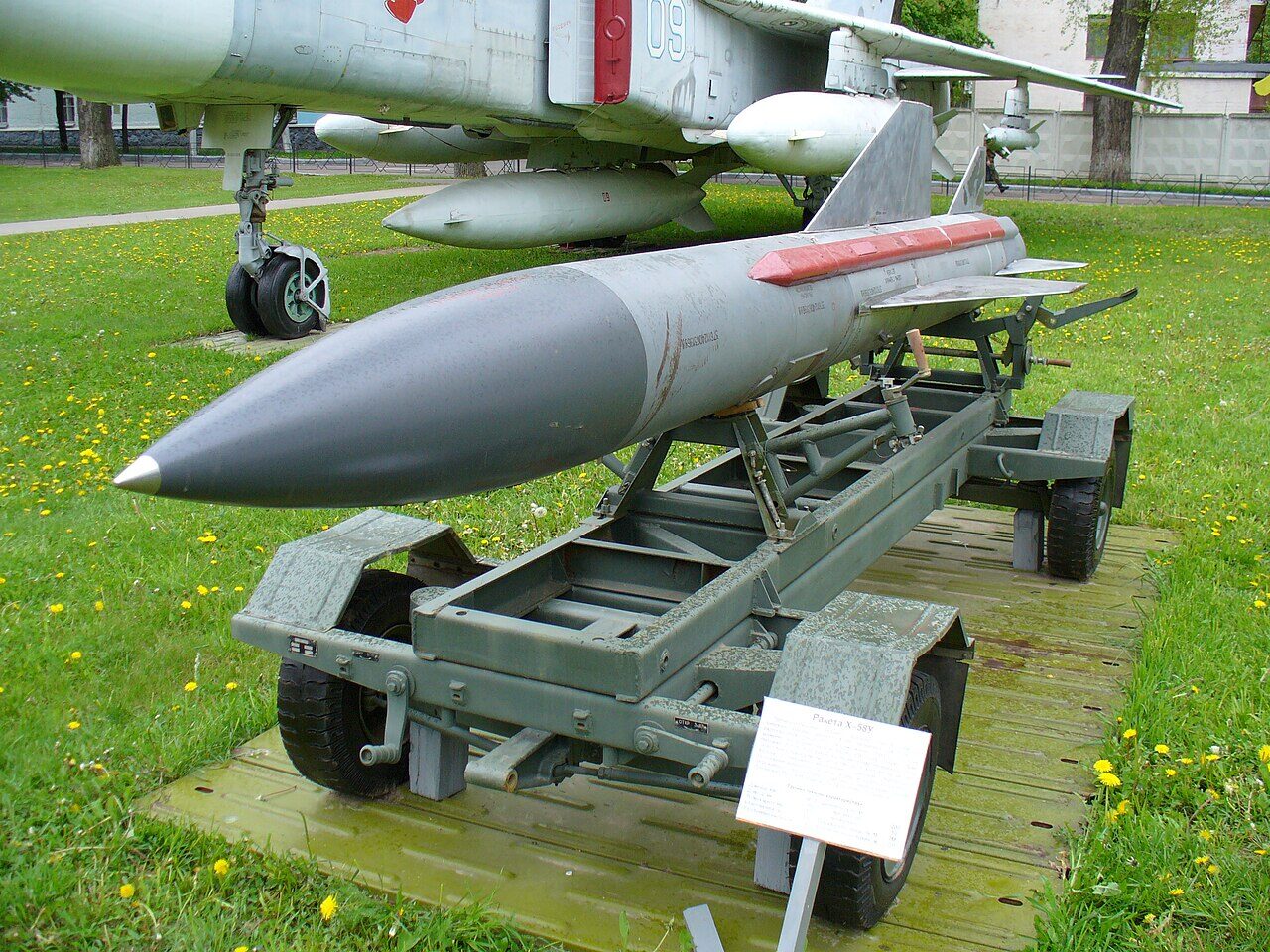
Record revision 1 · The Su-24M's anti-radiation missile, first fired in combat by Iraq in 1987.
Real-world weapon as described in public sources. Weights and dimensions change with the fins, fuzes and variant fitted; the data plate names the variants its figures describe, and differences are noted beside the number they affect. The record describes the weapon; it is not a guide to employing it.
Kh-58 (AS-11 Kilter) · Kh-58 / AS-11
- Type
- Air-launched anti-radiation missile [1]
- Origin
- Soviet Union
- In service
- 1982 on the Su-24M; Kh-58U from 1991 [1]
- Weight
- 650 kg (1,433 lb) [1]
- Dimensions
- Length 4.8 m (15.7 ft); diameter 38 cm (15 in); wingspan 1.17 m (3.8 ft) [1]
- Warhead or payload
- 149 kg (328 lb) high explosive [1]
- Guidance
- Inertial with a passive radar seeker; the Kh-58U can lock on after launch [1]
- Fuzing
- Not given in the cited source
- Delivery
- Cued by the Su-24's Fantasmagoria target acquisition system; range depends heavily on launch altitude [1]
- Range
- 36 km (19 NM) from low level to 120–160 km (65–86 NM) from altitude; Kh-58U 250 km [1]
- Carried by
Successor to the Kh-28
The Raduga bureau developed the Kh-58 in the early 1970s as a solid-fuel successor to the liquid-fuelled Kh-28 anti-radiation missile, to arm the new Su-24M attack aircraft. [1] It was designed to work with the Su-24’s Fantasmagoria target acquisition system, and like other Soviet missiles of its time it could take seeker heads tuned to particular air defence radars, such as those of the Nike-Hercules or Patriot. [1] Its range depends heavily on launch altitude: 36 km from low level, 120 km and more from altitude. [1]
In combat
Iraqi MiG-25BMs first fired the Kh-58U in November 1987 against Iranian Hawk batteries, disabling at least one radar, and in July 1988 Iraqi Kh-58Us and Kh-31PsKh-31 OrdnanceA Mach 3.5 Soviet missile in anti-radiation and anti-ship versions. destroyed an Iranian early-warning radar site. [1] In 2007 a Kh-58 fired at a Georgian radar missed and failed to explode; during the 2008 war Russia did not use anti-radiation missiles, likely because Georgian operators kept their radars off until Russian aircraft were in range. [1] The Kh-58 is being superseded by the Kh-31. [1]
Sources
- Kh-58. Wikipedia (secondary source). https://en.wikipedia.org/wiki/Kh-58 (accessed 2026-10-27).
Wikipedia articles are secondary sources and can change; they are cited with the date they were read. NAVEDTRA training manuals and budget justification exhibits are official US publications, but each describes the weapons in service when it was written.