
Drafted — not technically validated
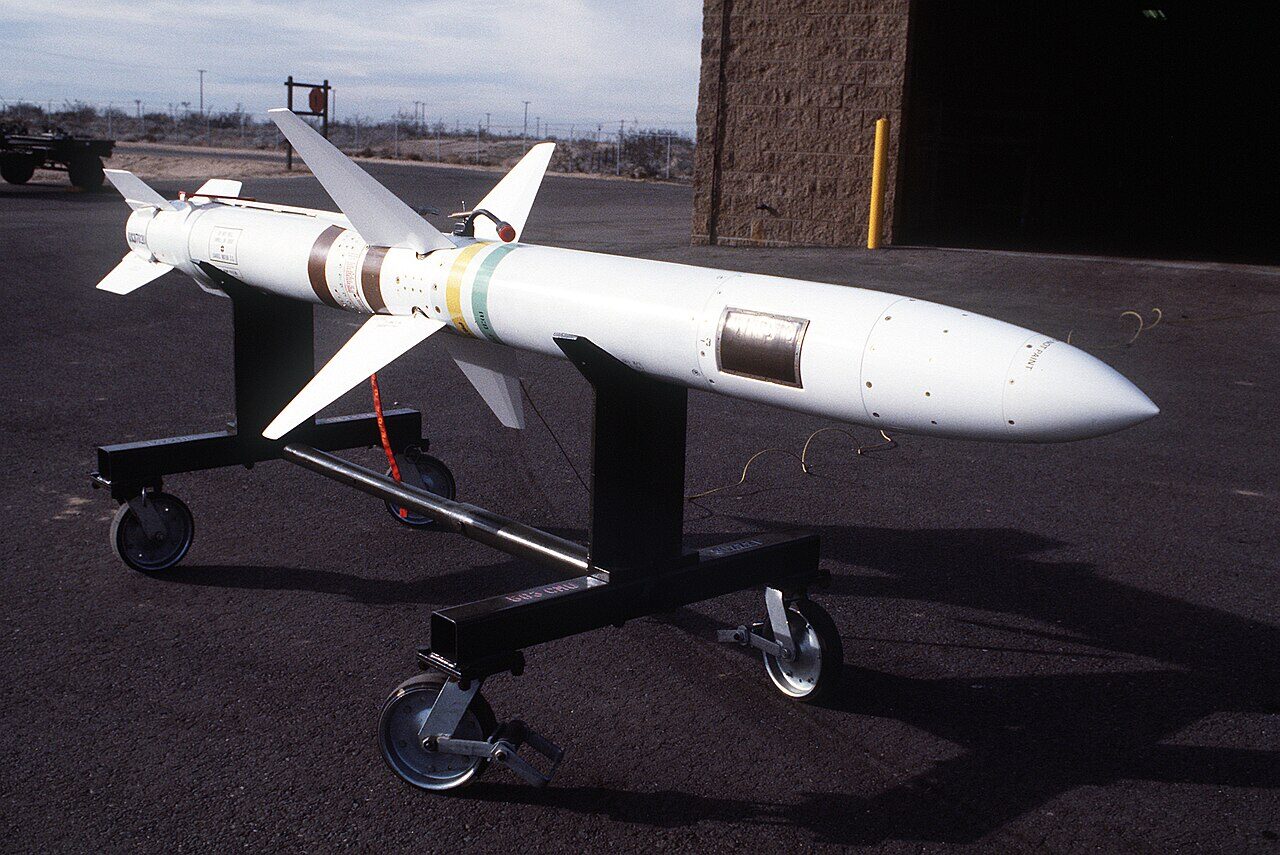
Record revision 1 · The Vietnam-era anti-radiation missile built from a Sparrow, lofted at Fan Song radars by Wild Weasels.
Real-world weapon as described in public sources. Weights and dimensions change with the fins, fuzes and variant fitted; the data plate names the variants its figures describe, and differences are noted beside the number they affect. The record describes the weapon; it is not a guide to employing it.
AGM-45 Shrike · AGM-45
- Type
- Anti-radiation missile for attacking anti-aircraft radars [1]
- Origin
- United States
- In service
- 1965–1992 in US service [1]
- Weight
- 390 lb (177 kg) [1]
- Dimensions
- Length 10 ft (3.05 m); diameter 8 in (203 mm); wingspan 3 ft (914 mm) [1]
- Warhead or payload
- About 149 lb (67.5 kg) Mk 5 or Mk 86 blast-fragmentation, or 147 lb WAU-9/B [1]
- Guidance
- Passive radar homing [1]
- Fuzing
- Not given in the cited source
- Delivery
- Typically lofted about 30° above the horizon at a radar some 15 miles away [1]
- Range
- 16 km (8.6 NM) AGM-45A; 40 km (22 NM) AGM-45B [1]
- Carried by
- US Navy: A-4, A-6, A-7 [1]
- US Air Force: F-105F/G Wild Weasels, F-4F-4 Phantom II AircraftThe big two-seat Cold War fighter-bomber; the F-4E added an internal gun and slats after Vietnam., F-100F-100 Super Sabre AircraftThe first US Air Force fighter supersonic in level flight; a fighter-bomber and fast FAC in Vietnam., F-16F-16 Fighting Falcon AircraftA single-engine multirole fighter: fly-by-wire, 9 g, and the US Air Force's main strike and SEAD aircraft. [1]
- Israel; RAF Vulcans in the Falklands War [1]
A Sparrow with a radar seeker
The Shrike was developed at the Naval Weapons Center, China Lake, in 1963 by mating a radar-homing seeker head to the rocket body of an AIM-7 SparrowAIM-7 Sparrow OrdnanceThe West's main radar-guided missile from the late 1950s to the 1990s, which homes on radar energy the fighter reflects off its target.. [1] It homes on hostile anti-aircraft radar. The Navy first fired it over Vietnam in 1965 from A-4 Skyhawks, and the Air Force adopted it the next year on F-105F and G Wild Weasels, later on the F-4F-4 Phantom II AircraftThe big two-seat Cold War fighter-bomber; the F-4E added an internal gun and slats after Vietnam.. [1]
Against the Fan Song
The Shrike’s nominal range was shorter than that of the SA-2SA-2 Guideline Threat systemThe classic six-launcher site around a Fan Song radar: radio-command-guided, and the SAM US crews met over North Vietnam. missiles it was used against, though it was a great improvement on the earlier method of attacking SAM sites with rockets and bombs from F-100FF-100 Super Sabre AircraftThe first US Air Force fighter supersonic in level flight; a fighter-bomber and fast FAC in Vietnam. Super Sabres. [1] A Shrike was typically lofted about 30° above the horizon at a Fan Song radar some 15 miles away, for a flight of 50 seconds. [1] Even after the faster, longer-ranged AGM-78 Standard ARM arrived, the Weasels kept carrying Shrikes because a Standard cost about $200,000 and a Shrike $7,000; a typical F-105G load was two of each. [1]
Its limits
Radar operators learned to switch off. In the Falklands War, RAF Vulcans fired Shrikes at an Argentine TPS-43 surveillance radar, whose crew simply turned it off during the attacks; it survived the war, though the Shrikes hit two secondary fire-control radars. [1] The US phased the Shrike out in 1992; the AGM-88 HARMAGM-88 HARM OrdnanceThe high-speed anti-radiation missile that hunts air defence radars, announced with the call Magnum. replaced it. [1]
Sources
- AGM-45 Shrike. Wikipedia (secondary source). https://en.wikipedia.org/wiki/AGM-45_Shrike (accessed 2026-10-27).
Wikipedia articles are secondary sources and can change; they are cited with the date they were read. NAVEDTRA training manuals and budget justification exhibits are official US publications, but each describes the weapons in service when it was written.